English
 Español
 Français
 Deutsch
 Italiano
 Português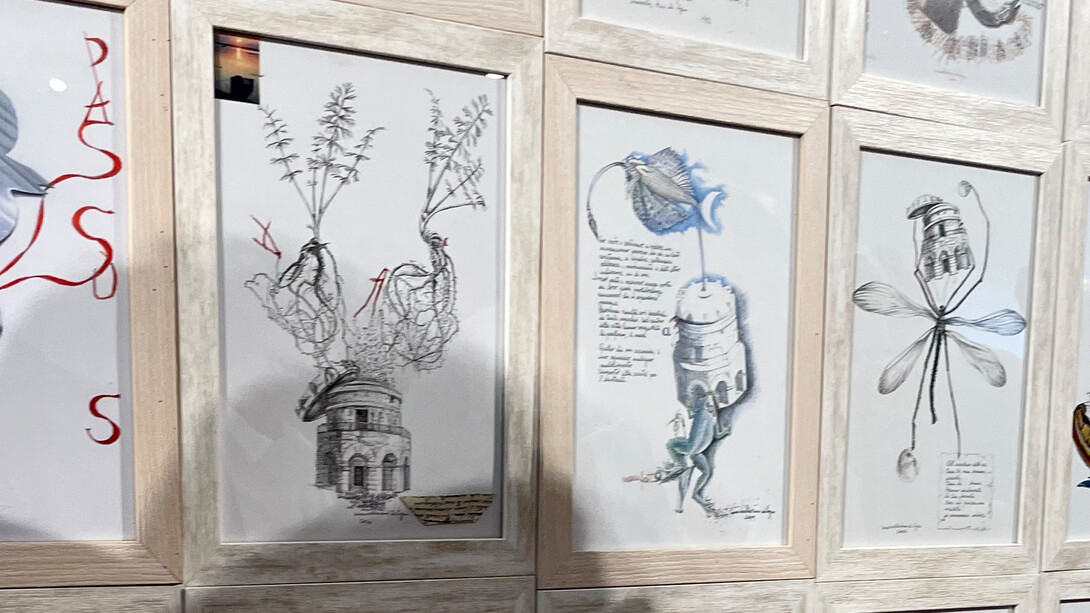
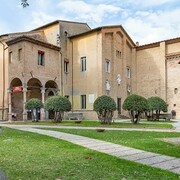
In un'aria diversa, Teodorico is the exhibition by Mariella Busi De Logu, currently on display at the Spazio Teodorico of the National Museums of Ravenna, along the pathway leading to the Mausoleum of Theoderic, until 6 September 2026. The title itself is a promise. For here, the Mausoleum of Theoderic – symbol of power, stone, memory – ceases to be a monument to be contemplated and becomes a place to be inhabited. Thanks to the gaze of an artist who, for forty years, has listened to it, caressed it, transformed it into dream.
Her surname, De Logu, in Sardinian means "of the place". And Mariella Busi De Logu is exactly that: the genius loci, the spirit that guards the essence of a city. She does not celebrate the city: she inhabits it. She does not describe the Mausoleum: she questions it.
Guiding this dialogue is the thought of Marina Tsvetaeva (1892–1941), one of the highest poetic voices of the twentieth century. The Russian poet wrote that human creation is a recoil: a thing strikes the artist, and she strikes back; the thing questions her, and she answers; in response to the thing's answer, she poses a new question. It is always dialogue, interaction. The thing proposes an enigma, and beneath the brush a third entity is born – new, no longer the original thing, but the living fruit of the encounter.
Mariella has made this thought her own. The enigma of the Mausoleum struck her in the winter of 1986, when the silhouette of its dome reminded her of a panettone. But her gaze immediately annulled that too-easy resemblance. Thus a third entity was born – new – and since then, every work is either an answer or a new question. There is no distance between the artist and the monument: there is a recoil that renews itself, from work to work.
This same principle manifests itself also in the artist's relationship with space and environment. The Mausoleum is no longer an architectural object to be portrayed, but a living interlocutor with which to interweave roots. Mariella transforms the physical space of the monument into an inner place, where stone becomes breath and history becomes dream. Yet her most visionary act is another: she does not merely re-imagine the Mausoleum; she imagines Theoderic's horse and the king himself. Not stone, but living beings.
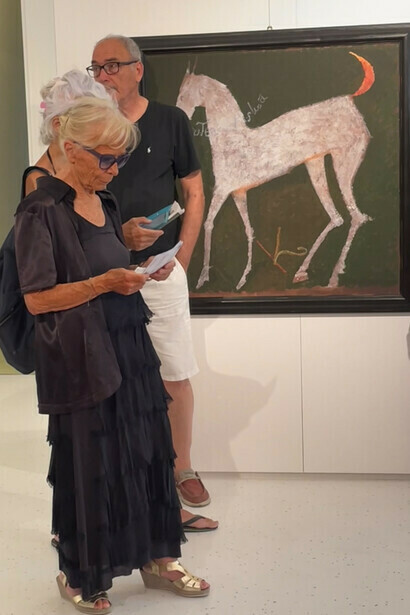
Thus is born the moon-horse of Theoderic, a white, lunar work, dancing on tiptoe hooves, with a quarter moon in place of its tail. The horse belongs to an intermediate zone between waking and dream. It is a figure that eludes every realistic grasp – it flies, dances, dreams, resists the gravity of history. That moon, looking forward, is the direction of lightness: not backward toward the weight of memory, but beyond, where dream still takes on flesh.
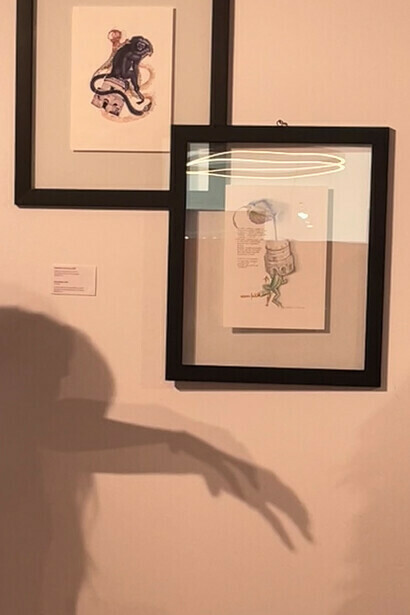
Then there is Theoderic himself. In a work titled Foto ricordo, Teodorico (Souvenir photo, Theoderic) – ink and collage, 2018 – Mariella imagines him as a tall, black figure, almost an insect or a spectre, rising above the monolithic dome of over 300 tons of Istrian stone of his Mausoleum. The body is built with a dense, vibrant ink stroke, while above, like a fragment of memory, a small photograph of the Mausoleum appears. It is a portrait that conveys the king without showing him, evoking him through line and matter. The long antennae reaching toward the sky seem like threads connecting Theoderic to his monument, to the city, to time. He is a king who has learned not to command anymore, but to connect. A secular god, a silent transmitter, balancing above the immense weight of history.
Beside the moon-horse and this figure of Theoderic, Mariella also imagines his Shield, where black and white evoke the duality between chaos and order. The artistic gesture becomes a magical act of protection. For Mariella, the shield is polyphonic: it unites art, history, and civic commitment. Together, moon-horse and shield compose a diptych of the soul. On one side, flight, ascent, the dream that does not fear height; on the other, defence, limit, the guardianship of a centre that must not be violated.
And then there is the scarabeus. In one of her most intense ink works, it is he who lifts the Mausoleum of Theoderic – not through force, but through the ancient patience of one who knows that history is not erased: it is carried. Like the ancient Egyptian symbol of the reborn sun, Mariella's scarabeus carries the weight of stone upward, toward that different air where the monument ceases to be a tomb and becomes a bud.
But there is an element that uniquely distinguishes her work: visual writing. In Mariella's works, the word is never a marginal annotation. It is an integral part of the creative gesture. Writing intertwines with drawing, accompanies it, questions it. Her manuscripts – born from childhood on notebooks with black covers – are the ancestors of her works. Ink does not only trace lines: it traces words, verses, questions. Titles do not quote: they generate. They are seeds of meaning planted in the gaze of the viewer.
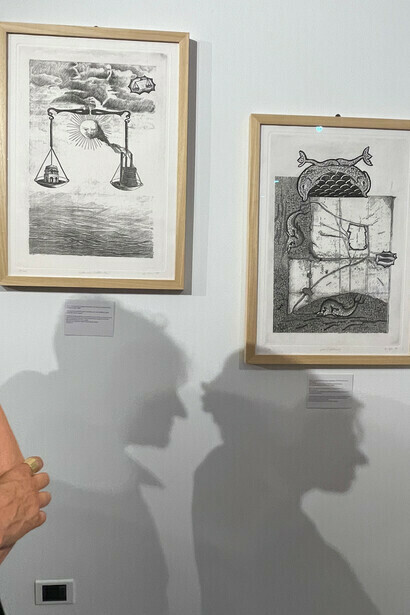
In works such as Passus, the word breaks apart and becomes body, bends like a wing, offers itself as an enigma. In Manufatto, handwritten text coexists with the frog, the flying fish, and the traces of the Mausoleum, like a voice conversing with creatures. Her writing does not describe: it breathes together with the image. It is the handwriting of thought – the sign that becomes word and the word that becomes sign, in an unstable and fruitful balance.
As Mariella writes: "My passion lies in doing and in taking risks. In a different air, my gaze widens and expands over the city, rises to the stars and to the mountains on the horizon." Her slow engravings, meditated ink works, watercolours and collages do not illustrate: they suggest, evoke, generate. Her titles – Equilibrio instabile (Unstable equilibrium), Polveri invisibili (Invisible dusts), Germogliazione (Germination) – are themselves visual writing, buds cast onto paper.
Guiding this dialogue is also Walter Benjamin's interpretation of Paul Klee's Angelus novus: the angel who fixes his gaze on the ruins of the past, while a storm called "progress" propels him forward. Mariella has made that gaze her own, but unlike the angel, who can only suffer the storm, she has learned to transform ruins into buds, weight into lightness, stone into breath. As in many of her most intense works, art becomes a passage through pain, not a denial of it.
And there is also the gaze of one who knows how to see. Cristina Mazzavillani Muti, who closely followed the genesis of this exhibition, has captured a rare trait in Mariella's research: resistance that turns into gentleness. In an era in which struggle hardens souls, Mariella – with her slow engravings, her solitary cycling, her obstinate dialogue with stone – offers a resistance made of grace, not force. It is a lesson that can be read in the works themselves: the moon-horse does not fight, it dances; the scarabeus does not crush, it lifts; the balance does not prevail, it seeks equilibrium. Hers is a poetic resistance, which does not oppose with arrogance, but with the lightness of one who has chosen to stop and listen.
Then there is the voice of Sara Maioli, a visual artist from Ravenna. During the inauguration, without a commission or a project, only to prolong the enchantment, Sara pointed her camera at the panels of the historical exhibition. In one of those improvised shots, the shadow of the Mausoleum stretches long across the wall, almost embracing the captions and history itself. It is a shadow that conveys the monument without showing it, that evokes it without representing it. She too, like Mariella, responded to an enigma – but with light. Her photograph is the perfect visual counterpoint to Mariella's work: art generated by the encounter between a light that offered itself and a gaze that welcomed it.
In this Creole garden – as Koyo Kouoh (1967–2025) would have said – the Mausoleum becomes a place where the improbable coexists with the real. Mariella, like an ancient "Artist Plant", transforms the monument of power into a place of grace. And we, visitors, are invited to enter. To follow Mariella's gaze. To let ourselves be questioned by stone, shadow, breath.
Because, as Mariella writes, "the experience remains, the work goes away." But what remains – in the engravings, watercolours, manuscripts, and Sara's photographs – is the bud of an encounter. A recoil that renews itself, each time, beneath the brush of one who has chosen to listen to the enigma of an ancient stone, and to respond with dream. And with writing. And with a white horse carrying the moon, and with a king balancing above the dome of stone, reminding us that history is not crushed: it is lifted.