English
 Español
 Français
 Deutsch
 Italiano
 Português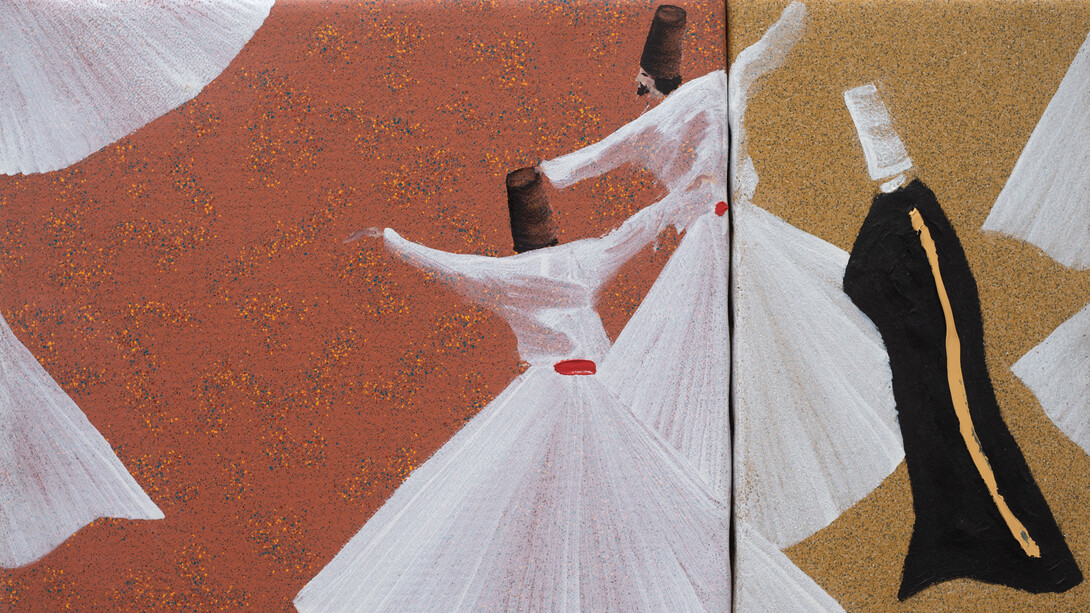
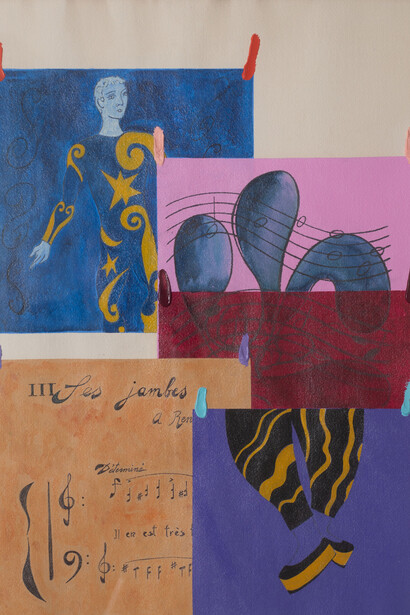
Galleria de’ Foscherari is pleased to present, from Wednesday, June 3, 2026, Merci satie, a solo exhibition by Aldo Mondino dedicated to music, understood not merely as an iconographic theme, but as a field of resonance between image, object, word, and movement.
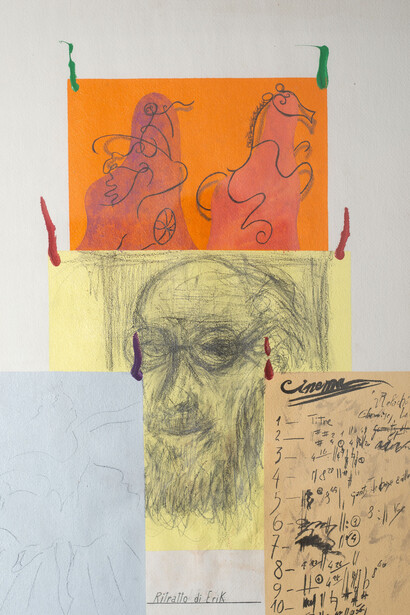
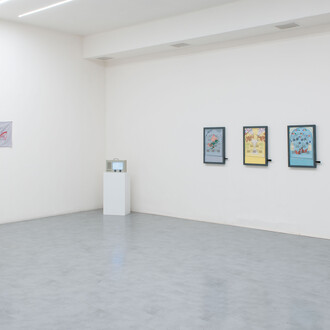
The exhibition Merci satie is born as a refined homage to that invisible, yet incredibly solid thread linking the visual universe of Aldo Mondino to the revolutionary sonic insights of Erik Satie. It is a dialogue between two genuinely free spirits who successfully turned irony and paradox into privileged tools to dismantle the rigid conventions of their respective eras. This homage becomes immediately apparent at the entrance of the exhibition space, where a series of drawings dedicated to Satie himself physically introduces the visitor to the itinerary. In Merci satie, Erik Satie is not presented as a simple biographical or musical reference, but rather as a true spiritual archetype—a master of the Parisian avant-garde and Symbolism with whom Mondino shares the same brilliant capacity to conceal profound conceptual seriousness behind the screen of provocation and linguistic play.
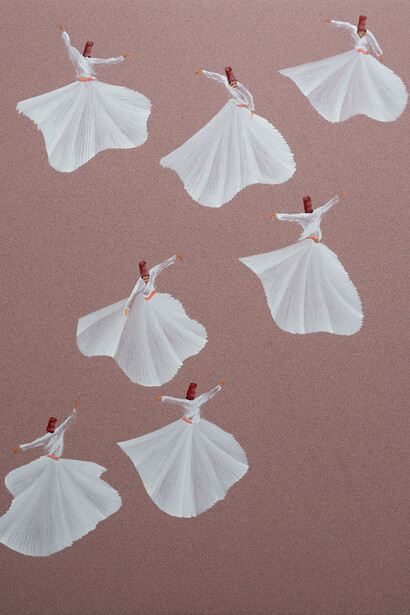
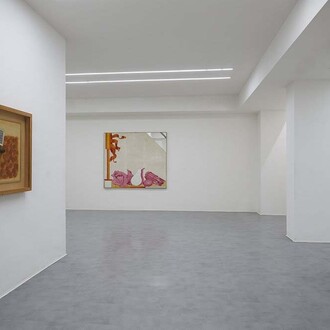
And just as Satie built his scores on obsessive and repetitive textures, so develops the hypnotic music to which the Dervishes dancing candid figures captured in the act of the Sema, the ritual Sufi dance. With one hand turned toward the sky to receive grace and the other toward the earth to dispense it, these whirling monks dance to a cyclic musical structure designed to reflect both the geometry of the dancers' movement and the laws of the cosmos, mimicking the rotation of planets around the sun and electrons around the nucleus. This ritualism was something Mondino had deeply absorbed during his travels to the East, and he chose to represent it because these dancing monks, who become the very personification of music, represent the painter's own alter ego: an individual spinning around his own axis to achieve transcendence through the obsession of the gesture.
Yet, Mondino’s exploration does not live on hypnotic repetition alone. Moving through the exhibition space from one room to another, the obsessive rhythm of the rotation undergoes a sudden deceleration, a change of register that leads the viewer out of the ritual trance to immerse them in a romantic idyll. At the center of the path sits an iron bench on which two silhouettes rest, leaning ever so slightly toward one another, as if suspended in the moment just before an intimate confidence. This is Viola d’amore, the bronze case of a time-worn viola, lying open on its hinge and evoking the presence of two figures gathered in absorbed proximity. But there is no trace of the instrument; only the void of its shape remains, the mute cavity of something that was once guarded.
In front of that couple on the verge of confession, two Serre made by orchids frame the two silhouettes in an olfactory and visual dimension that recalls the scent and warmth of those exotic flowers. Positioned mirror-like opposite one another, the works transform the exhibition space into a synesthetic chamber, where music merges with nature, synthesizing into an idyllic bucolic landscape. Here, high Western culture - Baroque music, symbolically represented by the viola case - reflects upon and contaminates itself with the exotic elsewhere: the orchids of the East.
It is here that the profound bond between the musician and the painter is revealed. On a musical level, Satie dismantled the traditional dramatic-narrative structure typical of 19th-century symphonies, erasing bar lines, locking together sequences of identical notes and fixed chords that never change key, and transforming music into a geometric loop that freezes time. In the exact same way, Aldo Mondino applies this very rejection to the history of art and European modernism. His obstinate need to experiment with concrete, everyday materials - such as chocolate, candy, coffee, bronze, flowers, ceramics, glass, and pigments - is not the whim of an undecided artist, but rather the ability to open a personal, unconstrained dialogue with the art and craftsmanship of all eras.
This stylistic inconstancy becomes a courageous form of artistic choice; a conscious decision that, just like Satie’s circular music, appears to oppose the idea of art progressing toward a uniform, shared modernity. Ultimately, it restores to the artist the freedom to traverse both the beautiful and the grotesque, the real and the visionary, wherein his polymorphous production emerges as an unceasing quest, an intimate and personal dialogue with the transformations of the world that were silently taking shape around him.