English
 Español
 Français
 Deutsch
 Italiano
 Português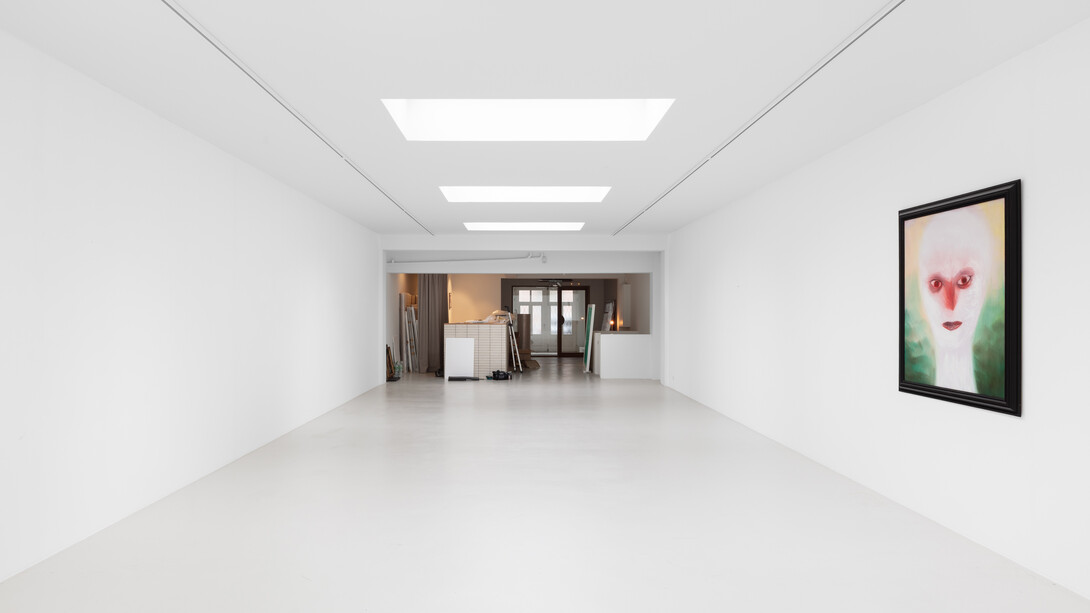
Miriam Cahn (b. 1949, Basel, CH) lives and works in Stampa, in the Bregaglia Valley. Radical and nonconformist, her artistic approach defies conventional categories of classification, particularly regarding her choice of techniques, constantly in a state of experimentation with her artistic means, she works with the media of performance, sculpture, film, sound and photography. Rooted in the feminist movements of the 1970s, she developed a practice in which body and mind are inseparable, creating monumental charcoal and chalk drawings executed directly on the floor, using her own flesh as both tool and medium. This radical physical engagement has never left her practice. More recently, her figurative paintings retain the urgency and brutality of that foundational gesture.
Working primarily in figurative painting, she constructs her compositions with rapid, instinctive strokes, refusing to rework or correct, so that each work retains the raw energy of its creation. Her imagery draws on performance art, feminist theory, and a sustained focus on current events, thus weaving connections between the intimate and the political. Recurring figures, vulnerable, naked, often genderless, become vessels for collective experiences of violence, desire, vulnerability, and resistance. Her work confronts head-on the realities of gender-based violence, armed conflict, and forced migration, addressing these subjects with uncompromising candor and deep empathy.
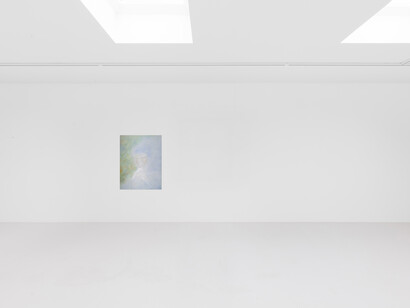
In den bergen denken belongs to a pivotal body of work in which the face becomes the sole subject, stripped of context, narrative, or gender. Dated with characteristic precision to October 16, 2001, the painting confronts the viewer with a spectral presence: a white face dissolving into an atmospheric ground, animated only by the visceral punctuation of red eyes and bruised lips. Cahn has spoken of her deliberate use of colour as a form of psychological intensity, applied sparingly, always to the most charged zones of the body: the eyes, the lips, the genitals. Here, colour functions as both wound and signal.
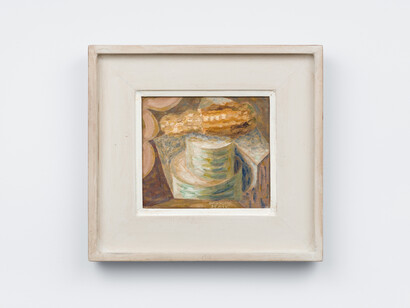
Serge Charchoune (1888–1975). Born in Russia in 1888, Serge Charchoune remains one of the most restless and singular figures of twentieth-century art. After discovering painting in Moscow, where he encountered the Russian avant garde alongside Van Gogh, Gauguin and the Fauves. Charchoune deserted the army and arrived in Paris in 1912, a city that would become his permanent home and immersed himself in the most radical artistic circles of his time, from Cubism under Metzinger and Le Fauconnier to ornemental Cubisme, developed during formative years in Spain, to the Dada movement in which he was an active participant alongside Picabia, Tzara, Arp and Man Ray, and founder of his own Russian independent Dada group.
Charchoune’s paintings don’t build upon drawing, but upon the material itself: thick, layered, worked into relief, tactile, the surface is as much carved out as it is built up, with touches of color whose palette evokes a return to the earth or a range of natural, earthy tones. His meticulous compositions are characterized by the juxtaposition of his thick brushstrokes. Charchoune oscillates between abstraction and figuration, guided by Rudolf Steiner’s anthroposophical teachings and a longstanding passion for classical music; his later work distilled sound and movement into quasi-monochromatic canvases of rare delicacy, moving back and forth between silence and light.
Paradoxically, Charchoune, as a true pioneer of abstraction and Dadaisme, remains one of the least known figures of the avant-garde, his work admired above all by his peers: painters, poets, architects, and a small circle of devoted collectors who understood, before others, what they were looking at. Charchoune’s works are held in major institutional collections including the Centre Pompidou and the Museum of Modern Art, New York.
Nino Kapanadze (b. in 1990, Tbilisi) is a French-Georgian artist who lives and works in Paris. She holds MFA from Beaux-Arts de Paris (2023), Master’s degree from Sciences Po Paris (2020) and Tbilisi State Academy of Fine Arts (2015).
Her recent solo exhibitions include Cavalcades, Vil la Atrata Palais-Royal, Paris, France; Cascades, Villa Atrata, Chapelle Saint-Croix, Angles-sur-l’Anglin, France; Rendezvous, Fondazione Bonollo Arte Contemporanea, Thiene, Italy (2025).
Her work was presented in selected groupshows: Croire la peinture, Michel Rein Paris, France; Mea sures of Intimacy, Andrew Kreps Gallery, New York, USA (2026); Studio Conversations, David Zwirner, Paris, France (2025); Meet me by the lake, Clearing, New York, USA (2024); Prélude, Super Dakota, Brussels, Belgium; Cache Cache, Perrotin Paris, France (2023); Extase de l‘abîme, Societa delle Api, Le Quai contemporary art space, Monte Carlo, Monaco (2022); Jardin Secret, Le Théâtre des Expositions, Paris, France (2021).
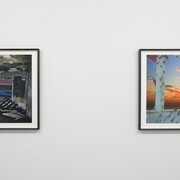
I got up (at 10:47 am) (1972), a postcard by On Kawara addressed to the artist Lee Lozano at her New York address. The work belongs to one of the most sustained and rigorous projects in the history of conceptual art: between 1968 and 1979, Kawara sent two postcards each day to members of his artistic circle, each stamped on the verso with the exact time he had risen, reducing all communication to a single, unrepeatable temporal coordinate. The length of each correspondence ranged from a single card to hundreds sent consecutively over a period of months; the gesture’s repetitive nature is counterbalanced by the artist’s peripatetic global wanderings and exceedingly irregular hours. With tremendous economy of means and a surprising visual elegance, Kawara creates a complex meditation on time, existence, and the relationship between art and life.
The 1972 card sent to Lee Lozano arrives at a precise biographical threshold: that year marked Lozano near-complete retreat from the art world, a withdrawal she had codified as an artwork itself. Kawara’s daily postcard thus takes on the character of a dialogue conducted across an asymmetry of presence, one artist methodically recording his existence while the other moved toward a principled disappearance.
Floral expressions of Harlem (2017) is a landmark work in Eric N. Mack’s artistic practice. Against a backdrop of electric blue quilted blankets, Mack composes a dense assemblage: on this surface of used, torn, or repainted fabric, printed images cut from fashion magazines and press photographs from newspapers are taped down and partially covered in colored ink. There is no hierarchy, but layers, and they all come together, coexist in a suspended form. Between painting, collage, and installation, Eric N. Mack explores how the medium can convey meaning while bearing traces of historical narratives, stories related to personal identity, as well as imagery and elements extracted from pop culture and history.
Eric N. Mack (b. 1987, Columbia, MD) attended The Cooper Union, NY (BFA) and Yale University, CT (MFA) and is the recipient of prestigious awards and residencies including the Chinati Foundation’s Artists in Residence Program (2023); the Rome Prize (2021-2022); the inaugural BALTIC Artists’ Award (2017); the Rauschenberg Residency on Captiva Island (2017); the Delfina Foundation Residency (2017) and the Studio Museum in Harlem Residency (2014-2015).
One-person exhibitions include Eric N. Mack, Paula Cooper Gallery (2023); Scampolo!, Douglas Hyde Gallery, Trinity College, Dublin (2022); Lemme walk across the room, Brooklyn Museum, NY (2019); NSU Art Museum Fort Lauderdale, FL (2021); and In austerity, stripped from its support and worn as a sarong, The Power Station, Dallas, TX (2019).
Major group exhibitions include Chronorama Redux, Palazzo Grassi, Venice (2023); Whitney Biennial 2019, Whitney Museum of American Art, NY; and Greater New York, MoMA PS1, NY (2015). Work by Mack is in the permanent collections of the Whitney Museum of American Art, the Studio Museum in Harlem, and the Brooklyn Museum, New York; the Baltimore Museum of Art; the Albright-Knox Art Gallery, Buffalo; the Institute of Contemporary Art, Boston; the Institute of Contemporary Art, Miami; and the Montreal Museum of Fine Arts.
Mack lives and works in New York.
Holy family with donor refers to a common 15th-16th century European art theme, often a sacra conversazione (sacred conversation), depicting the Virgin Mary, Child Jesus, and Joseph with the individuals who commissioned the painting. These paintings reflect the growth of humanism in the 15th century, where patrons wanted to be depicted directly with divine figures.
This painting from an unidentified european master is a perfect example of a sacra conversazione, with the donor in fashionable black clothes kneeling in front of the infant Christ and Mary. This kind of work were intended to be presented in the personal chapell of the patron or their private home. These works are historically important as these paintings record through ecclesiastic imageries the structure of the society at the time.
Ibrahim Meïté Sikely (b. 1996, France) is a painter whose work fuses the visual languages of art history, comics, manga, and video games into a richly layered iconography.
Blending fiction and realism, classic and contemporary references, he constructs personal fables that interrogate social determinism and power dynamics. Using a colourful, shimmering style, scenes of tranquillity alternate with epic scenes whose fantastic, dreamlike universe recalls both the works of Goya and their trenchant social criticism, and the poetry of the tales of marginal communities described by Martin Wong. Through portraiture and allegory, his paintings address struggle and justice, trauma and healing, while casting himself and those close to him as superheroes or figures drawn from 19th-century painting.
His work has been shown at the Palais de Tokyo, Anne Barrault, Nir Altman (Munich), Project Native Informant (London), the Palais de la Porte Dorée and the Frac Île-de-France, CAC Brétigny, Frac Lorraine, Metz, Frac Pays- de-Loire, Nantes, Villa Arson, Nice, La Villette (100% L’Expo), Paris, as well as at the Centre d’Art Contemporain de Cajarc, Les Tanneries, Amilly and Passerelle, Brest.
Josh Smith (b. 1976, Okinawa, Japan) is a New York-based painter working across collage, sculpture, printmaking, and artist’s books. Known for his gestural, often repetitive works that explore the nature of authorship and the act of painting, he was first recognized in the early 2000s for canvases depicting his own name, a motif that allowed him to probe the expressive boundaries between abstraction and figuration. Smith has since developed a prolific and wide-ranging practice encompassing gestural abstraction, monochromes, and figurative series including leaves, fish, skeletons, and palm trees.
The work never stays still, and that instability is precisely the point.
Smith’s work is held in numerous international public collections including The Broad, Los Angeles; Carnegie Museum of Art, Pittsburgh; Centre Pompidou, Paris; Moderna Museet, Stockholm; Musée d’art contemporain de Montréal; The Museum of Modern Art, New York; Museum moderner Kunst Stiftung Ludwig Wien, Vienna; and the Whitney Museum of American Art, New York.
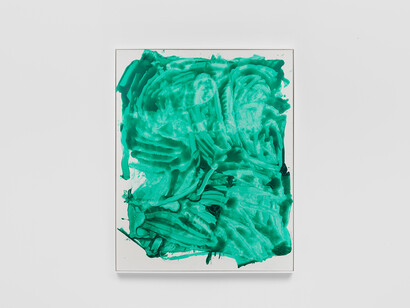
Untitled (2006) belongs to a pivotal moment in Josh Smith’s early practice. Having gained initial recognition for his “name paintings”, canvases in which the letters of his own name served as both subject and painterly structure, Smith was simultaneously pushing those same works toward total dissolution. By the mid-2000s, the name had begun to blur, bleed, and recede beneath thick, gestural applications of paint, giving rise to a group of works that functioned as near-monochromes: rough-hewn monochromes where the image no longer competes with the surface, but becomes it.
Single saturated green saturates the entire canvas in broad, loaded strokes. The white ground breaks through only at the edges and where the brush has dragged and lifted : traces of speed, pressure, and decision made visible. For all their apparent spontaneity, Smith’s canvases are ultimately the product of an intense psychological process. Smith has said that he “thinks in paint,” and his art can be seen as a vehicle for the testing of ideas, about the creative process itself, and what it means to be an artist. Here, painting is stripped to its most elemental proposition: mark, color, gesture, surface.