English
 Español
 Français
 Deutsch
 Italiano
 Português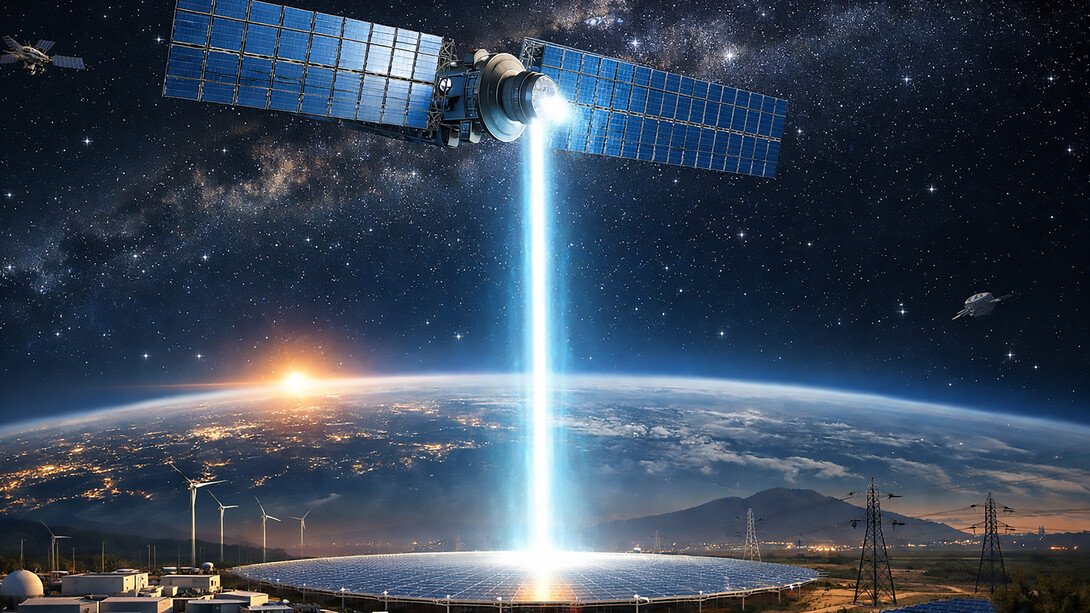
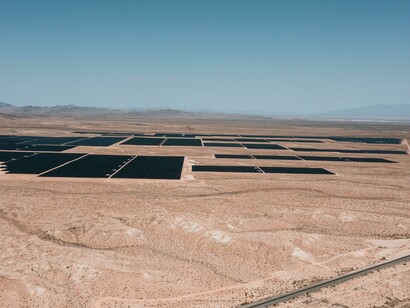
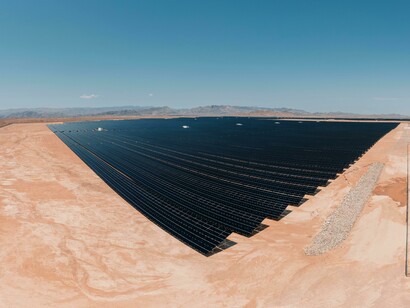
Every civilization is shaped by how it captures energy. Wood fueled early settlements. Coal drove the industrial revolution. Oil reshaped geopolitics. Electricity rewired daily life. Today, solar panels spread across rooftops, fields, and deserts, promising abundance from sunlight itself. Yet beneath this optimism lies an inconvenient truth: sunlight on Earth is intermittent, diluted, and geographically uneven. The Sun is constant. Our access to it is not.
Grid engineers wrestle with this reality daily. Solar power peaks at midday and collapses at sunset. Wind arrives on its own schedule. Batteries smooth fluctuations but remain expensive and resource-intensive at a continental scale. Nuclear offers baseload reliability but faces political hesitation and long deployment cycles. Meanwhile, demand rises relentlessly: electric vehicles, heat pumps, data centers, AI training clusters, and hydrogen electrolysis. The transition to electrification is real. The stability problem is equally real.
From time to time, someone asks a question that sounds almost impolite in polite policy circles.
What if we collected sunlight where it never stops shining?
Not in deserts. Not on oceans. In orbit.
Space-based solar power has been proposed since the 1960s. For decades, skepticism was justified. Launch costs were too high. Building kilometer-scale structures in orbit seemed implausible. Beaming energy through the atmosphere invited ridicule. The concept lived in academic papers and speculative conference slides.
But old ideas return when supporting technologies mature quietly in the background.
Lightweight roll-out photovoltaic arrays now deploy like sails. Autonomous robots dock, refuel, and repair satellites routinely. Microwave beam steering is standard in radar and telecommunications. Reusable heavy-lift rockets fly repeatedly, driving down launch cost curves. None of these achievements alone makes orbital power viable. Together, they shift the discussion from science fiction toward infrastructure planning.
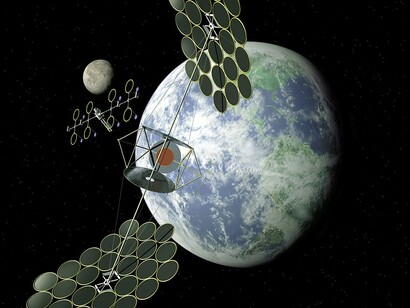
The physics is straightforward. A solar collector in geostationary orbit receives nearly uninterrupted sunlight year-round. It converts light into electricity. That electricity feeds a phased-array microwave transmitter that forms a coherent beam directed toward a receiving rectenna on Earth. The rectenna converts microwaves back into grid-grade power. Atmospheric losses are modest. Beam intensity is designed to be biologically safe—comparable to standing in natural sunlight. The receiving antenna is a mesh structure: rain falls through it, birds fly through it, and land remains usable beneath it.
Public imagination fixates on beams as weapons. Engineers see them as power cables without copper.
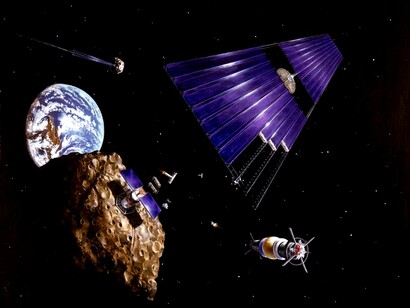
The true challenge is scale. A gigawatt-class orbital plant requires vast collector surfaces. It must be assembled in orbit, survive decades, maintain precise pointing, and remain serviceable. None of these violate physics. They resemble offshore oil platforms, global telecom constellations, or continental power grids—complex, expensive, but achievable through industrial discipline.
Launch cost remains the gatekeeper. As reusable heavy-lift vehicles reduce marginal cost per kilogram, orbital assembly becomes comparable to terrestrial megaproject construction. You do not launch a power station in one piece. You launch thousands of modules and assemble them robotically, exactly as skyscrapers rise from prefabricated parts.
Why go to such lengths?
Because continuous baseload power changes everything. Orbital solar power delivers electricity day and night, independent of weather or seasons. It stabilizes grids dominated by intermittent renewables. It reduces dependence on massive battery storage. It supplies constant power for data centers, industrial hydrogen production, and electrified transport networks. It offers energy independence to nations without fossil or hydro resources.
There is also a strategic dimension. A nation operating orbital power infrastructure becomes less dependent on fuel imports, shipping lanes, or pipeline politics. Energy security becomes a matter of orbital mechanics rather than maritime logistics. In a century defined by electrification, this is not a trivial advantage.
Governance will evolve accordingly. Microwave beams crossing borders require treaties. Spectrum must be allocated. Liability frameworks must define safety standards. International space law will adapt, as it always has when new infrastructure emerges. Energy systems have never been purely technical; they are socio-political constructs. Orbital power will be no different.
The first orbital solar projects will almost certainly be government-backed demonstrators: strategic installations, remote region suppliers, or defense-linked assets. Once reliability is proven, financial mechanisms will follow familiar patterns: long-term power purchase agreements, infrastructure bonds, and utility partnerships. Markets respond quickly when a stable baseload supply appears.
By the 2030s, experimental power-beaming platforms are expected. By the 2040s, pilot orbital plants may feed regional grids. By mid-century, orbital solar stations could quietly operate alongside wind farms, hydro dams, and terrestrial solar arrays—not replacing them, but anchoring grid stability.
And perhaps one evening, when you switch on a lamp after sunset, part of that electricity will have traveled from a structure silently orbiting above the atmosphere, where the sun never sets.
At that moment, night becomes optional.
Industrial revolutions have always followed new production environments: steam factories, electrified assembly lines, and automated robotics. Microgravity manufacturing is the next environment shift—one where gravity itself is removed from the equation. The early markets will be narrow, the margins high, and the learning curves steep. But once orbital factories begin producing for orbital infrastructure, a self-sustaining industrial ecosystem emerges above Earth. At that point, space stops being a destination and becomes a production zone. And the materials that define tomorrow’s technologies will quietly originate in factories that never touch the ground.