English
 Español
 Français
 Deutsch
 Italiano
 Português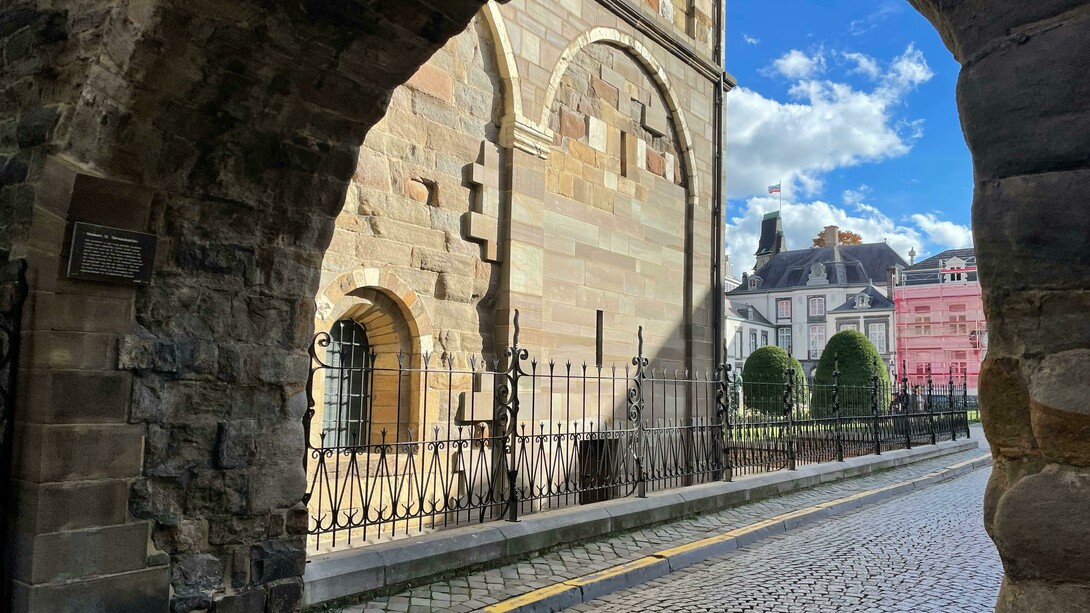
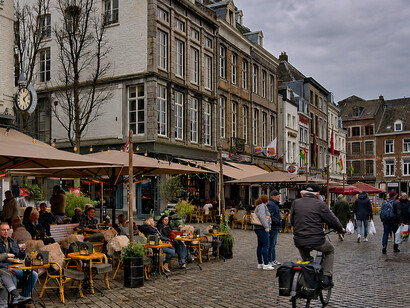
To understand Maastricht, one must first forget the quintessential image of the Netherlands. Here, in the country’s southernmost appendage, sandwiched between Belgium and Germany, the flat horizons and geometric canals of Holland surrender to rolling hills, terraced vineyards, and a meandering river valley. Maastricht is a city that feels delightfully un-Dutch. It is a place where the austere Calvinist sobriety associated with the Dutch north gives way to the softer rhythms of the Catholic south, where life unfolds not with haste but with ritualised pleasure. The locals proudly describe this ethos as "Burgundian", a word that encompasses indulgence, conviviality, and a deep appreciation for food, wine, conversation, and the art of lingering. In Maastricht, cafés are not merely places to drink coffee; they are extensions of living rooms, stages upon which daily life leisurely unfolds.
Founded by the Romans at a shallow crossing of the River Meuse, Mosa Trajectum in Latin, Maastricht claims the disputed and fiercely defended title of the oldest city in the Netherlands. Unlike many historic European cities whose ancient layers feel fossilised behind museum glass, Maastricht wears its past with effortless familiarity. History here is not preserved as a spectacle; it is embedded into the rhythm of ordinary life. The city’s streets curve organically rather than geometrically, shaped by centuries of merchants, pilgrims, soldiers, and travellers moving through its strategic crossroads.
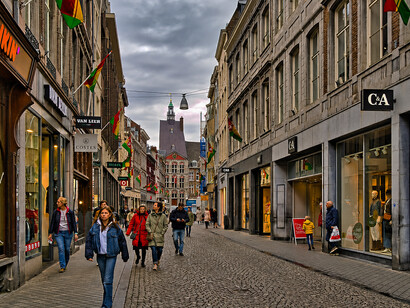
Nowhere is this atmosphere more palpable than in the Jekerkwartier, Maastricht’s enchanting Latin Quarter. Wandering through its cobblestone lanes feels akin to stepping into a forgotten mediaeval painting. Ivy climbs the facades of 17th-century merchants’ houses built from warm yellow marlstone quarried from the surrounding hills, while bicycles lean casually against centuries-old walls blackened by time. The River Jeker trickles quietly through the neighbourhood, crossing beneath tiny stone bridges and alongside remnants of ancient fortifications. Looming among them is the Helpoort, Hell’s Gate, the oldest surviving city gate in the Netherlands. Built in the 13th century, the fortress-like structure evokes Maastricht’s long history as a contested military stronghold, besieged repeatedly by Spanish, French, and Dutch armies. Yet today, the gate stands not as a symbol of conflict but as a picturesque threshold into the city’s gentler soul.
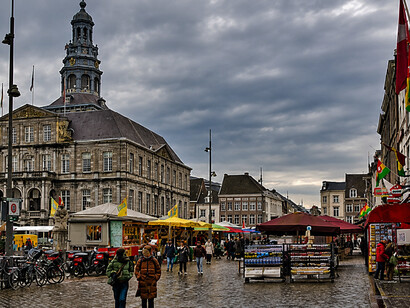
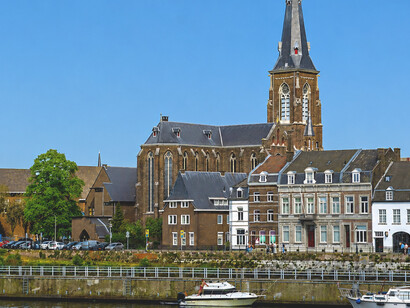
The spiritual and social heart of Maastricht beats within its two great squares, each possessing a distinct emotional register. The Vrijthof is grand and theatrical, an expansive plaza framed by leafy trees and animated terraces. Dominating the square are the imposing Romanesque Basilica of Saint Servatius and the Gothic Sint-Janskerk, with its unmistakable red tower piercing the skyline. For centuries, pilgrims journeyed here to venerate Saint Servatius, the Armenian missionary who became Maastricht’s first bishop in the 4th century and whose remains are still housed within the basilica’s treasury. Yet while the square retains its sacred gravitas, contemporary life animates it with warmth and irreverence. Waiters weave between tables, carrying glasses of crisp local beer and plates laden with Limburg delicacies. The bells of the basilica mingle with the laughter of students and the murmur of conversations drifting from sunlit terraces.
It is on the Vrijthof that one truly comes to understand the Burgundian philosophy of life. Time here is not measured solely by productivity but by pleasure: the pleasure of sharing wine beneath chestnut trees, of lingering over a generous slice of Limburgse vlaai, a fruit pie with delicate lattice pastry, or of simply watching the world pass by at an unhurried pace. In Maastricht, idleness is elevated into a cultural virtue.
A short walk away lies the Onze Lieve Vrouweplein, a square more intimate and introspective than the exuberant Vrijthof. Sheltered beneath dense linden trees, it possesses a hushed elegance that many consider among the most beautiful urban spaces in Europe. At its edge stands the Basilica of Our Lady, a dark, fortress-like Romanesque church whose austere exterior conceals an atmosphere of profound mysticism. Inside, the famed Chapel of the Star of the Sea flickers with hundreds of votive candles, their trembling light reflected against ancient stone walls. The scent of wax and incense hangs in the cool air, creating a sanctuary of silence amidst the city’s lively rhythm. Even secular visitors often find themselves instinctively lowering their voices, absorbed by the chapel’s meditative stillness.
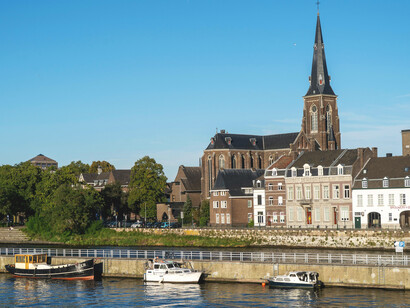
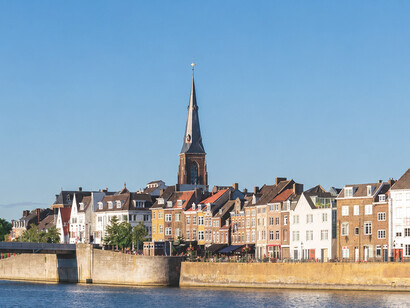
Yet Maastricht is not merely a custodian of its past. Crossing the graceful Sint Servaasbrug, the oldest bridge in the Netherlands, one enters the districts of Wyck and Céramique, where the city reveals its contemporary confidence. Former industrial spaces and ceramic factories have been transformed into stylish neighbourhoods filled with modern apartments, design boutiques, bookshops, and cafés. The architectural centrepiece of this reinvention is the Bonnefanten Museum, designed by the Italian architect Aldo Rossi. Its striking zinc-clad cupola rises above the Meuse like a futuristic lighthouse, simultaneously playful and monumental. Inside, mediaeval religious artefacts coexist with provocative contemporary installations, forming a visual dialogue between Maastricht’s ancient roots and modern ambitions.
Beyond the city centre, the surrounding Limburg landscape offers another dimension of Maastricht’s identity. The Sint-Pietersberg, or Mount Saint Peter, rises gently at the city’s edge, concealing an immense labyrinth of limestone tunnels carved through centuries of quarrying. Stretching for over 20,000 passageways, these caves have long served as places of refuge during wartime and occupation. During the Second World War, Dutch masterpieces, including Rembrandt’s The Night Watch, were hidden within these cool subterranean chambers to protect them from Nazi seizure. Exploring the tunnels today is both eerie and mesmerising: walls covered with charcoal drawings, endless corridors disappearing into darkness, and the heavy silence of a world untouched by sunlight.
Emerging once again into the golden light of the Limburg countryside feels almost transformative. Vineyards roll across gentle hills, church spires punctuate distant villages, and the Meuse winds lazily through a landscape that feels closer to Belgium or northern France than to Amsterdam or Rotterdam. This geographical ambiguity is precisely what makes Maastricht so compelling. It is a city of borders that ultimately transcends them.
Perhaps it is fitting, then, that Maastricht became the birthplace of the modern European Union through the signing of the Maastricht Treaty in 1992. Few places embody the European ideal so naturally. The local dialect borrows freely from Dutch, German, and French; the cuisine reflects centuries of cross-border exchange; and the culture itself is an elegant synthesis of northern discipline and southern sensuality. Maastricht does not overwhelm visitors with monumental grandeur or frantic tourism. Instead, it seduces slowly and subtly. It asks the traveller not to conquer the city through an itinerary but to surrender to it, to wander without urgency, to linger over meals, to sit beside the river at dusk, and to rediscover the increasingly rare luxury of living deliberately and well.