English
 Español
 Français
 Deutsch
 Italiano
 Português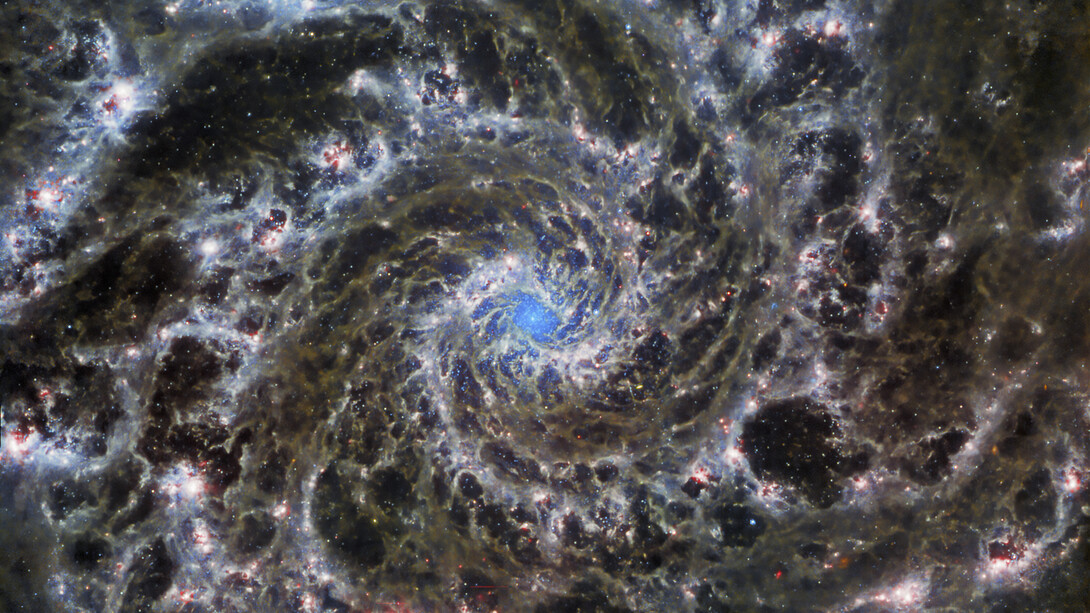
My foray into astronomy continues from last month’s article on tidal locking (the phenomenon which means we on Earth always see the same side of the moon), with this month’s focus on supernovae and stellar nucleosynthesis – a fancy way of saying that elements are forged within stars’ cores.
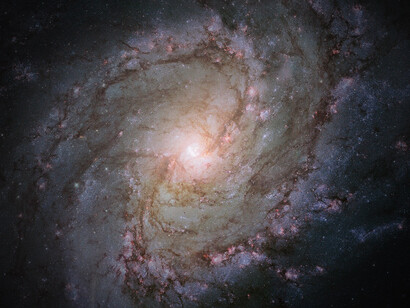
One supernova detected in 2013, referred to as Supernova 2013ej or SN 2013ej, was so far away from Earth that the light of its explosion was not visible in our sky for 30 million years. The galaxy that contains it, M74, contains an estimated 100 billion other stars and is located within the constellation of Pisces in our night sky. In terms of energy output, the explosion of SN 2013ej was equivalent to the simultaneous detonation of 100 million of our suns and was visible as a point of light in our night sky starting on July 23, 2013 (Allen, 2016).
A supernova is one of the strongest explosions that occurs in space and is incredibly important for scientists to study as it reveals an extraordinary amount of information about our increasingly-expanding universe, particularly through the dispersion of elements (like helium, carbon, and iron) fused within the star’s core prior to its combustion in a process called stellar nucleosynthesis. SN 2013ej’s star was roughly 200 times larger than our sun before going supernova, hurling elements and debris away from it at a mind-boggling speed of 10,000 kilometers per second, according to Govinda Dhungana of Dallas’ Southern Methodist University (SMU), the lead author of the discovery (Allen, 2016). These elements and debris will collide with other materials in interstellar space to create the stars, planets, and dust that make up new solar systems (NASA, 2016).
This discovery is substantial in that “the heavy elements made in the supernova and its parent star are those which comprise the bulk of terrestrial planets, like Earth, and are necessary for life”, said Robert Kehoe, SMU physics professor and lead of the SMU astrophysics team (Allen, 2016). Through analysis of this supernova’s life and death, we are able to determine a profound amount of information about our universe and others, and better understand the origin of all life and material in space.
SN 2013ej’s galaxy, the spiral-structured M74, was first measured and charted by the 18th-century astronomer Charles Messier. Later astronomers noticed its spiral structure, indicating it is relatively young and still undergoing star formation, like our Milky Way Galaxy. In the event that planets were orbiting SN 2013ej’s parent star, they were without a doubt destroyed in the supernova explosion (Allen, 2016). Despite its massive energy output, the supernova still required a telescope to observe the faint light appearing in our night sky, due to its distance from Earth. Kehoe and the SMU team observed the supernova using seven large, ground-based telescopes and NASA’s Swift satellite, while other researchers at the McDonald Observatory in Texas used SMU’s ROTSE-IIIb telescope and the Hobby Eberly telescope to observe visible light and a spectrum, respectively (Allen, 2016).
Observing multiple spectra of discharged light with different filters applied - a technique called direct imaging - allows astronomers to amass a collection of data about different characteristics of the star and its explosion, such as heat and light radiation, size, temperature, and chemical composition.
Kehoe adds that a spectrum analysis of the explosion discloses internal data of the supernova similar to the readings of an X-ray or CAT scan, revealing evidence of an array of elements, including hydrogen, helium, calcium, titanium, barium, sodium, and iron (Allen, 2016). A spectroscopic analysis of SN 2013ej first returned data of the explosion on July 23rd, 2013, though it was more properly discovered on July 25th by the Katzman Automatic Imaging Telescope (KAIT) at the Lick Observatory in California. Together, these telescopes and their analyses of SN 2013ej are able to determine that the supernova began only 20 hours before its “shock breakout” (Allen, 2016), or the moment when the explosion pushes past the outer layers of the star. This range of observations, giving us information on the supernova’s temperature, size, mass, debris, distance from Earth, and abundance of chemical elements, reveals a trove of new information about the life and death of supernovae, which are still enigmatic to scientists.
Supernovae are typically difficult to study because astronomers cannot directly observe the explosion; they must observe changes in the star’s light output as dust, debris, and raw elements are thrown from the star in the aftermath of the blast (Kulier, 2009). This makes it challenging to confidently interpret the results of observation or spectroscopic analysis because supernovae are still such a new subject of focus for scientists. To counter this, astronomers constantly take spectra of stars and supernovae to be able to infer averages and baselines for stars’ locations, brightnesses, and colours, all of which could appear to change as a result of illusions caused by our atmosphere, interstellar debris, and competing radiation waves from other stars or gravity waves from black holes.
Even after observing and cataloguing hundreds of supernovae in the observable universe, a lot of details about their lives and deaths are still to be discovered. What we do know, however, is that the force of this supernova’s blast will either leave behind a black hole or create “a neutron star like a giant atomic nucleus the size of a city” (Allen, 2016).
SN 2013ej was one of many massive stars located in the M74 galaxy, roughly 30 million light-years away from Earth, going supernova far earlier in its life than our sun will, due to its massive size and remarkable fuel combustion. Huge stars still undergoing fusion – the fusing of light elements into heavier elements to fuel the burning of the star – are classified as Type II supernovae, collapsing and combusting once their cores become too dense with heavy elements to withstand their own gravitational pull (NASA, 2016). The most massive and hottest stars begin their lives fusing hydrogen into helium in the same way as smaller stars do (like our sun), but their cores will progressively contract, heat up, contract, and heat up as they fuse their way through increasingly dense elements until their core is too heavy to support itself.
On the tenth day after the explosion, the remnants of the star were still twice as hot as Earth’s core, which is estimated at 6,300 Kelvin. Our sun’s surface burns at a relatively cool 5,800 Kelvin, and the remnants of SN 2013ej reached approximately 30 days after combustion (Allen, 2016).
A typical star can generate energy at a rate that expands its core just enough to withstand its own gravitational pull, without becoming so large as to cool itself. When a star runs out of nuclear fuel, its mass begins to flow into its core, becoming so dense that it can no longer generate energy quickly enough to withstand gravity. Eventually, the core becomes so heavy that it becomes unstable, collapses in on itself, and explodes in a supernova (NASA, 2016). For most of its life, which likely lasted tens of millions of years, SN 2013ej would have fused hydrogen into helium, as our sun does currently. When the stores of hydrogen began to run low, the fusion of denser elements would begin: helium for a few hundred thousand years, “carbon and oxygen for a few hundred days, calcium for a few months, and silicon for several days” (Allen, 2016).
The final and heaviest element is iron, which, when it cannot be burned as fuel, would collapse the core of SN 2013ej’s parent star, going supernova within a quarter second (Astro.berkeley.edu, 2016).
Observing and measuring the output of supernovae is valuable to our understanding of the development of the universe, as their explosions often change the content of the interstellar medium through the dispersion of heavy elements like iron, and allow important observations of gamma ray emissions (currently the deepest we are able to see in the explosions of supernovae) (Kulier, 2009).
Through analysis of this supernova’s life and death, we are able to determine a profound amount of information about our universe and others, and better understand the origin of all life and material in space. Robert Kehoe, lead of the SMU astronomy team, uses this opportunity to look to the future, disclosing that “part of what makes SN 2013ej so interesting is that astronomers are able to compare a variety of models to better understand what is happening [in the aftermath of a supernova]. Using some of this information, we are also able to calculate the distance to this object. This allows us a new type of object with which to study the larger universe, and maybe someday dark energy” (Allen, 2016). As one of the largest explosions that ever occurs and the reason for the abundance of both light and heavy elements in space, supernovae are undoubtedly valuable subjects of focus in our continuing fascination with the vast expanse of the universe that engulfs us.
References
Allen, M. (2016). Nearby massive star explosion 30 million years ago equaled detonation of 100 million suns. Phys.org.
Kulier, A. (2009). Supernova nucleosynthesis. Princeton University.
SN 2013ej. (n.d.). Berkeley Supernova Database – University of California, Berkeley.
NASA. (2026). What is a supernova? NASA Space Place.