English
 Español
 Français
 Deutsch
 Italiano
 Português
It is tempting to see the 2014 annexation of Crimea as a sudden “information success.” In reality, what happened was far from spontaneous. What happened there was not spontaneous. Russia had already been building its use of the information space as a tool of power for years, and by the time 2014 came, this approach had been adapted to a highly connected, digital environment.
In Russian strategic thinking, especially when it comes to the “near abroad,” there is a consistent belief that Russian-speaking communities can be kept within Moscow’s sphere through shared culture and identity. This is not just a cultural idea. It has clear political use. The narrative of “protecting compatriots abroad” has repeatedly been used to justify actions beyond Russia’s borders. Analyses by NATO StratCom COE around 2014–2015 show that this concept is not accidental. It appears regularly in official discourse, alongside a broader effort to maintain a Russian-language information space outside national borders.
This became more visible during the political crisis in Kyiv in late 2013 and early 2014. For Russia, the events around Euromaidan were not only about Ukraine’s geopolitical direction. They were also about controlling how the situation was interpreted. Legitimacy, identity, and representation all became part of the struggle. At this point, the idea of “hybrid warfare” helps explain the approach. Military force is only one part of the picture. Political pressure, psychological influence, and communication strategies are used together to weaken a target from within.
By 2014, the difference was not only in intent but also in how developed this system had become. State-linked media, online troll networks, and the ability to create echo chambers on social media were not operating separately. They were part of the same effort. When needed, cyber operations and even physical actions targeting communication infrastructure could support this strategy. A CCDCOE study on this period points to an important detail. In the Russian approach, “information security” is not limited to technical protection. It also includes shaping how people think. In that sense, the message itself becomes a weapon.
How the Crimea operation unfolded step by step
It makes more sense to see the annexation of Crimea not as a single bold move, but as a carefully structured sequence that unfolded quickly. The process did not happen all at once. It moved in stages, each one preparing the ground for the next.
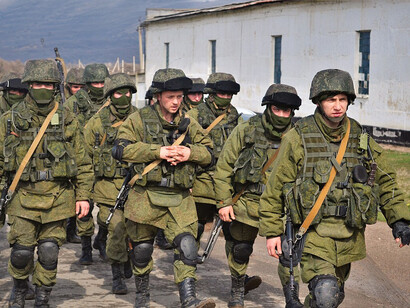
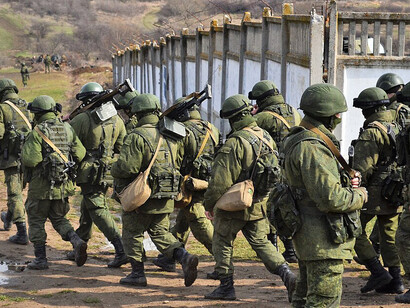
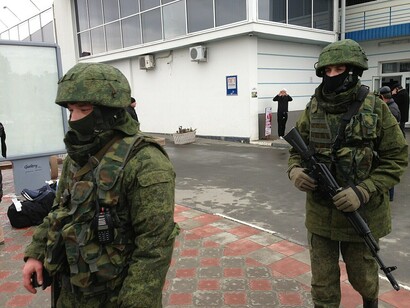
The first visible moment was the use of force on the ground, but even here things were not straightforward. Armed men without uniforms or clear insignia appeared, yet they were clearly well-trained and well-equipped. They took control of key buildings and strategic locations, creating a situation that was both controlled and unclear over time. When government buildings and the parliament in Simferopol were seized on 27 February 2014 and the Russian flag was raised, it marked the beginning of the operation in practice. At the same time, the question of who these forces actually were was left unanswered. This ambiguity made it harder for Ukraine and others to react quickly or decisively.
Once control was established, the next move was to turn it into something that looked political and administrative. Holding territory was only part of the goal. What mattered just as much was shaping the narrative around it. Political decisions began to take place under pressure in an environment where armed presence was always in the background. Local leadership was reshaped, and a new political line emerged that appeared to ask for Russian support. This allowed the situation to be presented not as an external intervention but as a response to local demand. At the same time, a referendum was quickly placed on the agenda. The language of legality and “the will of the people” was used to give the process a formal appearance.
While this was happening, the level of open military violence remained relatively low, but that did not mean force was absent. Instead, it was used in a controlled and calculated way. Ukrainian military units were surrounded, key infrastructure such as airports and roads was secured, and communication channels were disrupted. These actions limited Ukraine’s ability to respond while increasing the risks of any escalation. Analyses by RAND point out that this mix of pressure and uncertainty made it difficult for Ukrainian leadership to fully understand Russia’s intentions. Faced with unclear red lines, decision-makers acted more cautiously, worried that any strong response could trigger a larger invasion.
At the same time, communication played a central role in maintaining deniability. The presence of armed forces without insignia was supported by the claim that they were simply “local self-defense groups.” This narrative helped delay international reaction and made legal responsibility harder to establish. It also shaped how the situation was perceived on the ground, avoiding the immediate image of a foreign occupation. Over time, official statements shifted. Early denials that any Russian troops were involved were later replaced with claims that Russia had only provided support to maintain order. This gradual change in messaging shows how ambiguity was used deliberately to buy time.
The referendum on 16 March 2014 became the final step in this process. It was not only a vote but also a way to connect the situation on the ground with a legal and political narrative. However, two things stand out clearly. The vote took place under military control, and its legitimacy was widely rejected by the international community. Despite this, the idea that it represented “the will of the people” was strongly promoted. This is where the logic of modern information warfare becomes visible. Even a procedure that does not meet international standards can still be effective if it creates the desired perception. The OSCE refused to recognize the referendum and did not send observers, while the United Nations General Assembly, through Resolution 68/262, rejected its validity and supported Ukraine’s territorial integrity.
Seen as a whole, this sequence closely follows what is often described in discussions of hybrid warfare. First, the ground is prepared through information and narrative. Then, pressure is applied through political, cyber, and covert means. Control is established on the ground with limited but effective use of force. Finally, the outcome is framed in a way that gives it a sense of legitimacy, even if that legitimacy is widely contested.
Inside the information warfare playbook
One of the most striking parts of the Crimea operation is that the narratives did not appear randomly. They followed the timing of events on the ground. There was a clear targeting strategy. On one side, Russian-speaking communities in Crimea were framed as groups under threat and in need of protection. On the other side, the change of government in Kyiv was presented to international audiences as chaotic, illegitimate, and driven by extremist forces.
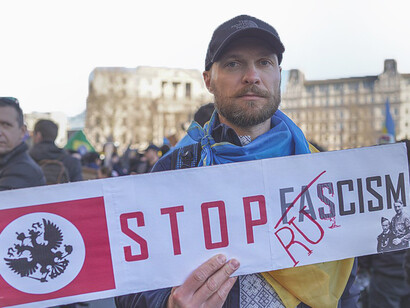
Research by NATO StratCom COE shows that from the early days of the crisis, Russian media pushed a consistent message: Euromaidan was not a protest movement but a coup. Protesters and the new authorities were labelled as “nationalist” or even “fascist,” which helped create a sense of fear, especially among Russian-speaking audiences. This was not just traditional propaganda. What made it effective was that it unfolded at the same time as real actions on the ground. As the feeling of threat increased, ideas like "self-defense" or outside support began to sound more acceptable.
For this kind of messaging to work, content alone is not enough. The way it spreads is just as important. In Crimea, television, online news, social media, and organized troll activity all reinforced each other. A StratCom COE report points out that media control in Russia works both directly and indirectly, including organized online trolling. There is also evidence that these networks were not improvised. Reports mention recruitment and coordination efforts already in place months before 2014, with a visible increase in pro-Russian activity as the crisis escalated. This suggests that the information campaign was prepared in advance rather than built in reaction.
Troll networks played a deeper role than simply supporting pro-Russian narratives. Their real impact was in overwhelming the information space. RAND describes this as the “firehose of falsehood” model, where large amounts of content are spread quickly, across many channels, often without concern for consistency. The goal is not to convince people with a single narrative but to exhaust them. When audiences are constantly exposed to competing claims, confusion grows and it becomes harder to verify anything. During the Crimea crisis, multiple stories circulated at the same time: claims of a coup, threats against Russian speakers, Western conspiracies, or NATO expansion. Together, they created a sense of uncertainty rather than a single clear message. As Pomerantsev and Weiss argue, this approach does not rely on one fixed ideology but on continuously reshaping how reality itself is perceived.
Beyond the local level, international media channels also played a role. Outlets like RT did more than report events. They helped extend Russian narratives to global audiences while presenting themselves as an alternative to Western media. This made it easier to introduce doubt and competing interpretations, especially in already polarized environments.
Some of the most effective messaging was also the most subtle. A well-known example is the spread of “Polite People” imagery during the operation. Pro-Russian accounts shared photos of unmarked soldiers interacting calmly with civilians, including children and elderly people. Instead of presenting force in a threatening way, these images normalized it. The goal was not fear, but reassurance. This made the presence of armed forces appear less like an occupation and more like protection, which in turn reduced resistance on the ground.
At the same time, information warfare also worked by dividing society. The new authorities in Kyiv were framed as extremist, while those supporting Ukraine’s territorial integrity were labelled as provocateurs. Meanwhile, Russian-speaking communities in Crimea were presented as vulnerable groups in need of defense. This dual framing weakened the legitimacy of one side while strengthening the justification for intervention. The idea of “protecting compatriots,” often highlighted in StratCom analyses, played a central role here. It allowed foreign policy actions to be framed as defensive rather than aggressive.
A key element connecting these narratives to real-world control was deniability. The use of unmarked forces sent a clear signal of strength but, at the same time, blurred responsibility. This ambiguity worked on multiple levels. Internationally, it delayed reaction and complicated legal responses. Locally, it shaped perception. If the forces on the ground could be seen as "self-defense groups” rather than foreign troops, the idea of occupation became less clear. RAND notes that this helped limit resistance, especially when combined with disciplined behavior and supportive messaging.
Non-state and semi-official actors also played a role in reinforcing this picture. Groups such as Cossack formations or pro-Russian volunteers appeared in visible roles, from checkpoints to street patrols. Their presence helped create the impression of local support. In some cases, more organized groups with strong ideological ties to the Kremlin also became visible, both on the ground and in the information space. One example often mentioned in analyses is Night Wolves, an ultra-nationalist group that combined symbolic actions with media visibility during the Crimea events.
This use of loosely connected actors points to a broader pattern. Influence does not rely only on official state structures. It can also involve partners, proxies, and informal networks. While Belarus was not a decisive actor in Crimea itself, later developments show how allied or dependent actors can play roles in disinformation and cyber activities. This kind of networked approach creates flexibility. It allows influence to spread while maintaining a degree of distance from direct responsibility.
Finally, many of these elements connect to wider debates about modern warfare. The ideas discussed in Valery Gerasimov’s 2013 article are often mentioned in this context. Although not a formal doctrine, the text reflects a way of thinking where the line between war and peace becomes less clear, and where political, informational, and military tools are used together. What happened in Crimea fits this pattern closely. Narrative shaping, covert action, and limited but effective use of force all worked in parallel. At the same time, some scholars argue that calling this a fixed “Gerasimov Doctrine” can be misleading. What Crimea ultimately demonstrated is not just a regional operation, but a model. A model where information, ambiguity, and limited force are used together to achieve political goals without triggering a full-scale war. This is what makes it both effective and difficult to counter.