English
 Español
 Français
 Deutsch
 Italiano
 Português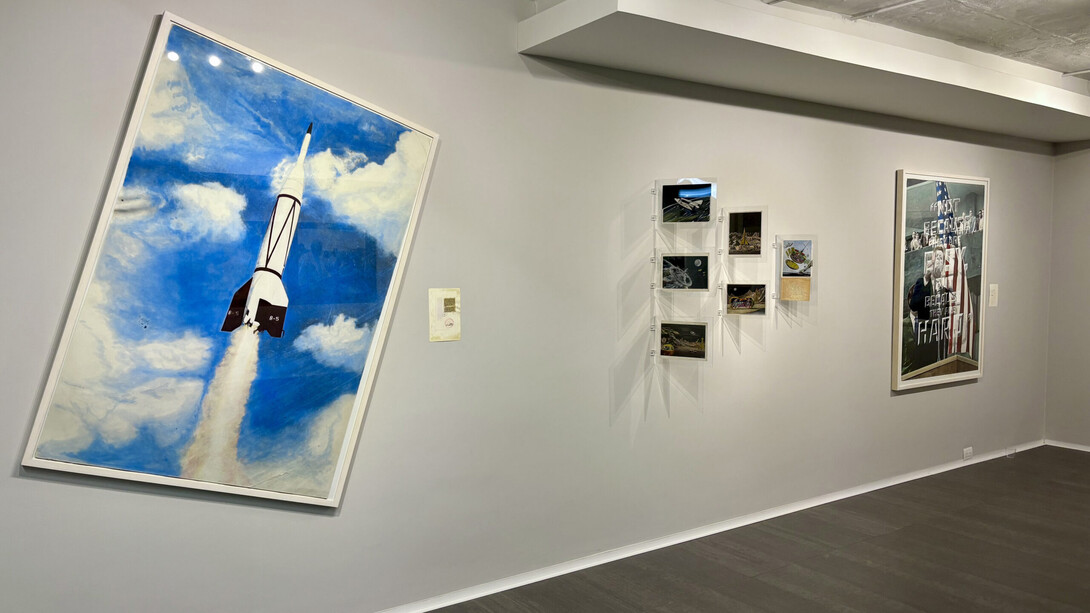
Someone has been watching us, just as they have been watching our precious earth. We are disappearing through the dark hole of an eye whose existence we are not even aware of. But more than one person can play this game. And I still have my toy—my camera, which renders things invisible.
(Gerald Murnane, The plains)
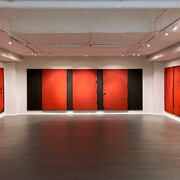
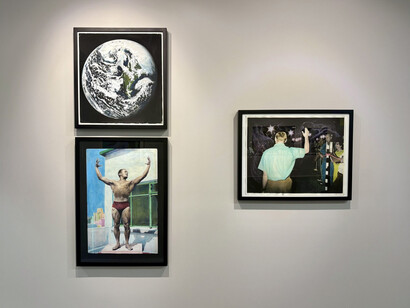
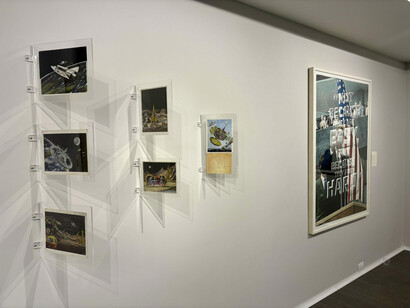
Andrés Orjuela surprises us with a series of satellite images of the Earth, the Amazon rainforest, the cosmos, and the early NASA assemblages for space exploration, all of them linked to the dawn of a new frontier for human conquest. The tensions of the Cold War period provided fertile ground for an ideological, technical, and economic advance, accompanied by the emergence of new notions of modernity and progress. The idea of a new horizon for humanity was articulated in John F. Kennedy’s inaugural address in 1961, where he invited us to “explore the stars together,” opening the horizon of a new era.
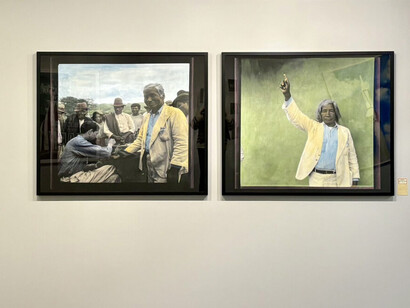
The images proposed by Orjuela, drawn from various original archives that the artist has been collecting for years, are carefully intervened through both enlargement of scale and the application of color and paint. From the Earth we look toward the stars and dream of space conquest; from space we look back at the Earth and are moved by the fragility of the blue planet, with its precious atmosphere—a mantle that protects the wonders of forests, oceans, and the majestic diversity of the natural world. All of this has been made possible by the photographic camera and the development of telescopes and lenses of ever-increasing scale. At the terrestrial level, this “universalism” is intertwined with colonial practices. The Indigenous leader from Cauca, Manuel Quintín Lame—whose ancestors were sharecroppers on large estates—appears in a photograph while a sample of his blood is being taken; or was it a vaccination? This loop repeats itself again and again, taking us from outer space to the most remote reaches of the planet, accumulating along the way diverse meanings, sensory explorations, imaginaries, and symbols that are irreducible and irreplaceable. The jungle becomes exotic, yet the prejudices remain.
The future of space has been one of humanity’s great projections since the dawn of antiquity. In the twentieth century it was an invitation to hope, perhaps even a mechanism of escape. Today planetary forces reveal themselves as an immediate present, a landscape of uncertainty driven by the global expansion of techno-political-military spheres that confront us with the threat of nuclear catastrophe.
This imaginary is framed in terms of the “planetary” or the “universal”; it is within this loop—this back-and-forth between the universal and specific scenarios—that a grand aspiration at a small scale takes shape (Miss Universes and bodybuilders seeking recognition, obscure sites of experimentation within the sciences of space). It is at this point that Orjuela situates his work. The references assembled here feed into one another, breaking with the principle of linear causality that dominated science until the mid-twentieth century. One image refers to another, triggering associations between disparate events.
This is not about relations between different realities; rather, it is a recognition that this “realism” is nothing more than a mirage, both literal and figurative. It is the game of the camera. In the words of Nobel Prize–winning author László Krasznahorkai, and following the semiotics of Peirce, “the truth is that no such thing really exists,” since our ideas of the universal continue to revolve around emotional and imaginary relations; we cannot say what a truly “universal” point of view might be. “In fact, it represents a radical shift in the concept of reality—indeed, the disappearance of reality itself.”
That someone has been watching us corresponds to the eye of the camera, through which extraordinary records have been produced—images that stimulate, comfort, and terrify. This is the great enigma of the black hole of an eye: Who is watching us? Whom are we watching?
(Text by Ana Patricia Gómez Jaramillo)