English
 Español
 Français
 Deutsch
 Italiano
 Português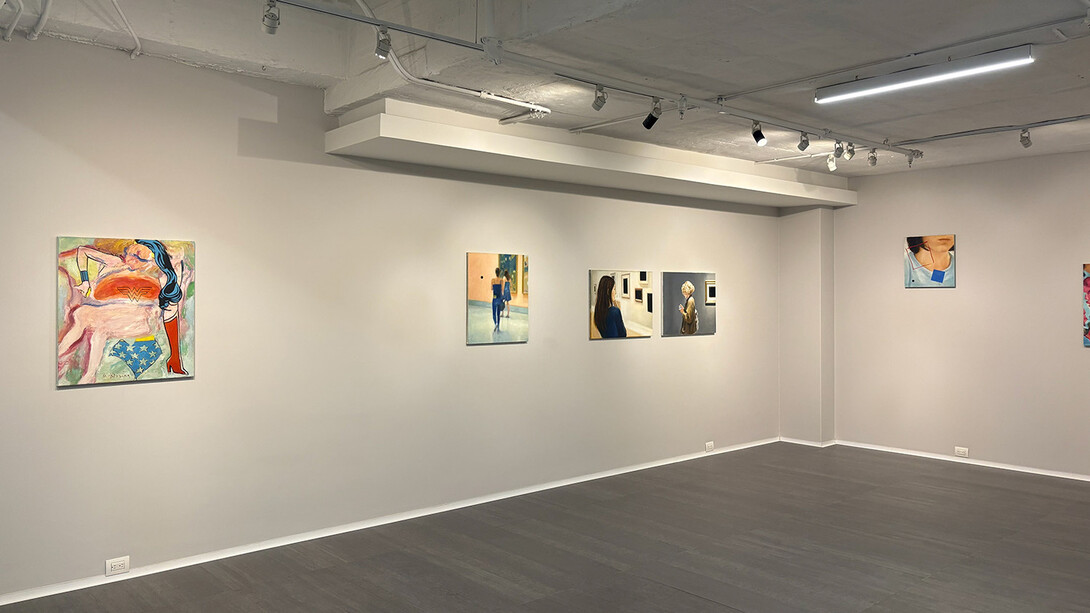
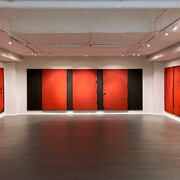
The images that run through these paintings do not arrive for the first time. They circulate from other moments and other dispositifs: cinema, the museum, art history, a visual memory that takes shape before each encounter with what is visible. These are scenes already seen, interpreted, fixed. In Andrej Savski’s painting, the image comes to a halt. Something within it slows down, shifts, loses the immediacy with which it usually appears, and becomes aware of its own trajectory.
Painting presents itself as a space in which representation ceases to be transparent. What appears familiar—an interior scene, a recognizable framing—emerges as a surface traversed by layers of time and meaning that remain open. The visible operates as a dense plane, marked by prior uses, by repetition, by ways of seeing that persist.
Perception is never an isolated act. It is formed in relation to other images, other times, other accumulated experiences. In Savski’s work, this condition becomes explicit: seeing appears as something learned, repeated, inherited. Nothing is offered immediately; painting holds attention and introduces a delay that shifts the viewer toward a more attentive and uncertain mode of observation.
From this awareness of the gaze, the work situates itself within a critical tradition of European contemporary art that has consistently questioned how images and the narratives of art history are constructed. As a founding member of the IRWIN collective and the NSK (Neue Slowenische Kunst) movement, Savski was part of a generation of artists who introduced irreverent and complex readings of the modern canon, authorship, appropriation, and the ideological status of the image. In his individual practice, this conceptual rigor shifts toward painting, where the dialogue with art history, cinema, and visual culture operates as a constant tension.
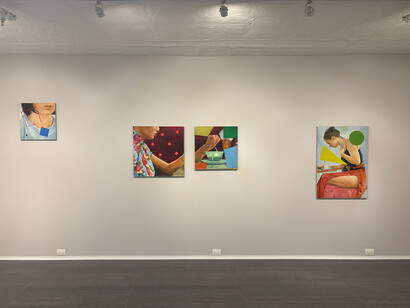
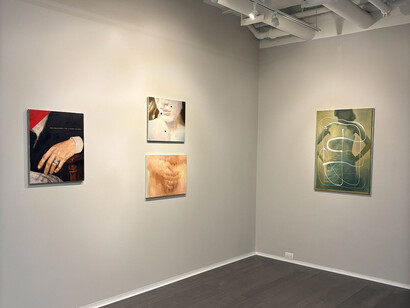
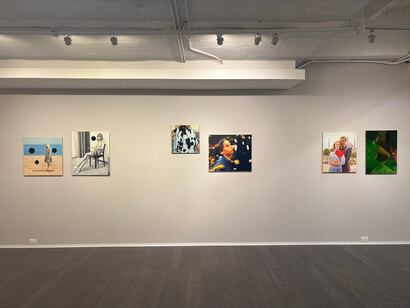
To return to a scene is to reactivate it. References to cinema, canonical painting, or visual culture retain their historical density even when subjected to minimal alterations. Discreet geometries, zones of blurring, or barely perceptible interruptions introduce a distance that destabilizes the pictorial surface and prevent it from closing into a fixed reading. The history of what is represented remains active, held in suspension.
In this process there is no single formal method repeated from one work to another. Each painting establishes its own visual regime and its own way of being constructed. Realism, understood as a predominantly mimetic practice, shifts across different degrees of definition and materiality: sharply rendered images coexist with filtered, blurred, or densely worked surfaces. These variations do not respond to a stylistic pursuit, but to conceptual decisions that directly affect perception.
The female figure runs through the body of work as an insistent presence. It is not tied to a specific identity or to a defined narrative, but refers instead to other images, to partially recognizable scenes, to forms of representation that have circulated throughout the history of art and cinema. There are clues and dispersed references, but never an obvious reading: the image offers itself through approximation and remains open.
In these paintings, the figure occupies a threshold. It is near, yet never fully given; it allows itself to be seen, but not fixed. Historical, cultural, and visual layers overlap without forming a hierarchy. The scene sustains this accumulation in tension. Even when the register becomes more intimate, a distance persists, reminding us that any image charged with history continues to operate beyond an immediate reading.
The works remain open, sustaining an ambiguity that arises from the coexistence of multiple layers. Before them, perception does not settle on a single key: it shifts, returns, hesitates, and ultimately recognizes its own implication in what it observes.
(Text by Ana Lucía Arbeláez Z)