English
 Español
 Français
 Deutsch
 Italiano
 Português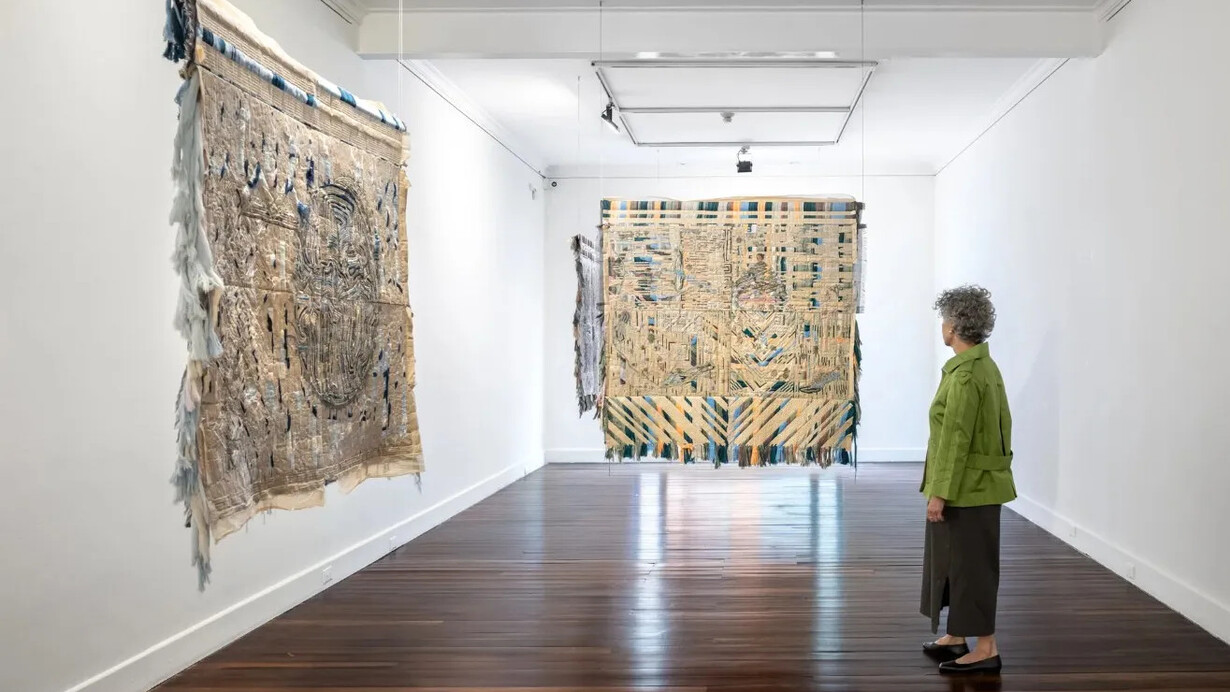
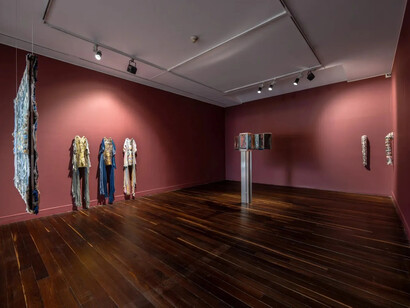
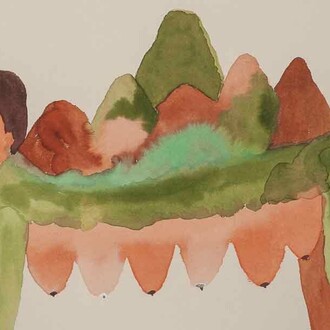
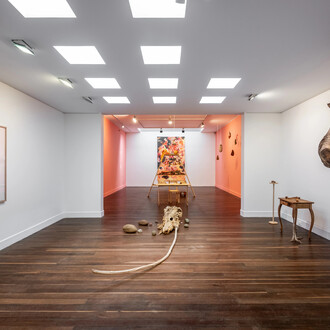
Miguel Mesa Posada's exhibition Potosí takes its name from one of the symbolic epicenters of colonial modernity: the Cerro Rico of Potosí (Bolivia), whose mining operations established global circuits of wealth, violence, and extraction from the 16th century onward. However, instead of taking a historicist approach, the show proposes a material and conceptual shift. Mesa Posada's Potosí considers other ideas of value and wealth present in textiles: a territory of temporal crossings and reflective stitches, where Latin America's cultural inheritances are woven, covered, and blurred.
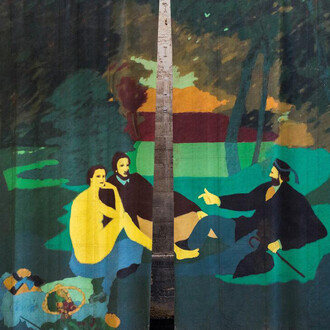
In Mesa Posada's work, weaving operates as a palimpsest of beliefs. Forms of colonial violence coexist with exercises in translation, survival, and hybridization capable of producing new epistemologies, which can be read as ways of inventing new pasts to sustain a future open to historical mixture.
Historian Serge Gruzinski, in his book The mestizo mind, proposes that the encounter between Europe and America enabled hybrid forms of thought which, despite the dispossession and abuse of local populations, generated key intellectual and artistic inputs for cultural mestizaje (understood beyond race). The mixtures implied by colonization in all its material and symbolic forms can be read as creative inheritance from the chaos of the "conquest," highlighting in that encounter a force that transformed the Old World—and it's in the encounter with indigenous thought that the dynamics of globalization begin. Today, that globalization continues amid multiple tensions, allowing imaginaries and knowledge to connect across rigid borders. In Potosí, Mesa Posada engages with this perspective by insisting that memory, material culture, and contested pasts can still build something new.
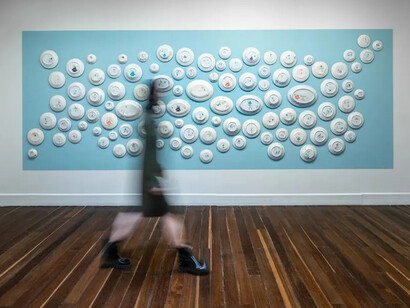
In this exhibition, the boundaries between art and history, between the popular and the industrial, between utilitarian object and aesthetic work dissolve. Materials are reconfigured here as fields for sensory experimentation, and Mesa Posada's gesture resembles that of an explorer seeking to find something new.
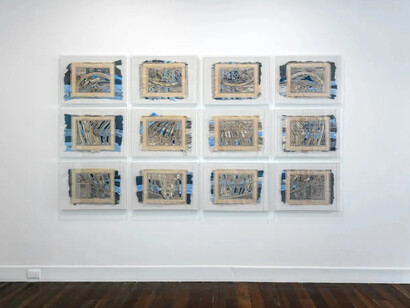
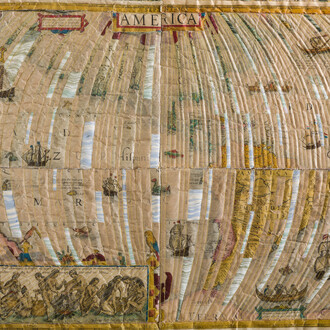
From this position, the map ceases to be merely a geographic document and becomes, in dialogue with textiles, a narrative rich in layers. The lines stitched onto cartography resemble veins through which material and symbolic capital is permanently extracted. The shine of metal, present throughout the exhibition, articulates the tension that emerges between the sacredness of the earth for some and the historical anxiety associated with gold and silver extraction for others. Equivalent to the use of metal as transit and offering for the former, and as a source of accumulation tied to extractivist logic for the latter.
The confrontation between European and pre-Columbian representations is key. While modern cartography consolidated territory as a surface for control, delimitation, and sovereignty, many indigenous cultures configured the map as an inhabited place, a weaving of relationships and tutelary presence—the mountain, the altépetl, is a living entity and symbolic axis of community. In this sense, Brian Harley's reflection in his book "Maps, Knowledge and Power" is illuminating: maps are not neutral instruments but inherently political documents. Projections, symbols, and cartographic silences are selected to reinforce authority structures and legitimize specific sovereignties. The map, therefore, doesn't just represent the world—it orders it according to a regime of writing, reading, and domination.
In Potosí, the gesture of sewing and unveiling maps is not merely formal—it's a critical operation. The needle and the hand that tear the paper interrupt the presumed Cartesian objectivity and rewrite it, converting these documents into mestizo collisions. Textiles introduce interstices, layers, and plots yet to be un-covered. America reappears thus as terra incognita, not in the colonial sense of the unknown to be conquered, but as territory that rewrites itself. Permeable and critical toward the narratives that have fixed it in the universal imaginary of abundance.
The exhibition ultimately proposes thinking about wealth beyond metal and shine. If Potosí's imaginary condensed the promise of infinite opulence, Mesa Posada's works suggest another form of wealth: one that emerges from multiplicity, from memory that doesn't close itself off, and from the capacity to hybridize traditions to invent possible futures based on new pasts.
Each stitch is, then, a minimal but insistent gesture, a way of rewriting the ending of history from the weft.
(Text by María Wills Londoño)