English
 Español
 Français
 Deutsch
 Italiano
 Português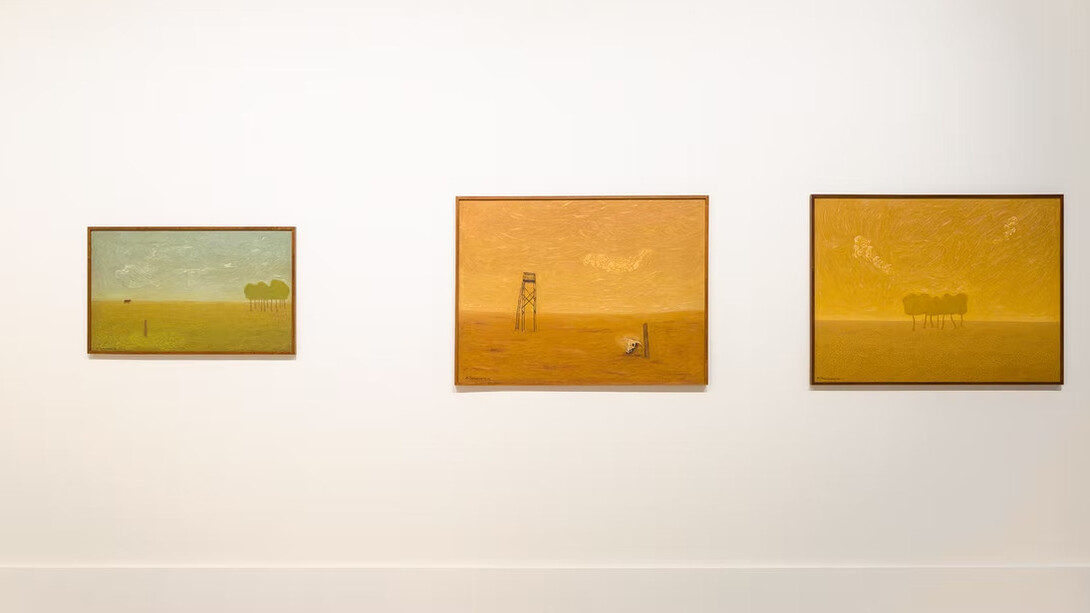
Alfio Alfredo Spampinato was born in Gravina, Italy, in 1925. He sailed to Argentina the following year and spent his childhood in Avellaneda in the Buenos Aires suburbs. In the late 1940s he began to study painting with Pedro Domínguez Neira and then Enrique Policastro, who was his most important mentor. Policastro would meet him at Retiro station and together they’d take the train to Muñíz, where they would paint landscapes. Policastro’s influence on Spampinato is clear in the scenes of desolate planes, the palpable appreciation of simplicity and solitude, the meticulous use of colour and the obsession with capturing light. However, Policastro showed little interest in the suburban periphery, dark interiors or worn out workers. Spampinato very consciously worked to develop his own style. He used to say that one day, looking at his early works, it occurred to him that he’d only have to change the signature to sell them as Policastros. This spurred him to strike out on his own.
The appearance of his mature style coincided with a move to José C. Paz in 1953, where he bought a plot of land with his wife Francisca after they were married. They had previously lived in the Liniers neighbourhood. At the time, like much of the area around the city of Buenos Aires, José C. Paz, previously a village, was expanding through the construction of new neighbourhoods to house industrial workers and public infrastructure. Spampinato worked for SEGBA (Electrical Services of Greater Buenos Aires) checking metres and every morning got up at five to commute into the city. He would return at four in the afternoon, have tea, sometimes take a nap and then lock himself in his studio to paint into the night. On Sundays he would go on outings with his daughters Ana and Susy to enjoy the landscape he depicted in his paintings. Today, it’s hard not to wander through the hectic centre of José C. Paz and marvel at how not so long ago it was all open countryside. To a degree, Spampinato’s paintings documented how the pampas landscape began to be eaten up by this urban sprawl.
The 1950s and 60s were when Spampinato enjoyed his greatest prestige in the artistic circles of Buenos Aires, holding solo exhibitions at galleries such as Witcomb, Rubbers, Alcora and Dinasty, in addition to appearing at several salons. Contradicting the notion that he was a solitary painter with no interest in prestige or economic success, during this time he made a great effort to promote his work. On Thursdays or Fridays he would attend exhibition openings, getting back home by train at ten or eleven at night where Francisca was waiting to hear how it had gone. Although he painted for pleasure and often gave his paintings away, Spampinato was also interested in selling them. In private he would say that he was convinced of their value but he also admitted that recognition and money would probably only come to his grandchildren. At tea one afternoon in Polvorines, his daughter Ana told me, “When his career was at its height he would go to exhibitions, he knew everyone, he was a very energetic person. That was in the 50s to the 60s, 70s until 86, 88. When did he have his heart attack? In 86, no, 88 …”.
The heart attack changed everything. In his 60s with a heart only working at a quarter of its previous capacity, Spampinato was forced to leave his job and make significant changes to his lifestyle. He thus stopped visiting the city so often and was far less active in artistic circles. However, he continued to paint, almost obsessively. He painted so much that the shelves of his studio filled up, followed by his easels and then the floor until there were so many paintings that one could barely move around the studio. Ana said to me, “I think painting saved him, prolonging his life for twenty more years. It was what kept him grounded.” In his final years, from around 2010 until his death in 2012, painting with oils became too tiring so he moved on to watercolours, which he could spread out more easily on a table.
Apart from his health issues, Spampinato’s experiences in the art market might well explain his estrangement from the scene. He set out to keep a ledger for all his works, recording in detail where each of his paintings ended up (and at what price) with the clarification that he couldn’t remember what had happened to the pieces he made between 1950 and 1961. What was effectively a personal diary reveals his disappointments and frustrations with the vicissitudes of the local art market. He describes and rails against the “fraudsters” who took his works without paying the agreed upon price, “screwing him over”. In time, Spampinato began to doubt the honesty of dealers in general which exacerbated his alienation from the commercial art circuit.
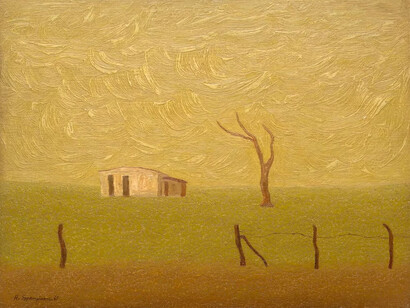
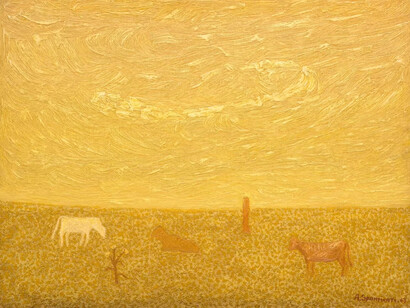
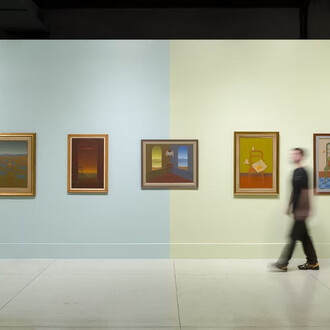
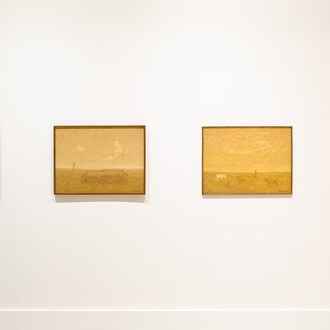
The sixties saw the consolidation of the language that defines most of his output. The emphasis on texture and conscientious materiality of his paintings was one of the aspects that he most enjoyed. Working with oils, he would superimpose layers of paint, sometimes in different colours, which he would then scrape away very carefully to achieve the texture he was looking for, especially in the skies, which were his greatest obsession. He would also add sand to the painting and even let one of his nails grow long so he could use it to put the finishing touches to the works. Delving further into characteristic aspects of Spampinato’s work, another striking feature is his repeated use of yellow, which dominates most of his output together with orange. His granddaughter Mariana told me that she went to buy him oils (always oil paints) at the D’Alessandro art supplies store, the moment he saw her the owner would laugh: “We’ve got the ochres for your grandpa.” Spampinato’s preference for the colour was such that he would buy ten times more tubes of ochre than any other. The few works with muted, green and blue tones marked periods of sadness or trouble in his personal life.
Spampinato’s fixation with ochres can be explained by the fact that his primary theme was light. The furious yellow that dominates a large part of his works would seem to suggest a fierce, all-encompassing sun. In that regard, a review of his work by the critic Carlos María Carón is illuminating. Spampinato enjoyed it so much that he carefully preserved it, as his family continues to do to this day. They showed it to me because they feel that it describes very well the motivations behind his work. In rather florid, metaphorical language, the text focuses on the relationship between the artist and sunlight:
Everything that Spampinato paints he transforms into light, whether he’s painting on card, canvas or hessian, conjuring the magic of the glowing storms, turbulent seas with diaphanous waves, or his very soul which – like his word – is full of light and crystalline qualities. Occasionally, the mist and storm clouds lift and the fields or sea appear in glorious oranges and yellows, with a blinding sun embedded in the canvas. Then we feel the light heedlessly flooding over us, conveying a sense of freedom, but no less than that found in the dull stormy skies that burst into the realm of our emotions.
The scenes that Spampinato painted also convey a profound solitude and, one imagines, an imposing silence. The frequent sunflowers and teasels, in small isolated groups, seem to shudder, scorched by the sunlight. Save for rare exceptions, people do not appear in his work and when they do they only accentuate the solitude: solitary figures without expression or emotion, or humble houses, shacks or boats that suggest a human presence without showing it. Raúl González Tuñón’s description of his work is interesting, because it mentions some of these elements but also because of the comparison he makes with ingenuous painting, similarly to Mujica Lainez in his influential genealogy of Argentine art naíf:
The style of Spampinato, which combines harmonic and functional forms, realities and abstractions with authentically ingenuous aspects, has tended more and more towards profound simplicity, the boat, the willow, the silence enveloped in a serenely transparent light that touches the deepest sensibility of the viewer.1
The inclusion of Spampinato in the local naive art movement arises from a solo show held at the El Taller gallery in 1963, the year it opened. It concentrated on promoting what began to be called at the time “ingenuous painting” with the gallery texts written by Mujica Lainez, which were then collected in a 1966 book that established the main references and concepts that defined the movement. However, the notion of an ingenuous artist as an outsider with no artistic education, training or pretensions does not fit Spampinato, who exhibited regularly, took part in competitions and trained under two masters. As Oscar Félix Haedo writes in his study of Argentine ingenuous painting, Spampinato did not identify with the label and preferred to place his work within a tradition of what he called “poetic realism”. The intimate, personal style of his painting was not a consequence of his exclusion from the art world, but an exploration of his own sensibility.
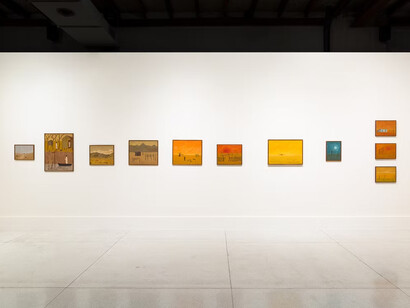
Another aspect that stands out is the small size of his works, almost all of which are made on hardboard, which he bought, cut, sanded and prepped with a layer of chalk and glue. He also occasionally painted on canvas (and sometimes on hessian) and when he was most active on the institutional art scene he made large format works after realizing that it was the larger pieces that tended to win awards at the National Salon. However, there is no doubt that he preferred smaller works, a preference that grew further ingrained when the heart attack limited his ability to physically make and move around larger pieces. But this predilection was also an aspect of his relationship to painting. He once said that he preferred smaller paintings because he could finish them more quickly while he was already thinking of the next. It was as though he were satisfying an unquenchable desire for painting, or painting was a source of unending relief.
I have no way of knowing when I first came across the work of Spampinato; his paintings have been hanging in the homes of my mother’s family since before I was born. My grandparents were close friends of Alfredo and Francisca, a relationship that arose because their daughters went to the same school and in time became a network of family ties, trips, gatherings and anecdotes that continued for decades. The works I see in the homes of his daughters and grandchildren and those of my aunts were gifts to mark special occasions accompanied by affectionate dedications. Spampinato clearly understood the power of art as a tool to form emotional connections, not just in private but also as a way of showing one’s love for the neighbourhood. He was an active figure in the cultural life of José C. Paz, helping to run the Historical Museum and organizing painting competitions for local children. I think once more of his mentor Policastro and how he is almost always described as a popular painter with close ties to working class communities. Although Spampinato’s paintings are usually absent of people, evoking melancholy and quiet desolation, behind them lay a deep sensibility and affection for his place in the world and the people with whom he shared it.
(Text by Juan Allermann)
Notes
1 Cited in Chierico, Osiris. La temporada plástica 1976 (The 1976 art season). Buenos Aires: Pluma y Pincel, 1977, p. 438.