English
 Español
 Français
 Deutsch
 Italiano
 Português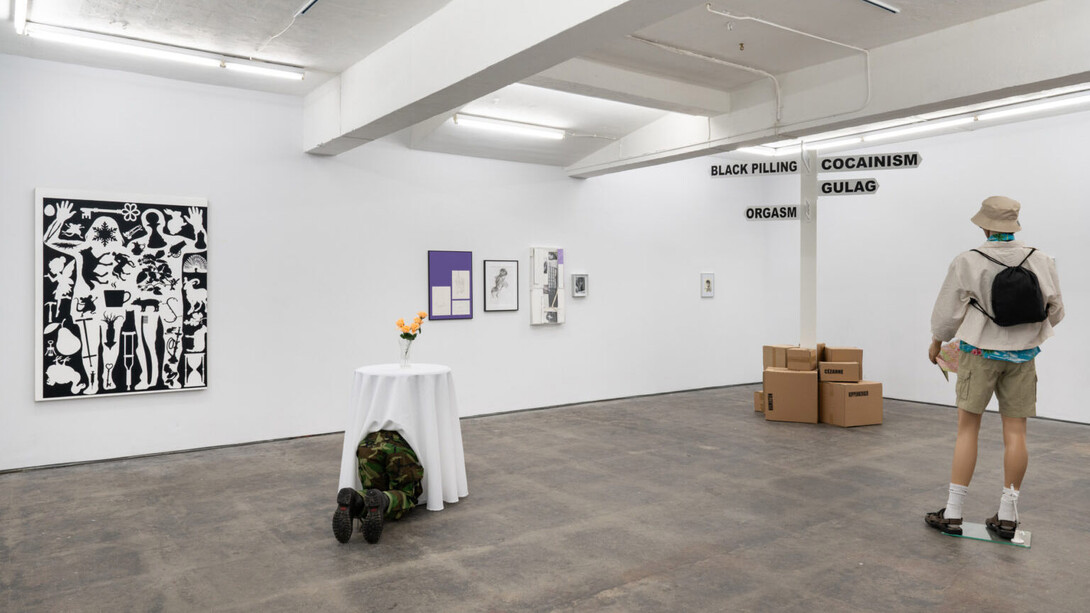
The infrastructure is too big. There are too many advisors, too many galleries, too many artists, too many fairs. Everything will need to downsize. In my blunt opinion, blood will flow in the streets before the art market finds a new balance.
(Alain Servais, Belgian collector and art market commentator, Artnet, September 2025)
In 1927, Austrian art historian Alois Riegl looked at the decorative arts of the late Roman empire and decided not to read them as symptoms of decline. Instead, in Die Spätrömische Kunstindustrie, he examined them on their own formal terms, for what they were, not for what they signalled about the empire collapsing around them. His approach was teleological: understanding a work through its end function, its relationship to a viewer and its own internal logic. That act of rehabilitation Riegl gave art objects, produced at a time of decline, is the starting point for this exhibition.
The art market is contracting. Fine-art auction sales in the first half of 2025 totalled $4.72 billion, down 40.9 per cent from 2022’s peak, according to the Artnet Price Database. The gap between what galleries charge on the primary market and what works achieve at auction has widened sharply. The structural diagnosis from within the trade is that the industry grew too large, too fast, and is now struggling to correct itself. The advice passed on to younger galleries is – “stay small for as long as you can”. In this world, fewer and fewer artists are given a serious chance, and galleries are run from generational wealth or into the ground.
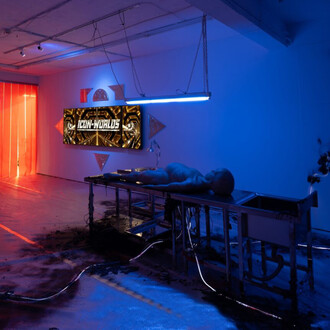
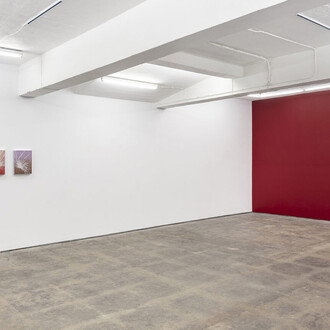
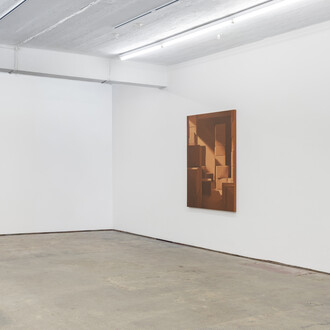
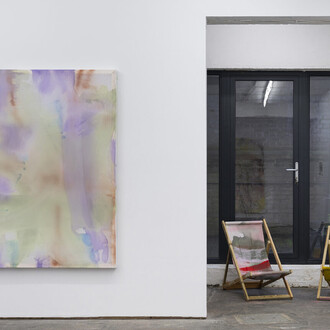
Kunstindustrie brings together twenty-five artists. Some were found through the usual channels; one or two were reached via Instagram DM. They do not share a movement nor an aesthetic; rather, it is the condition of making work now inside what Riegl’s title names: the art industry of their time.
The exhibition resists the convention of grouping artists under a single, vague conceptual umbrella, “dreams,” “nature,” “Freudian symbolism” or “being young” in favour of attending to the formal choices that actually emerge when aesthetics are shaped by constraint. What does an artist do when the market rewards the fashionable? When the conceptual offers total autonomy, but rarely attracts buyers? When the absurd has longevity but no immediate commercial purchase? Kunstindustrie takes the aesthetic categories within the show at face value, acknowledging their individual purpose.
Accompanying the exhibition is a diagram mapping the genres, styles, and methods adopted by the artists in the show and beyond. It is conceived as a response to Andrea Fraser’s seminal “Field of Contemporary Art” diagram, which charted the institutional forces and power structures that govern the art world. Where Fraser’s diagram is concerned with the machinations of institutions, this one is concerned with aesthetics: the formal conventions that have developed inside a period of financial contraction, that have largely gone unacknowledged, and that are too often flattened by the pressure to categorise artist’s work more broadly in lieu of marketability. The diagram is not prescriptive. It is a survey, and can be applied at the viewer’s discretion.
Associated with a period of decline, the artwork of the late Roman Empire was rehabilitated by Riegl, who sought to examine it not in comparison to the past, but for how its forms served the present. Kunstindustrie asks the same.