English
 Español
 Français
 Deutsch
 Italiano
 Português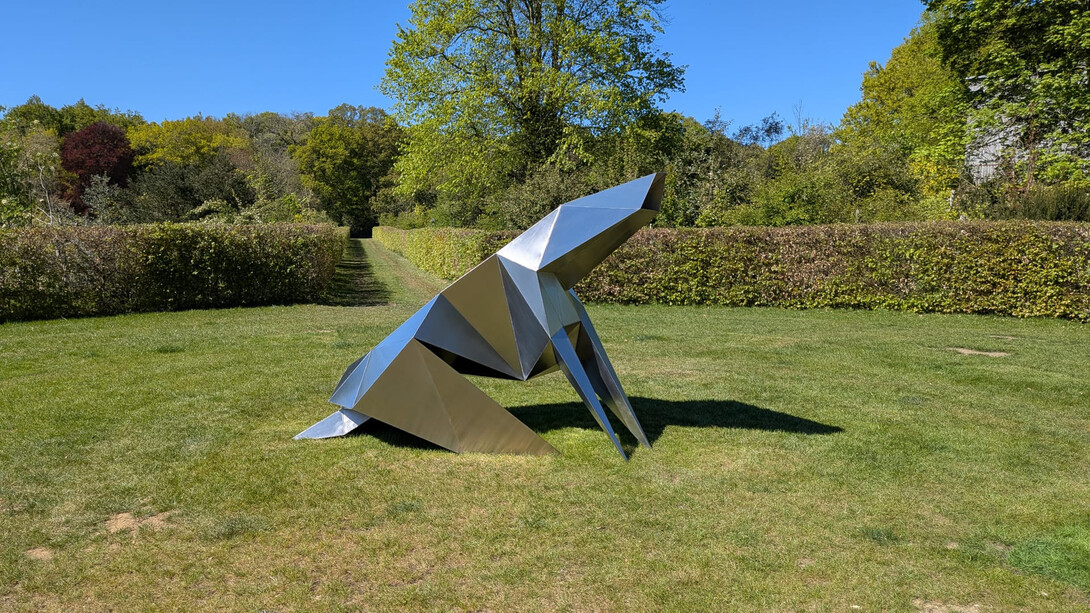
The exhibition of Lynn Chadwick at Houghton Hall arrives with the weight of both historical correction and curatorial ambition. Framed as the largest UK presentation of Chadwick’s work in over two decades, the show positions itself not merely as a retrospective but as a fundamental revision—an attempt to reposition Chadwick within the sculptural discourse of the post-war period and beyond. The challenge for narrating British sculpture/sculptors from the 1950s is always going to be how to extract them from the long shadow of Henry Moore, but the exhibition undeniably sharpens our understanding of Chadwick’s distinctive sculptural and architectural intelligence.
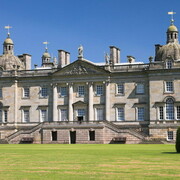
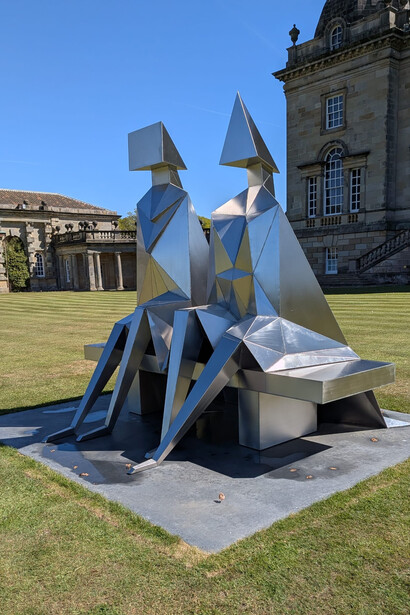
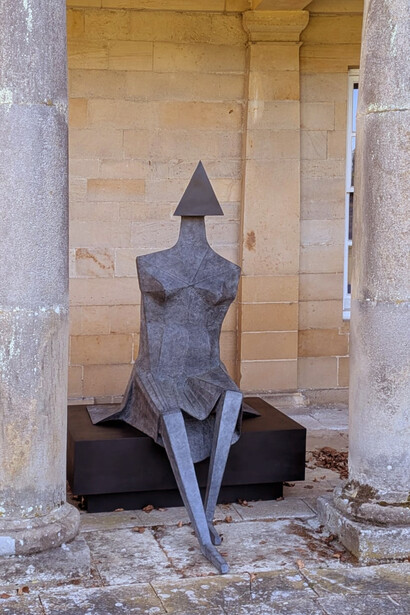
Installed across state rooms, gardens, and the gallery, the exhibition exploits the dialogic potential between the wonky asymmetry of Chadwick’s work and the Neo- Palladian architecture of Houghton. This setting is not incidental. Chadwick’s sculpture—rooted in construction, balance, and tensile force—thrives in environments where spatial relationships are legible and dynamic. His angular figures and beasts, with their spiked silhouettes and precarious poise, seem less like occupants of space than agents actively negotiating it. In this respect, the curatorial decision to distribute the works across interior and exterior contexts is particularly effective, foregrounding the artist’s sustained concern with how sculpture operates in situ. The external works benefit from and reflect the astounding light and big skies of Norfolk; the combined location and finish of the polished works lend a whole new dimension to works too often seen in stuffy collections.
Chadwick’s emergence in the early 1950s coincided with a broader shift in British sculpture away from the biomorphic naturalism associated with Moore and Barbara Hepworth. While Moore’s work retained an organic continuity with pre-war modernism, Chadwick, alongside figures such as Kenneth Armitage, pursued a more fractured, existential vocabulary. This was sculpture shaped by the psychological and material aftermath of war: jagged, skeletal, and often unsettling. Chadwick’s early "beasts", several of which are included in the Red Saloon, exemplify this tendency. Their bronze surfaces are roughened and accretive, their forms hovering ambiguously between animal and machine. They recall, at times, the iron-limbed austerity of Eduardo Chillida, though Chadwick’s sensibility is less concerned with void and mass than with balance and implied movement.
The exhibition is particularly strong in tracing Chadwick’s technical evolution. His transition from early mobiles and stabiles—echoing, though not derivative of, the innovations of Alexander Calder—to his mature welded figures is presented with clarity. Unlike Moore, who modelled and carved, Chadwick constructed. His use of welded steel armatures filled with grog reversed traditional sculptural logic: rather than carving mass from solidity, he built form outward from a skeletal framework. This method aligns him more closely with contemporaries like Anthony Caro, whose own break with modelling or subtractive processes in favour of construction, marked a decisive turn in British sculpture. Yet where Caro moved toward abstraction and colour, Chadwick retained a persistent, if elusive, figuration.
That figuration—often expressed through the motif of the couple—is a recurring thread throughout the exhibition. Works such as Back to Venice (1988), here presented in a rare disaggregated form, reveal Chadwick’s nuanced handling of relational dynamics. The figures are at once monumental and intimate, their rigid geometries softened by subtle shifts in posture and orientation. In this, Chadwick diverges from the heroic individualism of Moore’s reclining figures, instead proposing a sculptural language of interdependence and tension.
The inclusion of later stainless-steel works, installed across Houghton’s grounds, provides a compelling counterpoint to the earlier bronzes. These "beasts", with their sharpened profiles and reflective surfaces, demonstrate Chadwick’s continued experimentation well into the final decades of his career. The material itself—industrial, precise, and unforgiving—allows for a different kind of articulation. The forms are cleaner, more aerodynamic, and imbued with a sense of latent energy. In the Norfolk landscape, they appear almost anachronistic, as if relics from a speculative future rather than products of a late twentieth-century studio.
One of the exhibition’s most striking works is Ace of diamonds III (1986–1996), Chadwick’s final monumental sculpture. Installed on the main lawn, this six-metre kinetic piece encapsulates many of the artist’s enduring concerns: balance, movement, and the aesthetics of engineering. Its twin elements pivot independently in the wind, producing a choreography that is both elegant and faintly menacing. Here, Chadwick’s affinity with kinetic sculptors becomes explicit, though his work retains a gravitas often absent from the more playful idiom of mid-century kinetic art.
The exhibition also introduces Large barley fork (1975), a previously unrealised work completed posthumously. As a hybrid of beast and machine, it underscores Chadwick’s persistent interest in ambiguous forms that resist categorical definition.
Its belated completion raises questions about authorship and intention, but its inclusion is justified insofar as it illuminates the structural ambitions that underpinned Chadwick’s practice.
Contextually, the exhibition gestures toward Chadwick’s position within a broader European and British sculptural field. His 1956 victory at the Venice Biennale—where he notably surpassed Alberto Giacometti—is invoked as a pivotal moment, though the show resists over-reliance on this accolade. Instead, it situates Chadwick among a generation grappling with the legacy of modernism and the exigencies of post-war reconstruction. Artists such as Paul de Monchaux and Lesley Thornton (though working in different media and slightly later contexts) extend this dialogue, exploring materiality and form in ways that resonate with Chadwick’s concerns, even as they diverge in execution.
If there is a limitation to the exhibition, it lies in its relative insularity. While it successfully maps Chadwick’s internal development, it is less attentive to the transnational currents that shaped and were shaped by his work. The comparison with Chillida is suggestive but underdeveloped; similarly, the relationship to Caro could be more rigorously articulated. Nonetheless, these are probable curatorial overextensions rather than conceptual failures.
Ultimately, the Houghton Hall exhibition makes a compelling case for Chadwick as a sculptor of considerable originality and technical ingenuity. It reveals an artist who navigated the tensions between abstraction and figuration, stability and movement, and tradition and innovation with a distinctive and evolving vocabulary. In doing so, it invites a reassessment not only of Chadwick himself but also of the broader narratives through which post-war British sculpture has been understood.
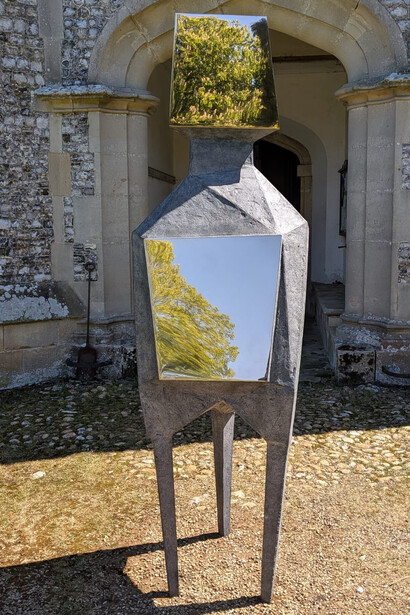
Definitely in the ‘must see’ category for visual wonder, luminosity and sense of placement. The work Square outside St Martin's Church is particularly wondrous and likely to be missed by the many.