English
 Español
 Français
 Deutsch
 Italiano
 Português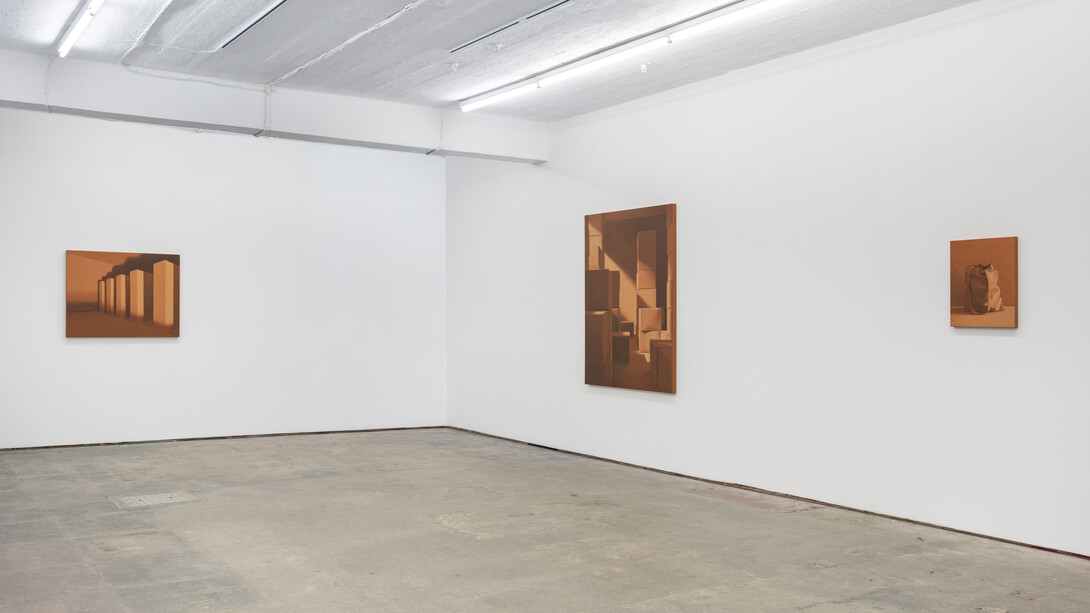
The observer of a quantum system cannot observe without drastically disturbing what he observes, and thus changes it. Therefore, he is not an observer but an actor. Moreover, no observer can know the state of a quantum system even in principle since quantum information cannot be reproduced. Quantum physics is therefore telling us that there are only actors.
(Irreducible, From observers to actors, Federico Faggin, 2024)
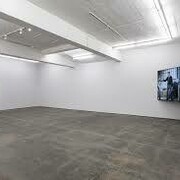
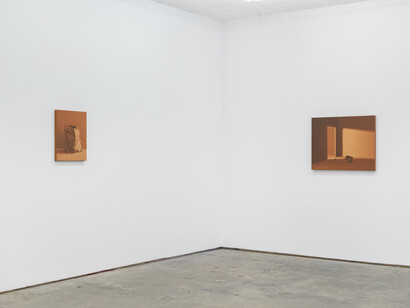
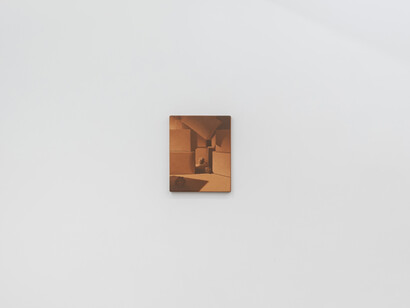
Jill Tate’s exhibition is an arrangement of painted panels, warm with earth tones and soft rounded edges. We are presented with atmospheric scenes with heavily contrasting shadows and unseen light sources. The images depict objects and scenarios that are instantly human in their concerns, a stack of empty boxes, unoccupied chairs and benches, a telephone off the hook, an upturned bowl spilling its contents. Figures though are conspicuously absent, actions or recent events are implied but it’s unclear who may have instigated them.
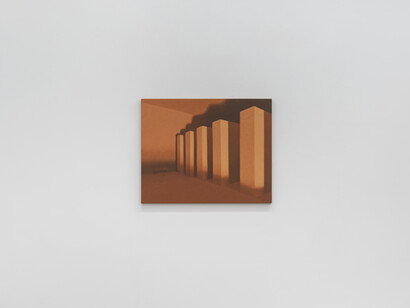
The painting Little knowledge depicts a row of five vertical blocks or columns. The columns are positioned in an orderly row, receding away from the viewer and are precisely illuminated by an unseen source out of frame. In the shadow to the left is a low bench that gives a sense of scale, making the blocks feel monumental, reminiscent of the stacks of a library, data centre or shelves of a warehouse. The bench implies that the minimalist, geometric forms describe an interior, and that interior would be inhabited at some point by people, and gives us a sense of scale. These staged spaces are idealised forms, reduced in complexity, possibly diagrammatic in nature.
Self-similar is a painting of an accumulation of cups overflowing a larger container, light pouring in from the side of the work, from what appears to be the corner of a corridor. Self-similarity is a term used to describe objects or patterns that look roughly the same at different scales, parts of the whole resemble the entire structure, like a coastline or a fern leaf or fractals. Are these repeating identical units alluding to molecular or atomic structures? Do Tate’s stacked boxes imply building blocks of matter? In this light the columns in Little Knowledge now resembles the famous pattern of photons in the double slit experiment.
Tate’s worlds are comprised of interchangeable forms, minimally depicted under a unifying principle of monochrome. The absence of figures in Tate’s scenes makes us conscious of our own presence and our role in completing these artworks, emphasis is on us the viewer, and our relationship with the painting – just as observation collapses the wave function in the double slit experiment. Tate highlights the viewer’s active role in completing the cycle of generating meaning, an active experiment between the art object, maker and the viewer.
Jill Tate lives and works in Newcastle upon Tyne, UK.