English
 Español
 Français
 Deutsch
 Italiano
 Português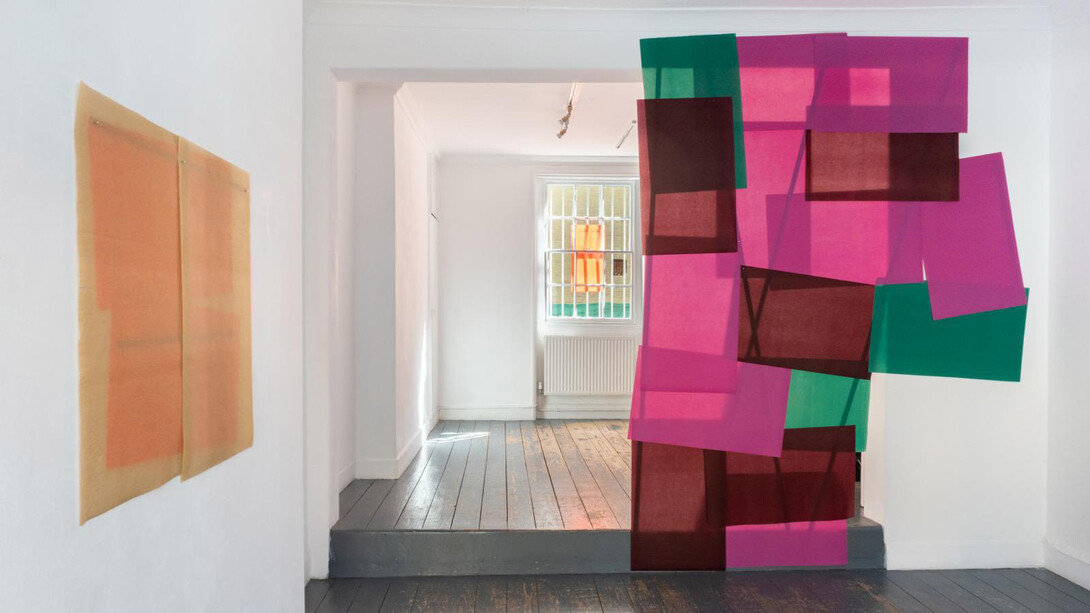
Excuse
Emily and
her Atoms
The North
Star is
of small
fabric
but it
implies
much
presides
yet.(Emily Dickinson, Envelope poem A 636 /636a)
An exhibition is, in effect, a proposition, a promise that a show will open and that the works will eventually be. How does one write about a body of work not yet invigorated by their installation? The works do exist, but not yet. They have not entered into relation with one another, there is no form of encounter to experience. To write at this moment is to attest not to composition but to components; not to the constellation, but to the particles from which the stars will be formed.
Lizzie Munn’s works currently reside in this suspended state: a material reserve of individual elements, atoms charged with potential, awaiting their eventual arrangement. Her process mirrors the beguiling paradox of Emily Dickinson’s ‘small fabric’ found floating in the corner of an unfolded envelope, message and medium inextricably linked. From the smallest weave, a feeling of vastness emerges. Here, a fragment carries the whole night's sky. Dickinson’s ‘atoms’ imply that scale is not a matter of size, but of things that are always in relation. How elements gather, how individual threads are woven. For Munn, an exhibition begins precisely here, in this heady state of assemblage.
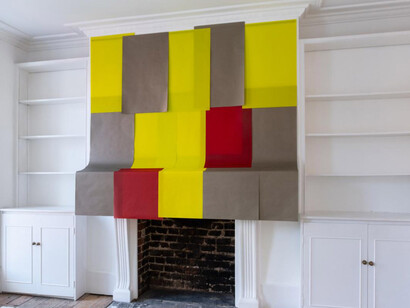
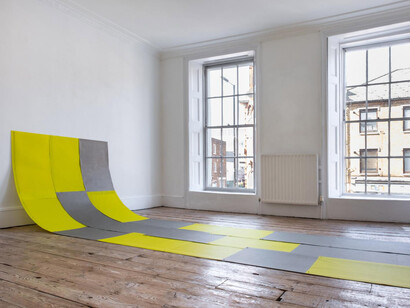
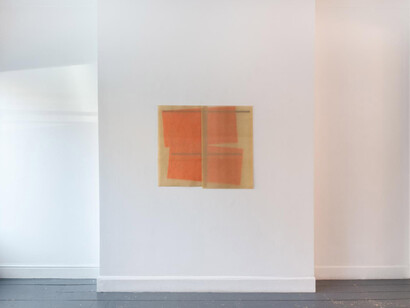
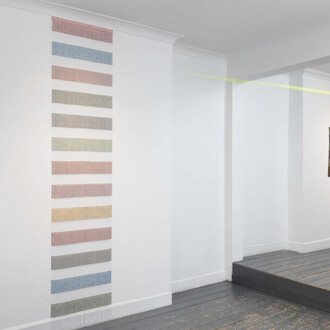
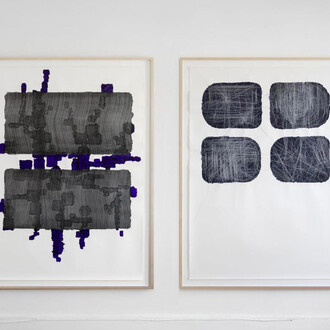
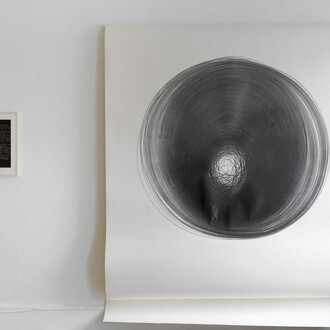
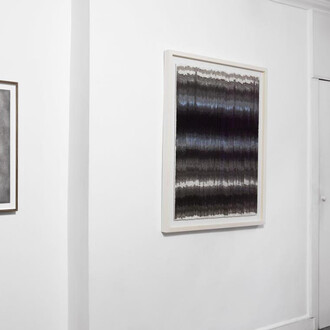
Butter-soft inks have been rolled flat, their vivid impressions imprinted onto uniform sheets. Piece by piece, each fragment is imbued with the residue and limitations of its making: the mechanical weight of the roller, the fragility of the deckled edge, and the rhythmic repetition of the process. Together they form a fabric, a weave of impressions. They are finished objects, yet unfinished in their relationship to space. Their meaning, provisional; contingent upon the parameters of Patrick Heide Contemporary Art, upon the rhythms of Church Street market beyond the glass, and the space’s memory of domesticity.
Here, Deleuze and Guattari’s notion of haecceity clarifies what is at stake. A haecceity is a singular event of relations: a season, an hour, a weather pattern. It is defined not by substance, but by a configuration of forces. A March afternoon at 6 o’clock. A draft moving through a room. These installations become precisely such a configuration: light, architecture, bodies, paper, air. Not fixed objects, but temporary in their formation. The pieces will come together and acquire volume, they will shift across the day: light altering chromatic intensity, air currents unsettling their alignment, the movement of visitors subtly activating the space. The works will not simply occupy the gallery, they will respond to it - a ‘small fabric’ implying much. For Munn, to extend printmaking beyond the fixed image and into an expanded spatial field is not simply to alter its mode of display, it is to shift the ontology of the medium itself. To magnetise prints to the window is to expose them to further contingency. Interior and exterior cease to operate as stable categories. Instead, they form a threshold across which the works continually recalibrate. This ‘small fabric’ is not merely a stockpile of parts, but a state of becoming. It names the intervals in which the work exists before and between arrangements, held in suspension, charged with accumulated potentials and always capable of becoming otherwise.
(Text by Alexander Harding)