English
 Español
 Français
 Deutsch
 Italiano
 Português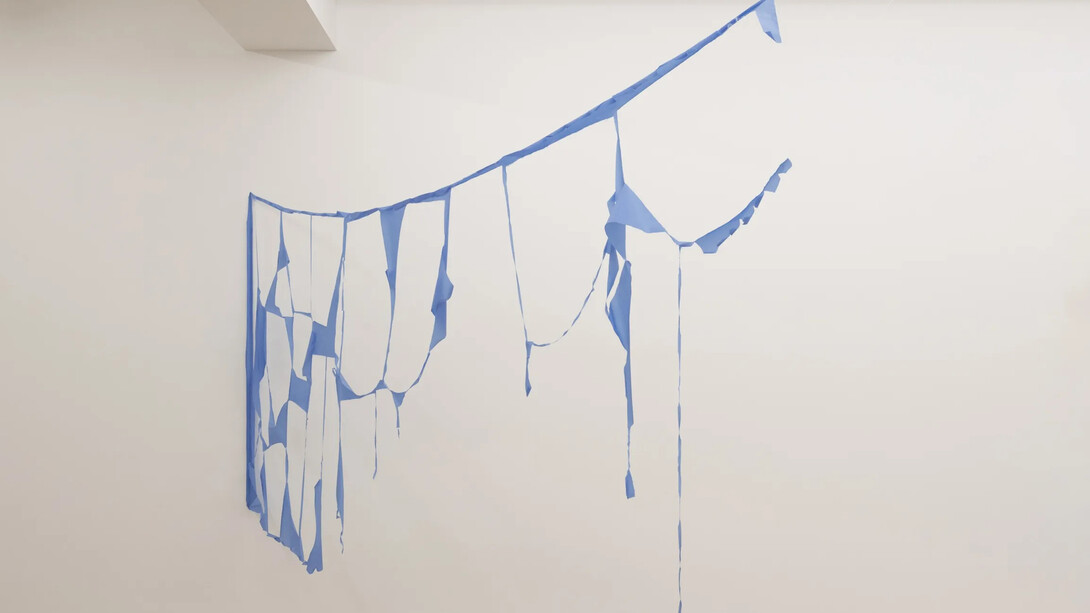
Galerie Peter Kilchmann, in collaboration with Irit Sommer (SommerContemporaryArt), is pleased to present Quel che rimane del cielo (What remains of the sky), a solo exhibition of new works by Marion Baruch (b. 1929, Timișoara, Romania). Marion Baruch is an artist whose life and work unfold across borders, languages, and artistic disciplines. Over more than six decades, she has lived and worked between Bucharest, Jerusalem, Rome, Paris, and Gallarate (Italy), engaging with social and political questions through a wide range of artistic forms. Throughout these movements, textile has remained the constant thread of her work. Often described as a pioneer of participatory art, a central figure in fiber art, and an early voice of performance-based practices, Baruch has continually reinvented her relationship to fabric, studying it, wearing it, producing it, collecting it, recomposing it, and ultimately articulating it into space.
For me, fabric is a living, pulsating material, I feel the ineffability of its breath or flow, a continuous flow that is also the flow of an entire society. Fabric reflects the history of humanity and, at the same time, the social dimension of work.
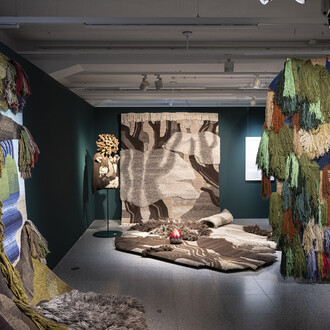
The works brought together in this exhibition illustrate the latest phase of Baruch’s work, developed since 2012, when she began collecting discarded textile leftovers from clothing manufacturing companies in Gallarate (Italy) and its surroundings. Rather than making permanent alterations to the material, the artist shapes the fabric offcuts generated by the industrial process only through her gesture and the force of gravity, shaping their voids and silhouettes – on the wall on in space – into unexpected configurations. What was once a residue of industrial production destined for disposal becomes, in her hands, the basis for a language in between sculpture and painting that reveals the poetic potential of what remains.
The machines that produce these wonderful ready-mades follow a precise programme designed to clothe the body, not to create an artistic piece. The artistic composition, the plastic poetry, is revealed through my act of salvaging these invisible scraps and rescuing them from the trash.
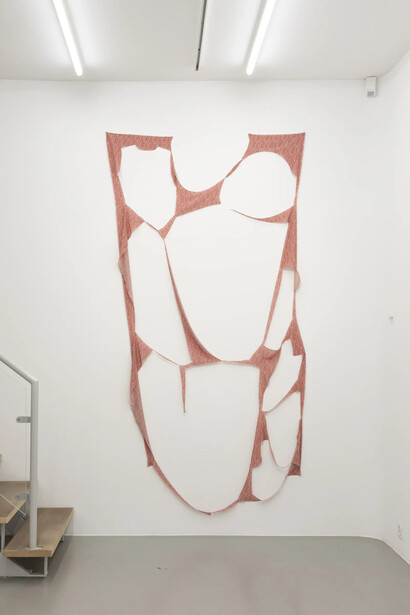
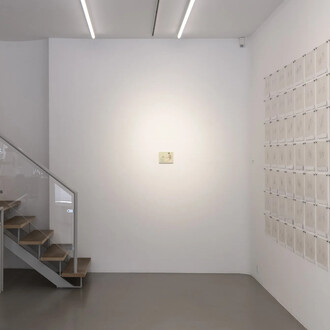
Quel che rimane del cielo (2024, Nylon, 165 x 177 cm), presented for the first time at the Loggia Palace in Brescia last fall in occasion of the festival “Meccaniche della Meraviglia”, lends its title to the exhibition. Suspended in space, the work unfolds at the threshold between object and void. The textile fragments neither enclose nor simply occupy the room; instead, they create passages, interruptions, and shifting perspectives that invite viewers to move through the work. The openings in the fabric appear like fragments of sky suspended within the gallery. In this liminal field of fragments and gaps, Baruch transforms the gallery into a space where absence, material, and language converge, allowing what remains to become the very substance of the work.
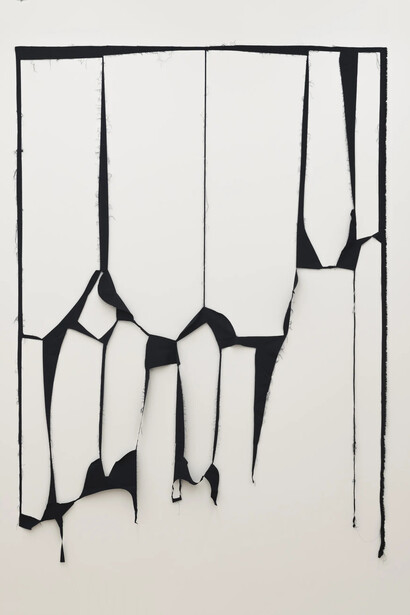
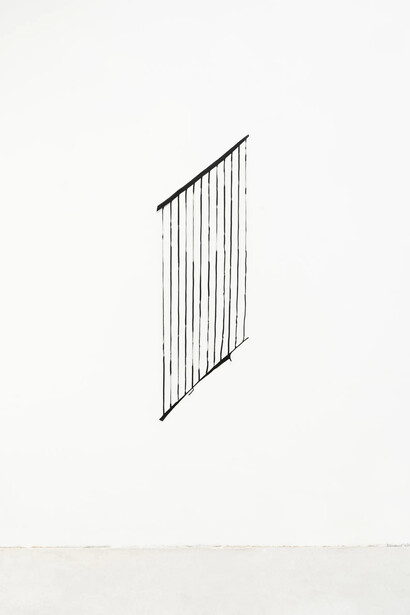
Other works on display include two Piccolo teatro pieces (2013, wool, 39 x 60 cm; cotton, 40 x 69 cm), belonging to one of Baruch’s earlier series, in which the artist uses rectangular textile scraps to create small stage-like compositions where empty space becomes the site of potential action. Witnessing the artist’s successive and intuitive explorations, Eingang (2014, Polyester, 195 x 70cm), draws on the wall an architectural opening and visual trajectories, articulating ideas of passage: an invisible door shifting boundaries between inside and outside. Déchiqueté – Squarciato (2015, Silk cotton, 190 x 169 cm) highlights irregular edges and torn silhouettes created by industrial cutting.
Across her research, Baruch moves freely between cultural references, memory and languages – she speaks seven. This reflects on the titles of the works: whether they are in German, Italian, English or French, they reveal the nature of the compositions. Often wordplays or neologisms, these are expressions that are difficult to translate; when moving from one language to another, something is always lost. Bringing together fragments of textile and language, Baruch creates new semantic constellations in which meaning emerges in the empty space, in what remains between words, materials, and forms.