English
 Español
 Français
 Deutsch
 Italiano
 Português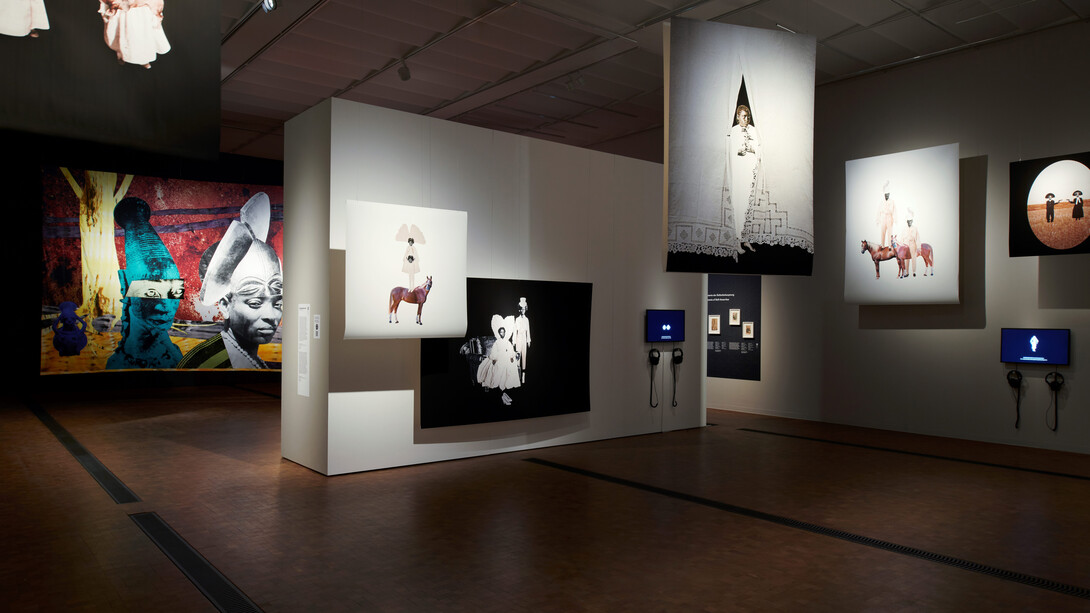
How can art help us tell polyphonic stories? What stories are concealed in historical photographs? And how have contemporary artists revealed these narratives? With A kind of paradise, Museum Rietberg presents a group exhibition that is the first to comprehensively explore this phenomenon in global contemporary art. Internationally acclaimed artists from and members of diasporas of Africa, the Americas, Asia, Australia, and Oceania have engaged with colonial-era visual material. Their works – poetic, critical, and visionary – explore how such images define identity, history, and a sense of belonging, and how they may be reinterpreted. These works reveal a healing power that transcends historical specificities and can touch us all.
Participating artists (in alphabetical order): Aline Motta (Brazil), Andrea Chung (United States), Cédric Kouamé (Côte d’Ivoire), Daniel Boyd (Australia), David Shongo (DR Congo), Dimakatso Mathopa (South Africa), Dinh Q. Lê (Vietnam), Frida Orupabo (Norway), Mary Enoch Elizabeth Baxter (United States), Omar Victor Diop (Senegal) & Lee Shulman (United Kingdom), Raphaël Barontini (France), Rosana Paulino (Brazil), Sammy Baloji (DR Congo), Sasha Huber (Switzerland), Tshepiso Moropa (South Africa), Tuli Mekondjo (Namibia), Wendy Red Star (USA), Yuki Kihara (Samoa), Zenaéca Singh (South Africa).
When we reject the single story, when we realize that there is never a single story about any place, we regain a kind of paradise.
(Chimamanda Ngozi Adichie)
A group of twenty renowned artists explore the current state of this photographic heritage across four thematic sections in A kind of paradise – Colonial-era photography in contemporary art, acting as archivists, counterpoints to the colonial gaze, protective forces, and powerful storytellers who make space for hidden stories. Formed of photographs, textiles, films, and sculpture, their collages expand the medium’s boundaries and bring together questions about their own identity and collective memories.
Shapeshifters
Millions of photos have been taken since the invention of photography – yet this heritage remains unevenly distributed. People in many places outside of Europe lack photographs which document their own past and offer answers about their origins, memories, and belonging. Without photographs, a part of their past remains hidden. The artists in the first section of the exhibition react to this absence by creating their own archives. Their works make visible that which has been passed down – and what has gone missing.
Confrontation
Colonization unfolded in tandem with the rise of photography around the world. The camera acted as a tool to depict people in the colonized world as different. Such images were reproduced en masse in magazines and postcards, becoming anchored in our visual memory. But images do more than simply shape how we see the world. They also dictate who we believe we are. The artists presented in the exhibition’s second section draw strength and resistance from these clichés. They draw on their own experiences to find old photographs, then deconstruct them and tell their stories anew.
Care
Time and again, historical photographs have depicted injustice. Around the world, cameras documented the exploitation of bodies and land. The artists shown here counteract these historical images with radical empathy. They intervene in the images and strive to protect those experiencing injustice in front of and beyond the camera. These works remind us that this past endures and its echoes can even be felt in the present.
In the photo fantastic
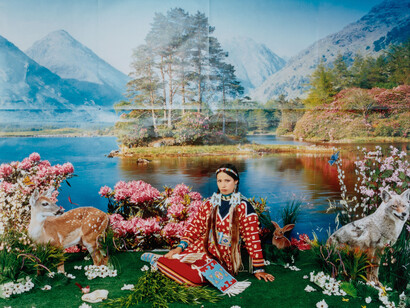
Lacunae in written history, fractures in one’s own biography, or missing information about the individuals depicted all serve as the starting point for this final section. Here, artists draw on methods of critical fabulation developed by Saidiya Hartman, where gaps in history are filled in imaginative ways. Artists engage in this speculative visual practice which builds on fragmentary historical traces and scenes emerge which blend memory and fantasy. The figures depicted take on new roles, voices, and identities. The artists are ultimately able to liberate those figures and bring them into a space full of possibilities where past, present, and future intermingle – and where, for a moment, paradise seems within reach.
Historical photographs
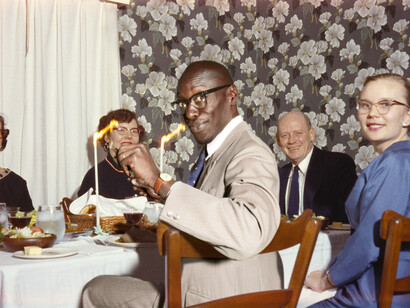
Museum Rietberg holds a vast collection of photographs taken in Africa and Asia in the late nineteenth- and early twentieth-centuries. These include ethnographic and colonial visual documentation as well as studio photographs by African and Asian photographers. These photographs are a subtle common thread running through all sections of the exhibition, and in their new works, artists have drawn on them to make visible the messages hidden in these images.
A film produced for one part of the exhibition shows the questions raised, perspectives opened, and interpretations offered by this collection. It captures key moments from a workshop held at Museum Rietberg in late March 2025, where artists, researchers, and curators studied and worked together on the museum’s collection of photographs.
In this space, visitors are also invited to reflect on their own photographs. What can pictures tell us about our history and memories? In what ways is our ability to remember shaped by viewing photographs? People from Zurich have allowed us to take a peek inside their personal photo albums, sharing their stories with us. These personal visual archives grow over the course of the exhibition, creating a new space for visual polyphony.