English
 Español
 Français
 Deutsch
 Italiano
 Português
Europe is heading inevitably towards "militarisation of foreign policy. "Security tools will be the primary driver of relations with the Middle East. Development and human rights are no longer the only issues; "security stability" is hard currency.
A comprehensive strategic vision for the future of European security and defence in light of current geopolitical changes. It goes through a deeper understanding of the tendency to shift towards "strategic independence" and then the repercussions of this on the Arab region.
Strategic pillars of the new European security
Europe is transitioning from a phase of "total dependence on the American umbrella" to a phase of "self-reliance in coordination with allies," and this can be detailed in the following points:
Increased defence spending from commitment to capability
Exceeding the 2% threshold: Defence spending is no longer just a goal in NATO but an existential necessity. The trend now is towards a "war economy" (War Economy), which aims to rebuild ammunition stockpiles, develop domestic defence industries, and reduce dependence on imported (especially American) military technology.
Industrial integration: Creating a "single European defence market" to avoid duplication of purchases, thereby enhancing spending efficiency and harmonising technical standards among EU countries.
Tensions with Russia: managing a protracted conflict
Deterrence and containment strategy: Europe’s shift to a "forward defence" strategy (Forward Defence) along the eastern borders (the Baltic States and Poland), with a permanent increase in ground forces and air defence systems.
Hybrid warfare: Preparing for cyberspace battles, securing energy infrastructure, and countering Russian disinformation campaigns makes European security more of an internal issue than an external one.
The impact of US policy: the era of "strategic scepticism"
Strategic independence: Europe is aware that Washington may shift its focus (the Pivot to Asia initiative aims to counter China, leaving a "security gap" in Europe). Therefore, the continent is seeking to develop a European "rapid response capability" independent of American decisions.
European NATO: Strengthening the "European pillar" within NATO so that Europe is able to manage crises in its immediate neighbourhood (Africa and the Middle East) without waiting for the green light from Washington.
Challenges and opportunities of the next phase
Domestically, the divergence in priorities between Eastern European countries, which are more focused on Russia, and Southern European countries, which prioritise migration issues, presents a challenge. This highlights the need for a unified European defence industrial policy as an opportunity to strengthen integration. Internationally, the fluctuating US position stands out as a major challenge, countered by the potential opportunity of Europe emerging as an independent strategic power capable of playing an active role on the global stage.
At the regional level, Europe faces challenges related to tensions in its southern neighbourhood, but this opens the door to developing comprehensive security partnerships with countries in the region that enhance stability and cooperation.
In light of this shift towards strategic independence, will you think that Middle Eastern countries will benefit from this trend to diversify their international alliances, or will excessive security dependence on Europe reduce their political flexibility?
To answer the question posed, we must look at the scene from the perspective of "geopolitics of balances," as the European shift towards strategic independence opens a window of opportunity, but at the same time imposes structural constraints on Middle Eastern countries.
Impact on relations with the Middle East
A change in European defence doctrine will lead to a reshaping of the relationship with the Middle East along two main paths:
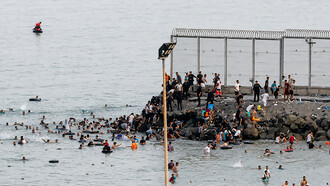
Militarisation of the borders: European migration policy will see increased reliance on defence technologies (drones, satellite surveillance, and intelligence security cooperation with transit countries).
Security cooperation with "the transit state": Europe will try to create "zones of stability" in North Africa and the Middle East, which will increase its intervention in the security affairs of these countries under the guise of "counter-terrorism" and "stability".
The energy file and the quest for political sustainability
Diversification away from Moscow: Europe will continue to rely on gas and oil from the Middle East but will demand "security partnerships in exchange for energy".
Investing in hydrogen: Europe will push for renewable energy projects in the region to secure its energy future, which means linking European energy security to the stability of political systems in the region.
Why might Middle Eastern countries benefit?
Europe's move to reduce its dependence on the United States gives countries in the region greater "room for manoeuvre":
Multiple centres of influence: In its quest for independence, Europe will seek to build direct security and technological partnerships with Middle Eastern countries, bypassing the American "filter". This means that countries in the region can purchase defence systems or sign security agreements with European countries (such as France or Germany) without necessarily being subject to Washington's rigid agenda.
Equal partnership: When Europe feels an urgent need for energy or to control immigration, it will be more inclined to offer political "concessions" or technical and developmental support to the countries of the region, thus transforming the relationship from "dependency" to a "partnership of mutual interest".
The "Western alternative" option: If the American position falters or it becomes preoccupied with Asia, Middle Eastern countries will look to Europe as a "balanced" security partner that possesses advanced technology and does not have the same "historical burdens" or sharp political interferences that American policy may cause in some issues.
Why might freedom of movement be reduced?
On the other hand, this independence may come at a high political cost:
Security as a prerequisite: Since Europe's primary motivation for engaging with the Middle East is its "internal security" (migration, terrorism, energy), any partnership will be contingent upon a strict "security approach". This could compel countries in the region to adopt security and surveillance policies that serve the European agenda of border control and migration prevention, potentially infringing upon their national sovereignty or political autonomy.
Securitisation of relationships: Shifting the relationship from "development" to "security" means that Europe will prefer to deal with "stable regimes" in terms of security, even if they lack reforms. This may tie the fate of the region's countries to fragile stability and make it difficult for them to adopt independent policies that might anger Europe (such as dealing with international powers that are rivals to Europe).
Relying on defensive strategies: If the countries of the region decide to rely on European defence industries (as part of Europe’s defence independence), they will enter into a long-term supply and maintenance cycle, making their future political decision-making restricted by European “supply chains” and software, just as it was restricted by American weapons.
Strategic summary: "calculated manoeuvring"
The impact of the European orientation is not entirely "positive" or "negative", but rather a "multiplier of opportunities and risks" at the same time:
Middle Eastern countries that possess a clear strategic vision (Such as the Gulf States or major regional powers) will benefit from this shift by "fragmenting interests"; that is, obtaining technology and security from Europe, in exchange for cooperation on energy and immigration issues, while maintaining open lines of communication with Washington and Beijing.
Middle Eastern countries suffering from structural crises. It will find itself facing a European "security coercion," where its national agenda will be side-lined in favour of an agenda of "European fortification" against immigration and crises.
Result: The region will transition from a state of "dependence to a single pole" (the United States) to one of "managing balances between divergent poles." Flexibility here will not be gained by choosing between Europe or America, but rather by the ability to link various issues (energy versus sovereignty, migration versus development), a game that demands highly precise decision-making.
Future scenarios
Pessimistic scenario: risks and collapse
Worst-case scenario: Europe is entering a "strategic recession", where increased defence spending is draining development budgets, generating internal social unrest. In the Middle East, this could transform European policy from that of a "partner" to that of a "fortress", pursuing coercive containment policies that exacerbate regional instability and fuel proxy wars.
The overlooked risks: "The complex technology trap" – relying on emerging European defence industries could lead to long-term technological dependence on immature standards, making defence systems vulnerable to hacking or supply chain disruptions.
Reasons for failure: Internal European fragmentation (divergent visions between France, Germany and the Baltic states) could thwart any independence, leaving the region facing a "leadership vacuum" that other international powers (such as China or Russia) would exploit more aggressively.
Optimistic scenario: opportunities and prosperity
Best results: The rise of Europe as a balancing power (Balancer) is a genuine break from bipolar hegemony, giving Middle Eastern countries the opportunity to build “security for technology” partnerships free from American ideological and political interference.
Available opportunities: Exporting "security expertise"; Middle Eastern countries can play the role of strategic partner in energy security (hydrogen) and maritime security files, making them an integral part of the European national security system and not just a recipient "neighbourhood".
Success factors: The formation of strong regional blocs by countries in the region that negotiate as a single bloc with the European Union imposes "parity" in military technology transfer deals and investment in local defence industries.
Pragmatic scenario: results and reality
The most logical decision: Treating Europe as a "multi-dimensional tactical" partner, not a "sole strategic ally".
Practical steps
Military diversification: Acquiring European defence systems (to reduce dependence on Washington) while ensuring that maintenance and software are localised.
Economic linkage: Linking any security cooperation with Europe to investment programs in renewable energy infrastructure to ensure a sustainable European interest in the stability of the region.
What should be postponed: Any attempts to adopt "decisive security positions" that are biased towards Europe in its conflict with Russia, and to maintain a distance of positive neutrality.
Timeframe landmarks
Foundational stage, and it begins": A legal and technical review of all current defence contracts with Washington, identifying gaps that European companies could fill.
A contractual phase and its witnesses: Launching "joint energy security" initiatives that link European supply security to investments in local defence manufacturing in the region, conditional on "advanced technology partnerships" (cyber-security, AI, drone tech).
Coordination phase: Activating the "Arab Committee for Energy and Security" to exchange information on European security policies and prevent any attempt at individual security blackmail., and Establishing direct intelligence communication channels with the "European pillar" of NATO, to overcome dependence on the US administration in assessing regional risks.
The dilemma of regional coordination bears a profound question
Do the countries of the region have the political capacity to coordinate amongst themselves to form a "negotiating bloc" with Europe, or will regional competition make each country an easy target for European security bargaining?
The direct and shocking answer is: at the moment, the countries of the region do not have the ability (or the will) to form a unified negotiating bloc.
The reality is that regional competition, conflicting economic agendas, and varying degrees of security ties with both Washington and Beijing make the region an "individual importer" of security rather than an "active bloc".
Europe is well aware of this vulnerability and deals with each country according to a specific security "measure" that serves its interests in immigration and energy. Continuing this fragmentation means that the countries of the region will be mere "security zones" for Europe, not "partners" with it.