English
 Español
 Français
 Deutsch
 Italiano
 Português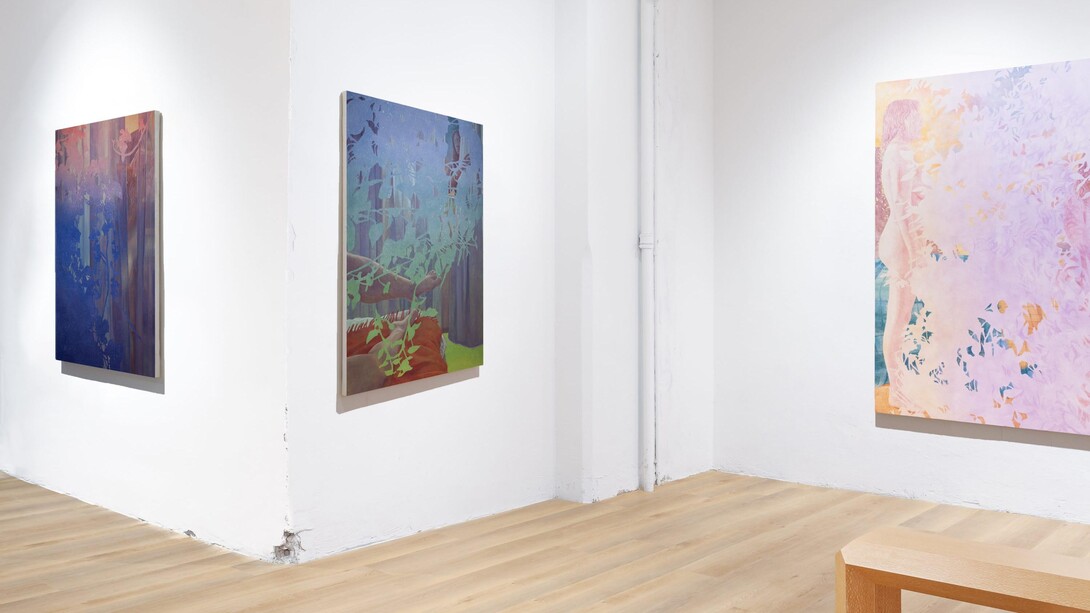
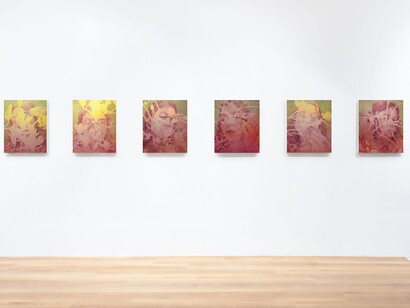
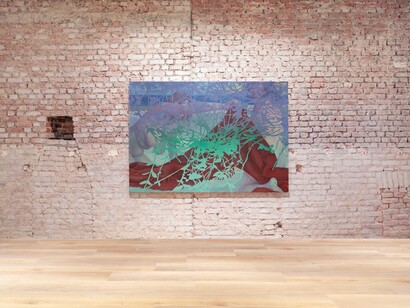
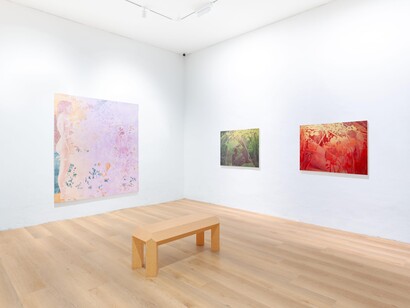
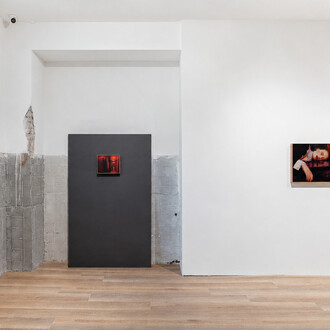
Linfa is Martina Cinotti’s first solo exhibition with LUPO. Conceived around the image of sap as an invisible yet essential force, the exhibition presents a new body of paintings in which the body does not appear as a finished form or an object of contemplation, but as an organism traversed by processes. Fragmented, immersed, at times screened by vegetal elements or enveloped by water, Cinotti’s figures are conceived as permeable surfaces and spaces of transition, where interior and exterior, presence and disappearance, remain in constant exchange.
The artist’s research focuses on suspended states: the moment before emergence, awakening, the drying of water on the skin, blooming, or fading. Hers is a painting that inhabits the threshold, attending to that unstable phase in which identity is not yet fixed but still in the process of becoming. Rather than presenting the body as something resolved or fully visible, Cinotti approaches it as a site of passage, a form shaped by exposure, absorption, and transformation.
In silent dialogue with the tradition of the Western nude and with the politics of the gaze, Cinotti shifts attention away from the body’s surface toward its organic and temporal dimension. The works resist the logic of the image as spectacle, redirecting perception toward what is slower, less declarative, and more elusive. What emerges is not the image as object, but the image as process, something that forms gradually and remains open.
Sap, invisible yet vital, becomes both a conceptual and material key to the exhibition. It flows beneath bark and beneath the skin, sustaining growth while holding together nourishment and loss, memory and the present. In Cinotti’s paintings, this condition takes form through transparent glazes that do not conceal but settle, allowing the image to build through accumulation, sedimentation, and delay. Light is never merely descriptive, but acts upon the painted surface with a quiet insistence, as if the work were slowly surfacing from within.
Linfa ultimately conceives painting as a space of silent transformation, an inward embrace. It is a place where the body is less a stable image than a field of passages, and where visibility itself is understood as gradual, permeable, and unresolved.
(Text by Martina Cinotti)