English
 Español
 Français
 Deutsch
 Italiano
 Português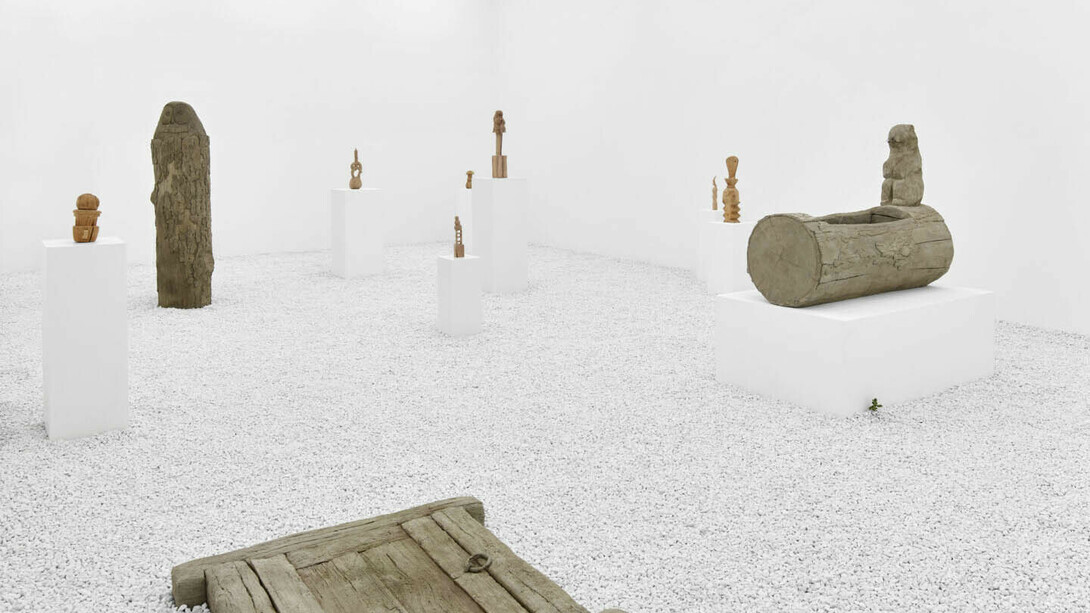
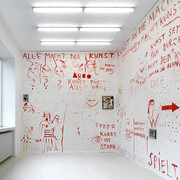
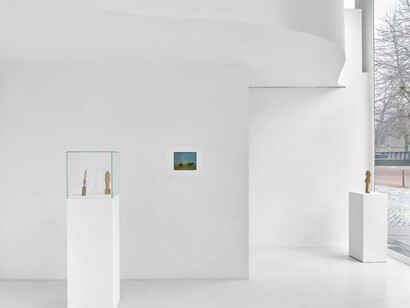
Sies + Höke is pleased to present Kuriosität, the first solo exhibition of French artist Laurent Le Deunff at the gallery. Bringing together new and recent works, the show is driven by a simple, insistent question: what are we really looking at?
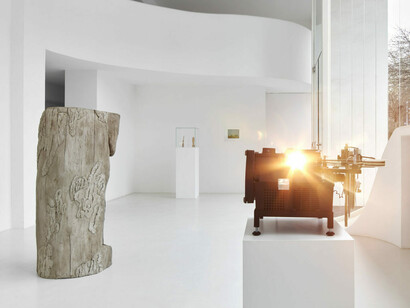
The title points to the cabinet of curiosities, where objects hover between knowledge and fascination. Le Deunff’s sculptures can read as specimens: discovered yet carefully staged, as if set inside a diorama. That atmosphere is sharpened through a dialogue between two materials—real wood and fake wood—so technique becomes a tool for perception, not merely display.
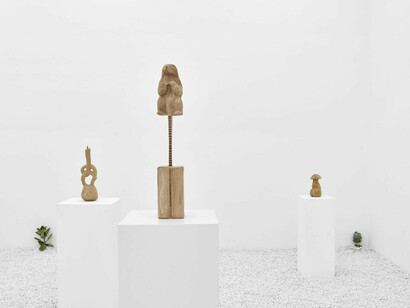
A central group is carved from single tree trunks. Le Deunff works alone, by hand, starting from logs gathered in the forests around Bordeaux. He marks each trunk with charcoal, dividing it into three sections. He then begins without deciding what the next section will become. One form leads intuitively to another in sequence, creating a contemporary, studio version of the Surrealists’ cadavre exquis method. Each sculpture stacks three distinct parts, one on top of the other, uniting animals, plants, and objects in totem-like compositions.
Their titles preserve the names of the trees used. Works such as Aulne (alder) or Cèdre rouge (red cedar) point back to the source material and underline that each trunk carries its own history. Diversity is essential: different woods have different grain, density, and colour, which shape both gesture and scale. A smaller trunk demands compression; a larger one allows for breadth. Seen together, the carvings evoke a “forest” inside the gallery, made of singular trees rather than an abstract idea of nature.
Le Deunff is also drawn to techniques linked to arts and crafts and to decorative artifices. Early on, he gravitated toward collage and papier-mâché, treating craft not as embellishment, but as a visual strategy. Alongside the solid-wood sculptures, he presents works made using rocaillage and rusticage, decorative techniques popular in nineteenth-century France in which concrete is carved to resemble wood. The process begins with an iron armature, built at full size and modelled after familiar forms. Two coats of cement mixed with sand and latex dry slowly, allowing the artist to work into it with knives, brushes, and other tools. Rather than imitating wood, he reproduces its logic of cuts, ridges, and knots, so the surface holds the memory of carving.
(Text by Nicolas Vamvouklis)