English
 Español
 Français
 Deutsch
 Italiano
 Português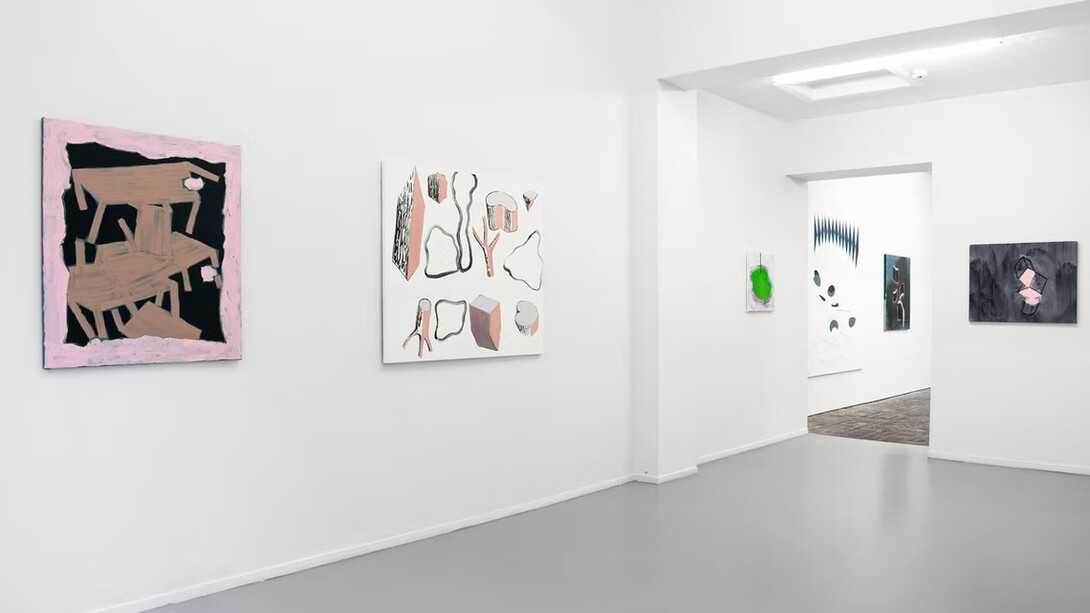
Giving a painting a title is never a trivial matter. It is said that in Belgium, René Magritte preferred to entrust the task — and the responsibility — of naming his new works to friends during lively evening gatherings. Naming an entire exhibition makes the exercise even more complex. One needs a word that attracts, that suggests, that perhaps even amuses, without saying too much. A word capable of clothing the whole without confining it.
The expression “Made in” emerged at the end of the nineteenth century within the framework of the Merchandise Marks Act, adopted in Great Britain in 1887. Its purpose was to mark (and above all distinguish) imported goods, often German, considered cheap and competitive. The fate of those two words is well known: from warning they became promise. What was meant to stigmatize gradually turned into a mark of quality. Economic history sometimes has a sense of irony.
Art history, too, is fond of geographical attachments. Venetian vedute find their counterparts in Spanish bodegones and Dutch seascapes. Belgian art, younger than that of some of its neighbors, nevertheless asserts a distinctive tone: often rebellious, sometimes surreal. From Antoine Wiertz to Jef Geys, by way of James Ensor, Félicien Rops, René Magritteand Marcel Broodthaers, one detects a taste for displacement, irreverence, and freedom of spirit.
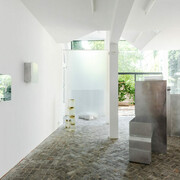
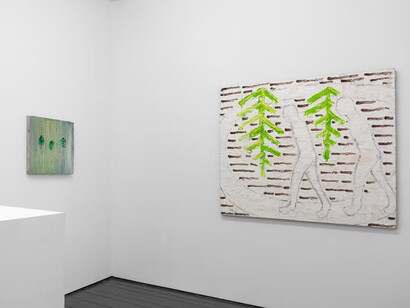
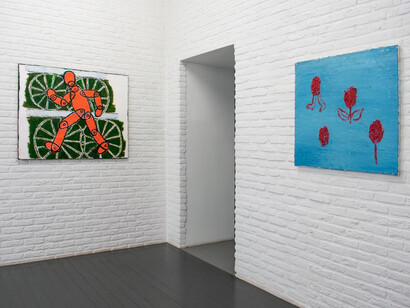
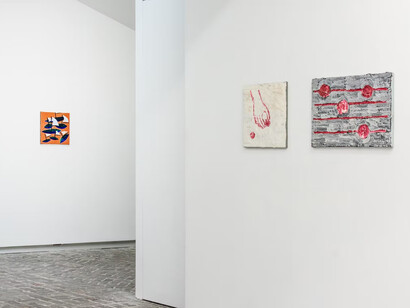
Born in the Netherlands but having spent most of his life in Belgium, Thé van Bergen can therefore claim this adopted belonging, not without a touch of mischief. Stamping his works in the colors of the Belgian flag is not merely a playful gesture; it is also a way of embracing a territory of invention, at a time when some once again dream of borders and labels.
And then there is the visitor. He or she sometimes looks for keys, reference points, an explanation to guide the eye. But are so many words truly necessary in order to see? Painting may ask only for a certain openness: to accept matter and form, their appearances and disappearances, without immediately trying to translate them.
From there on, it is for each person to invent their own words. All are welcome, even the most unexpected, for it is not impossible that the painter himself may discover, in these echoes, something he did not yet know about his own work.
So listen to Thé van Bergen in the silence of his images. Or, should you meet him, in his enthusiastic and voluble account. For he continues, with undiminished energy, to explore a colorful and shifting world where motifs appear, disappear, and return — a world that seems to come from everywhere and nowhere at once.
(Text by Simon Delobel)