English
 Español
 Français
 Deutsch
 Italiano
 Português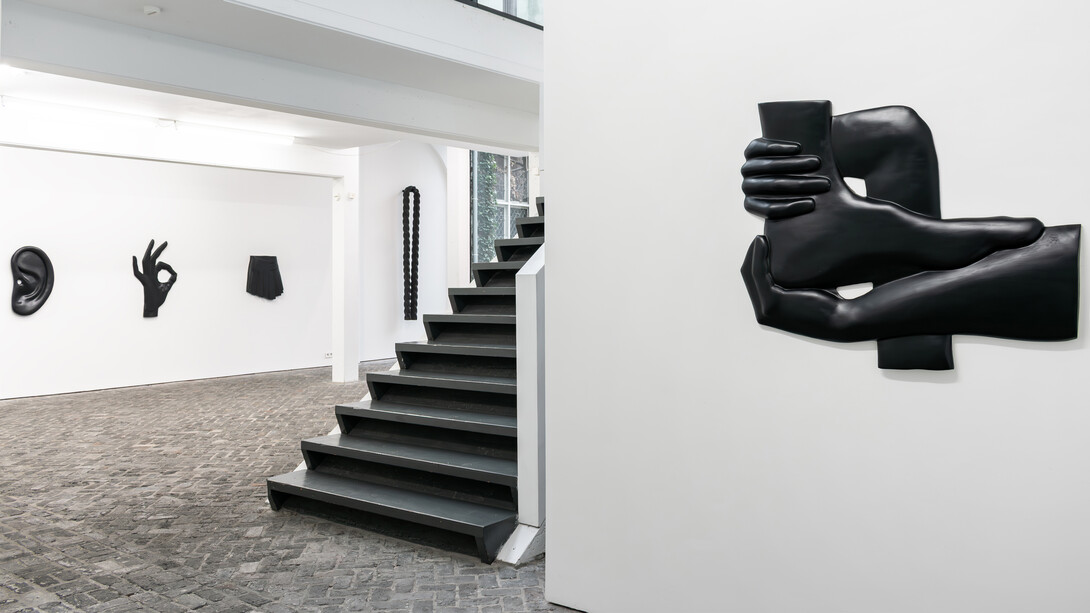
Reader.
At the centre of this exhibition by Paul Casaer stands a work entitled Le nœud de Balthus – Balthus' knot. Few know that Balthus earned a place in fashion history with a tie knot he invented himself, and few are familiar with Balthus' reputation as an artist. That doesn’t matter. All that counts here is the knot.
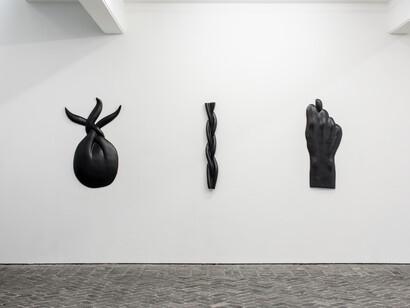
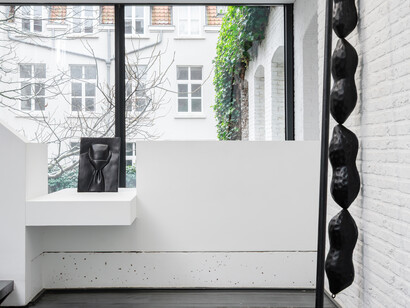
Balthus' knot shortens and thickens the tie. To achieve this, Balthus tied no less than four knots on top of one another. The result is almost clownish: this tie is worn with confidence. With personality. Balthus' knot is as a bas-relief on the body: a statement by the wearer, who is also its creator. Paul Casaer's statement is this bas-relief in which the body disappears almost entirely: no head, no torso, no arms and legs. Only that piece of the mannequin's neck. Then that knot becomes a noose –Balthus' noose.
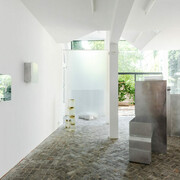
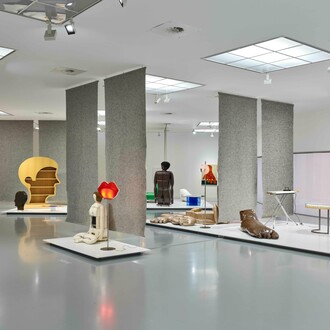
Paul Casaer makes his bas-relief in wood, painted black, just like the other works in this exhibition, which goes by the name Lexicon. A lexicon is a list of words. Each work in this lexicon carries a meaning, like a word. All of these works together tell a story (sooner or later).
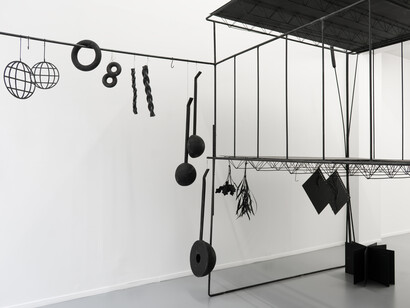
In the side room is a work made of metal, also painted black. There the title is Studiolo. This is an old Italian word for a study room. You can see the studiolo from the streetwindow, just like you can with the kitchen – the chef's laboratory – in the restaurant a little further down the road. You can also find it in the intarsia – the inlay work in wood – by Francesco di Giorgio or in the paintings by Vittore Carpaccio and Antonello da Messina, each depicting a saint surrounded by his tools: an open book, a compass, a candlestick. In Paul Casaer's Studiolo, all objects are made from standard metal plates. He uses them as existing letters in a system. This is completely different from the images in Lexicon, which were all carved from wood by the artist. If these new images form words in a lexicon, then the instruments and objects in the study are the grammar. If the bas-relief is the image, then the studiolo is the back room. The key to the work is behind the wall. The studiolo and the lexicon: the back and the front; the hard metal and the soft wood; the rational and the sensual; the work and the result.
Lexicon collects fragmented bodies in search of context: hands, a foot, legs, an ear, braids. A skirt: that you find around yet another bodypart– as context. Each object is headless, sexless, eyeless, detached from the body. Each piece in Lexicon leads to another piece. These are not randomly chosen body parts. A willing eye can reconnect them without too much effort to Balthus, the painter of intimacy, desire, and uncanny tension. The action lies beneath the surface. In what is not shown. In the suggestion – the part of the body we do not see.
From the knot to the skin. From the clothed, the finish, to the unclothed, where the outfit begins. From what is on the clothing to what is underneath. From the robust to the vulnerable body. One cannot exist without the other.
Sometimes the scale of the images corresponds to reality: the knot, the legs, the sourdines, the soap. Full stop. Sometimes the images are slightly too large: the skirt, the boot. Exclamation mark. Sometimes much too large: the hands, the ear, the braid, the peanuts. Question mark.
Next to Balthus' knot, another work leads to the exotic world of another misguided artist friend of Paul Casaer: Paul Gauguin. That work is called Donkey milk. In the (black, wooden, bas-relief) leaves, in which the willing viewer recognises the flora of the French master's Tahitian period, there is a protruding quadruple holder for white donkey milk soap (donkey milk: Cleopatra bathed in it to rejuvenate herself). Those four pieces of soap placed one above the other seem as grotesque as the quadruple tie knot next to them.
At the very top, the exhibition seems to culminate in a muffled climax. Four sourdines continue to play with themes from the work: the girlish, the familial, the isolated, the verbalised and (the fifth sourdine, separate in the desk) the feeling.
These are the images and artists that haunt Paul Casaer. Fetish images. That semi-glossy surface (of the tie, that skirt, those boots) looks like polished leather. The material conveys a quiet power that is also reflected in the not-quite-black black of this suggestive lexicon. It is reminiscent of Casaer's earlier work. Work such as The picnic, for example, created a good twenty years ago, with those innocent white caps on the heads of the young exotic girls in short white skirts, short red blouses and long white stockings under fluttering white suspenders. Once again, this work touches on controversy without being controversial. Once again, this work fits into traditional genres without being traditional. The seductive freedom of childhood comes across as a melancholic longing, a search for lost happiness.
Reader. Caress these wooden sculptures with your eyes. Place your senses in the artist's hands and think of the patient sawing, milling and sanding of these sculptures. Consider how the technique of bas-relief, with its shallow depth, requires visual adjustments that make the image realistic again. It is the movements of his hand and his tools that help determine the curves and contours. Think of the bond between the work and the artist in conceiving, realising and exhibiting these sculptures. Feel the nuances in the paint layer as painstaking work with brush and sandpaper.
Reader. Come and take on this work with the same shamelessly bold daring, curiosity and overconfidence, and with the same sense of wonder. View it as a riddle, straight up. Look at it like Balthus, like Gauguin, like Casaer – like a grown-up child.
Be yourself.
(Text by Pieter Van Bogaert, 2026)