English
 Español
 Français
 Deutsch
 Italiano
 Português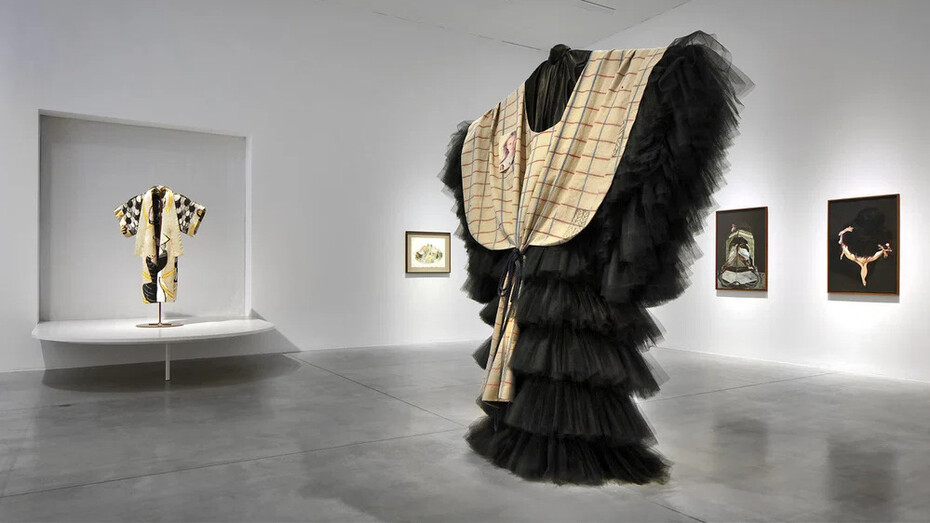
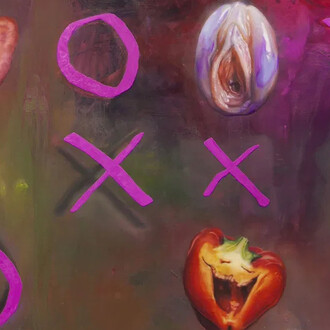
Valérie Mannaerts’s multifaceted oeuvre departs from intuition, materials and sensory experience. Through hybrid works, she questions the forms and properties of things and examines themes such as metamorphosis, identity and physicality, drawing on feminist theories. Her work is layered, amorphous and flexible. She explores questions such as: what is the autonomy of an object? What story can an object tell? When do the organic and the inorganic intersect? Her work resists unambiguous interpretations and predetermined norms and boundaries. It remains in a state of constant transformation and movement, balancing between representation and abstraction.
In the late 1990s, Mannaerts made her debut with works on paper in which she explored her own body and sexuality. She followed in the footsteps of female artists from the 1960s and 1970s, such as Eva Hesse, and developed a distinctive and adventurous visual language rooted in amorphousness. In 2003, Mannaerts represented Belgium at the Venice Biennale, alongside artist Sylvie Eyberg. She subsequently expanded her artistic practice to include sculpture.
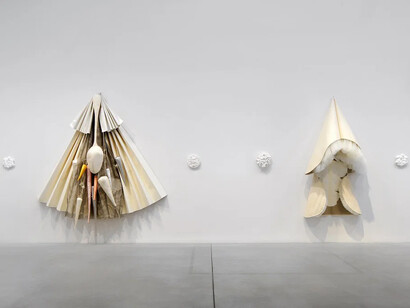
Mannaerts explores the visual language of sculpture and its boundaries, driven by a deep fascination with the notion of metamorphosis. When does an object become a sculpture? How does a sculpture relate to the pictorial plane, space and the viewer? In this context, sculpture manifests itself not as a fixed object, but as a process of constant transformation.
This focus on sculpture deepened her interest in architecture, spatiality and the relationship with the human body, leading to installations, paintings, textile works, kimonos, functional objects and projects in public spaces that engage directly with their surroundings.
In Antennae, Mannaerts looks back on thirty years as an artist while also presenting new work. The title of the exhibition is telling. On the one hand, Mannaerts uses it to refer to the antennae with which insects sense their surroundings. At the same time, it functions as a metaphor for her own artistic sensitivity: a reference to the ‘antennas’ with which, as an artist, she establishes subtle and complex connections between her world, her work, the viewer and the exhibition space.
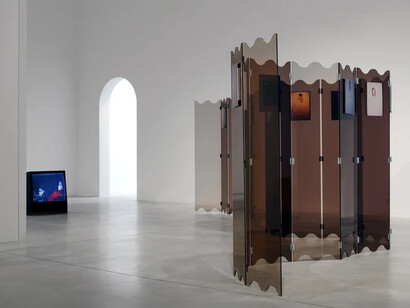
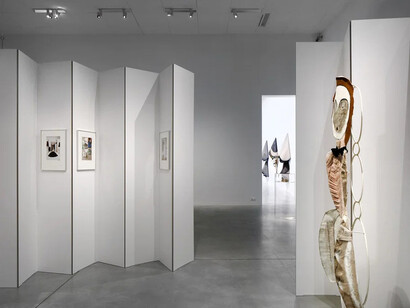
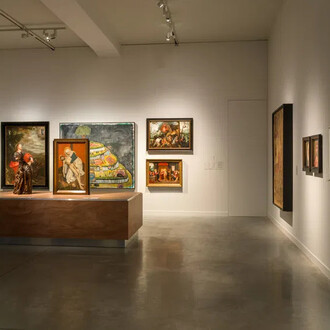
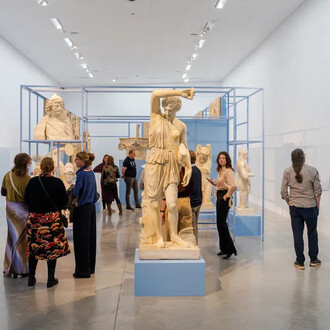
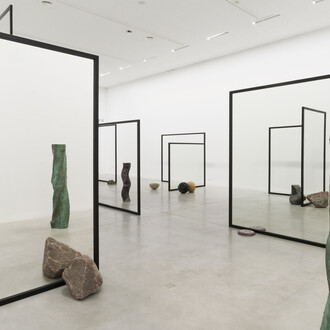
A sharp and contemporary picture of Mannaerts’s practice unfolds across five galleries. The first gallery explores the tension between painting and sculpture. In the next room, the focus shifts to the human body – a body capable of carrying and generating meaning through clothing, which is akin to a skin. The third room functions as a kind of outdoor space: a monumental woven garden that unfolds as a panorama of a personal place. In the final two rooms, the focus turns inwards, once more, to the interplay between the private and the public. The exhibition culminates in a new installation in which Mannaerts explores the position that artistic practice can occupy today.