English
 Español
 Français
 Deutsch
 Italiano
 Português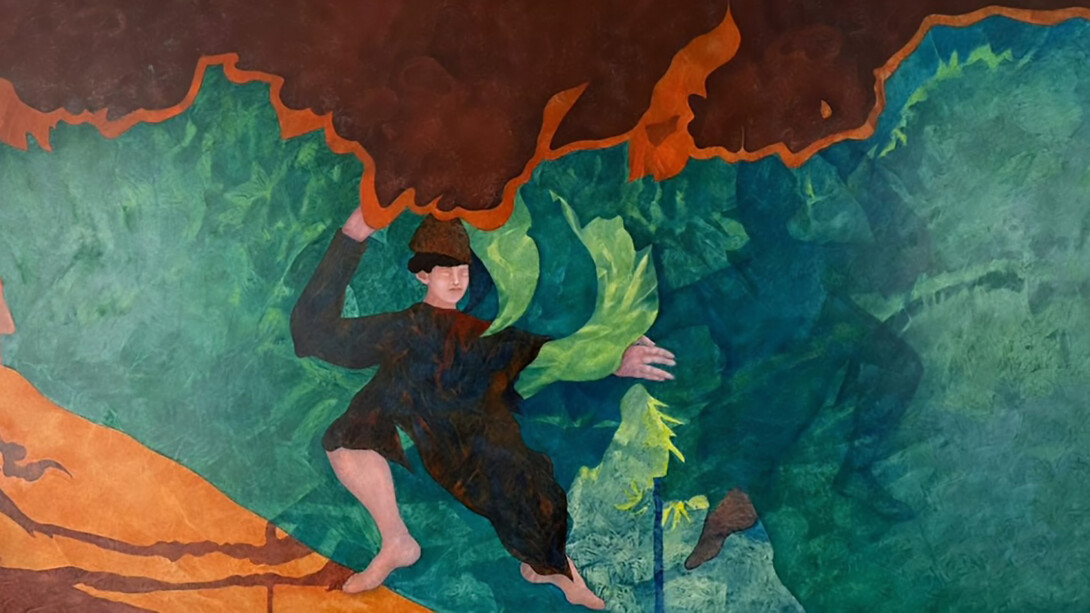
Agostino De Romanis (1947–2025) was an artist who knew how to blend the rigor of his traditional Italian art training with the spiritual exoticism of the Orient and the South Seas. Regarded as one of the leading exponents of the “Pittura Colta” (Cultured Painting) artistic movement, his work is a journey through myth, nature, and introspection, while his career is a fascinating path that winds through well-defined theme "cycles," the most significant of which explores the vibrant spirituality of the islands overlooking the Pacific “ring of fire." Sadly, he recently passed away, leaving behind an artistic legacy that continues to be celebrated by renowned critics and in exhibitions held in important institutional venues. Many of these works are housed in prestigious locations, such as the Rudana Museum in Bali, the Erice Foundation in Sicily, and a number of churches.
Background: from Velletri to the Orient
Born in Velletri, one of the seventeen "Castelli Romani" (Roman castle towns), De Romanis trained as a set designer at the Academy of Fine Arts in Rome. This theatrical background is fundamental to understanding his works—his canvases are not just images but actual “spaces” where light and figures interact in a dramatic and poetic way.
In the 1980s, he joined the “Pittura Colta” (Cultured Painting) artistic movement coined by critic Italo Mussa in the context of postmodernism as a counterpoint to the “Transavanguardia” movement. This group advocated a revival of technical skill and of mythological subjects, in contrast to the conceptual trends of the time. During this period, De Romanis' works represent an “introspective journey” by the artist, where inner torment finds peace in the spirituality of nature.
Love for the Orient and Polynesia
Although De Romanis is often associated with the Indonesian island of Bali, where he lived for a long time, his research spanned the entire Pacific and Indian Oceans, including Polynesia.
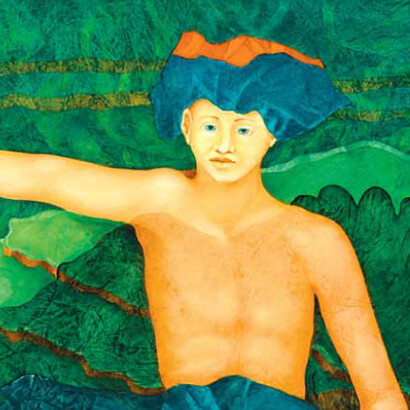
Like the French painter Paul Gauguin before him, De Romanis sought in these places untainted people and unspoiled nature. His Polynesian and Indonesian works are not mere landscapes but spiritual visions. His paintings explore sacred themes, the relationship between man and nature, and dreams: hieratic figures, temples nestled in the jungle, and rarefied atmospheres are the recurring protagonists of his pictorial cycles.
Technique between tradition and innovation: oil painting on paper laid on canvas
Technical expertise is the trademark of this artist from Velletri. His painting is highly refined because he masterfully reinterpreted the secrets of the great masters of the past.
One of his favorite techniques was oil painting on paper laid on canvas. The use of paper mounted on canvas allowed him to achieve the unique luminosity and vibrant texture that oil applied directly to the canvas would not allow.
His color palette is saturated with light and color, bright, and almost hypnotic. The light does not come from an external source but seems to emanate from within the objects and characters, creating an effect of "cosmogenesis," i.e., a world being born. His shapes are fluid, while his soft, sinuous brushstrokes are capable of rendering the evanescence of dreams and the density of tropical air.
Henotheism and the “Indonesian and Polynesian” period
For the Maestro born in Lazio, Indonesia, Polynesia, and the Orient were not tourist destinations but states of mind. His works are not simple landscape views but rather “transfigurations” of symbols and myths encountered in over thirty years of research.
In his creations, these places become symbols of a lost harmony. His art is an invitation to look “beyond” the physical surface of the world to touch the invisible and divine dimension that inhabits it. It is in his years of maturity when his encounter with the Orient radically transforms his palette: colors become warm and "tropical," and nature becomes ubiquitous.
His most significant inspiring places are:
Bali: The island of ‘a thousand temples,' where he lived and worked for a long time, celebrating its everyday spirituality;
Sulawesi (Tana Toraja): The exploration of rituals connected to life and death;
Siberut and Nias: The fascination with ancestral and primitive cultures, where time seems to have stood still;
Java: The splendor of monumental complexes and the harmony between man and the divine.
Major exhibitions
Rediscovering Indonesia, 2003-2004, is a significant exhibition project (with valuable catalogues edited by Vittorio Sgarbi and published by L'Erma di Bretschneider) aimed at strengthening the cultural ties between Italy and Indonesia. The exhibitions of the painter from Velletri were held in Rome, at the Museums of San Salvatore in Lauro, in 2003; Jakarta, Gedung Arsip Nasional, National Archives Building of the Republic of Indonesia, 2004; and Bali, Rudana Museum, Ubud, 2005, where some works from the cycle became part of the museum's permanent collection. This series of exhibitions earned De Romanis the reputation of ‘the Italian of Bali.'
Subsequently, we have the following major exhibitions where his Indonesian paintings in particular were displayed:
Vittorio Sgarbi, Agostino De Romanis. Il pensiero dipinto (Agostino De Romanis). The Painted Thought). La forza mistica del mondo orientale (The mystical power of the Eastern world), with an essay in the catalogue by Roberto Luciani, entitled “L’Indonesia e il suo infinito florilègio” (Indonesia and its infinite anthology), Chamber of Deputies, Complesso di Vicolo Valdina, 8–21 February 2012, exhibition catalogue published by Terzo Millennio, Cisterna di Latina 2012.
Roberto Luciani, De Romanis a Santa Maria dell’Orto, Church of Santa Maria dell'Orto in Rome, 20 November - 4 December 2016, exhibition catalogue published by Editrice dei Merangoli, Rome 2016.
Roberto Luciani, Agostino De Romanis per Anzio Imperiale, City of Anzio, Archaeological Museum of Anzio, 14–27 April 2019, exhibition catalogue published by Accademia Nazionale d’Arte Antica e Moderna, Rome 2019.
Roberto Luciani, De Romanis. L’arte incontra i sogni (De Romanis. When art meets dreams, Museums of San Salvatore in Lauro, Rome, December 2020 - March 2021, exhibition catalogue published by Il Cigno GG Edizioni, Rome 2020.
The master passed away on 13 March 2025, just a few months after the opening of a major exhibition celebrating twenty years of his work (2003-2023), which revisited many themes relating to Indonesia, light, and the inner journey:
- Marco di Capua, Nella natura la luce dell'anima (In Nature, the Light of the Soul), Vittoriale degli Italiani, Gardone Riviera (Brescia), Villa Mirabella e Museo d'Annunzio Segreto (MAS), 25 maggio - 30 settembre 2024, catalogo d'esposizione pubblicato da Il Cigno GG Edizioni, Roma 2024.
One of the most authoritative biographies is De Romanis pictor, edited by Antonio Venditti, with an introduction by Roberto Luciani, Palombi Editori, Rome 2015.
The two ‘symbolic’ works
It is estimated that the master created about three hundred works dedicated exclusively to Indonesia and the East, but some stand out for their iconographic, symbolic, and technical qualities.
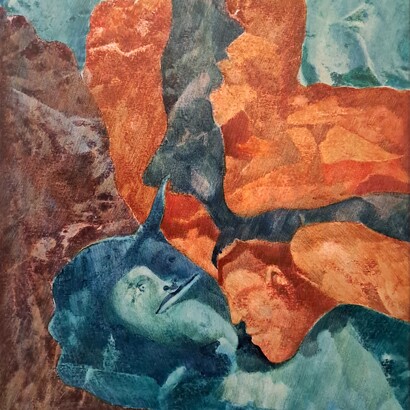
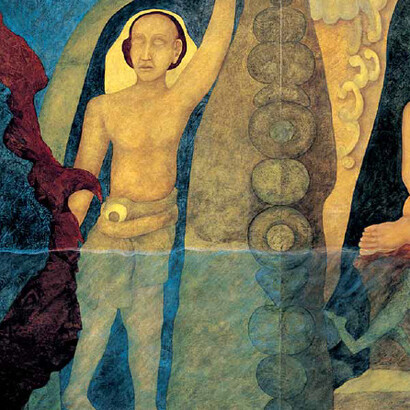
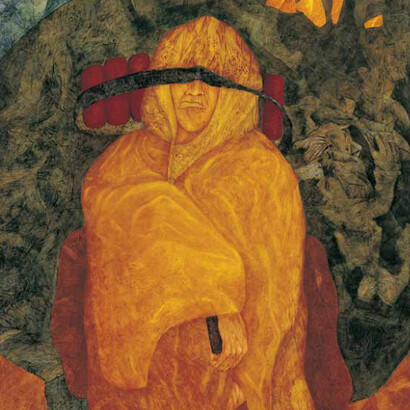
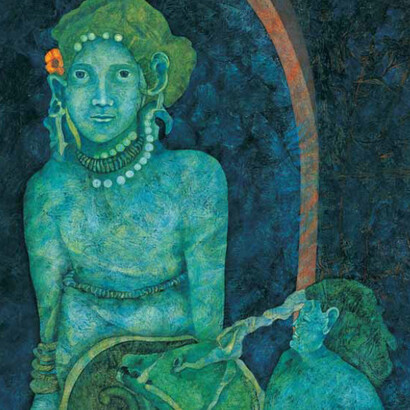
The works Ombre del giorno e della notte (Shadows of Day and Night) of 2003 and Tormento velato (Veiled Torment) of 2007 belong to Agostino De Romanis's more mature production, in which the spiritual and chromatic legacy of the East—Indonesia in particular—blends with his erudite and scenographic European training.
Both paintings share the signature style that has made De Romanis unique: the Mystical Light, i.e., a luminosity that seems to come from within objects and people, rather than from an external source; and the Sense of the Sacred, i.e., both when dealing with shadows and torment, the artist gives the canvas a ritual dignity, transforming personal feelings into a universal experience.
Although they are part of a unified journey, each work touches on different emotional and thematic chords: the first is a masterful example of De Romanis' ability to deal with dualism, while the theme represents the cyclical passage of time, a core concept in Eastern philosophy (the continuum between light and dark, life and death). It is not a clear-cut division but a coexistence of opposites.
The profound meaning of the artistic work suggests that every moment of the day bears traces of the other; the day is never completely devoid of mystery, and the night is never entirely devoid of enlightenment.
In the composition of the large painting (oil painting on paper laid on canvas, 250 x 130 cm), De Romanis uses figures that seem to float or emerge from dark backgrounds, illuminated by sudden flashes of light. The “shadows” are not absences of light but silent presences (spirits, ancestors, or memories) that inhabit everyday life.
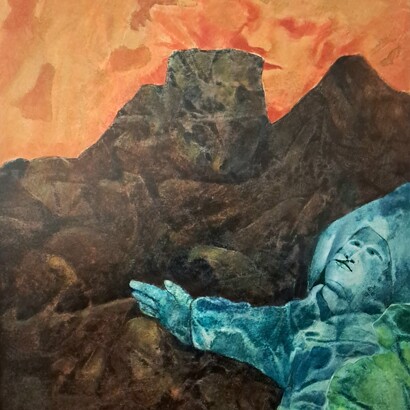
In the second painting, Tormento velato (oil on cardboard, 70 x 100 cm), the artist's more introspective and psychological side emerges, connected to his ability to “veil” emotions through his painting technique. For De Romanis, the concept of “veil” represents the overlapping of many layers of transparent color (similar to lacquers). In this work, the “veil” represents the defense of the soul: pain and torment are present, but they are filtered, rendering them modest and almost sacred through painting.
The centerpiece human figure, depicted in dark colors against a brightly colored background, visually occupies the entire space of the work and exudes dramatic tension, yet remains suspended in an atmosphere of uncertainty. The torment is not expressed through an open scream (as in Edvard Munch), but rather through a deep, underlying sense of restlessness that the observer can only discover by looking “beyond” the surface.
There is a clear link here with his interpretation of Tasso's Gerusalemme Liberata (Jerusalem Delivered)—the dramatic struggle of the hero or saint against his inner demons.
In this regard, see the works by the Maestro featured in the monumental volume by Roberto Luciani and Agostino De Romanis. La Gerusalemme Liberata Dipinta (Agostino De Romanis. Jerusalem Delivered Painted), published by AIAC—Italian Association of Architecture and Criticism, Rome 2018.
The works Ombre del giorno e della notte and Tormento velato were the highlights of major exhibitions marking the career of Agostino De Romanis, particularly in his dialogue between Italy and Indonesia.
Ombre del giorno e della notte was exhibited as a symbol of the dichotomy between the sunlight of the tropics and the mystery of Balinese nighttime rituals, first in 2003 in Rome at the Museums of San Salvatore in Lauro, then in Jakarta in 2004 at the Gedung Arsip Nasional, in 2005 in Bali at the Rudana Museum, Ubud, and in the exhibition Nella natura la luce dell'anima (In Nature, the Light of the Soul) in 2024 at the Vittoriale degli Italiani, Gardone Riviera (Brescia).
Tormento velato was exhibited in 2016 at Santa Maria dell'Orto, Rome-Trastevere, along with 32 other paintings.
Conclusion
During his stays in Indonesia, it is said that the Maestro did not limit himself to painting in his studio but would spend hours observing rituals in temples. This allowed him to capture not only the aesthetics but also the energy of those gestures, making his works come “alive” for the local population as much as for the European public.
All the paintings belonging to this theme successfully explore the concept of Tri Hita Karana (the Balinese philosophy of harmony between man, nature, and God), which Agostino De Romanis was able to translate visually into “vertical” compositions that draw the eye from below (the earth) upwards (the divine).

Agostino De Romanis, Tormento velato, olio su cartone, cm 70 x 100, 2007.