English
 Español
 Français
 Deutsch
 Italiano
 Português
In the work of artists from Paraná who were active throughout the first half of the 20th century, a recurring preference for the theme of landscape stands out, mostly developed through the observation of the state’s natural environment. Notable examples include painters such as Alfredo Andersen, Theodoro de Bona, Guido Viaro, Miguel Bakun, among others.
Starting in the 1950s, the Rio–São Paulo axis became the epicenter of intense artistic effervescence, marked by major institutional milestones such as the founding of the Museums of Modern Art, the São Paulo Biennial, and the opening of various art galleries. At the same time, Paraná also experienced a significant movement of renewal in its artistic scene, accompanying in its own way the transformations that redefined the landscape of art in the country.
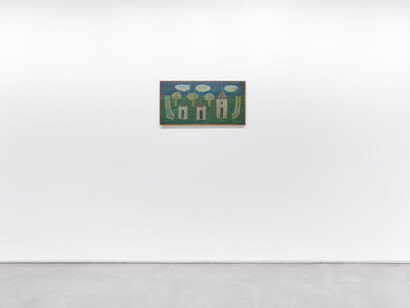
Art critic Adalice Araújo noted that "although the dominant style in Paraná’s visual arts during the 1950s was Expressionism, while Abstractionism prevailed in the 1960s, today these artists follow a wide variety of trends1." Mario Rubinski, however, did not align himself with specific styles or movements. From the beginning, he chose to work with the landscape with a certainty that surpassed even the very categorization of “landscape painter.” His drawings and paintings, after all, did not seek to reflect or translate the environment, but rather to take it as a cue for mental, schematic, and two-dimensional compositions that the artist pursued throughout his life.
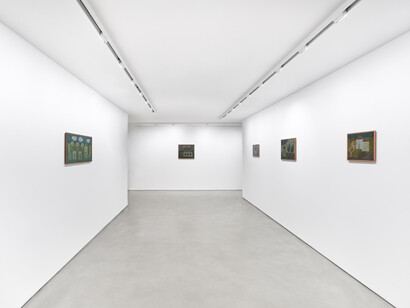
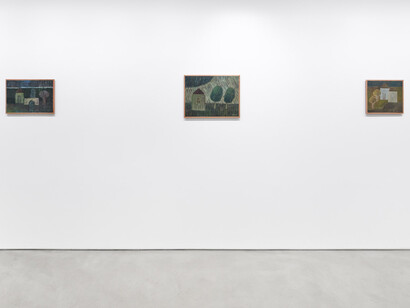
Throughout his career, Rubinski developed a remarkable constructive awareness, crafting dynamic scenes from elementary forms. It is through the arrangement of houses and minimalist buildings that the artist suggests a world in which nature is shared—not through the direct presence of humans, but through architectural forms that evoke shelter and protection. His compositions, even devoid of light effects or shadow appearances, are capable of producing effects of depth and movement purely through the organic arrangement of elements within the scene. Like Alfredo Volpi and Eleonore Koch, painters contemporary to him, Rubinski relied on a rhythmic, compositional brushstroke that, in his case, was repeated in both the figures and the background, contributing to the impression of complete harmony among the elements.
Although the use of geometric forms and the artist’s obsession with lines and planes point to one of his educational backgrounds (in addition to studying painting at the School of Fine Arts of Paraná, he also taught Geometric Drawing in high schools for years), his work is not guided by a pursuit of mathematical precision nor by an analytical application of geometry.
Art critic Aurélio Benitez highlights that "the main characteristic of the art of painters from the 1960s is that it begins to reveal the psychological and emotional behavior of the people of Paraná2." In retrospect, Rubinski’s body of work reveals precisely an artist who built his path around introspection, resulting in a metaphysical painting style that reflects traits of his own personality.
This quietness, combined with regional boundaries, may have contributed to Rubinski’s work finding greater resonance in the southern region of Brazil, distancing him from potential connections with artists who developed similar formal investigations, such as Arnaldo Ferrari, Ione Saldanha, or Marga Ledora. A renewed reading of his work, attentive to the dialogues and unique aspects of his trajectory, allows not only for a repositioning of Rubinski, but also for a recognition of him as a consistent strand of modernity in the south of the country,one that understands landscape not as mere representation, but as a delicate and sensitive structure of the world.
(Text by Thierry Freitas)
Notes
1 Excerpt from the text by Adalice Araújo, published in the catalog A arte de Mario Rubinski, Curitiba: Solar do Rosário, 2007. p. 11.
2 Excerpt from the text by Aurélio Benitez, published in the catalog A arte de Mario Rubinski, Curitiba: Solar do Rosário, 2007. p. 12.