English
 Español
 Français
 Deutsch
 Italiano
 Português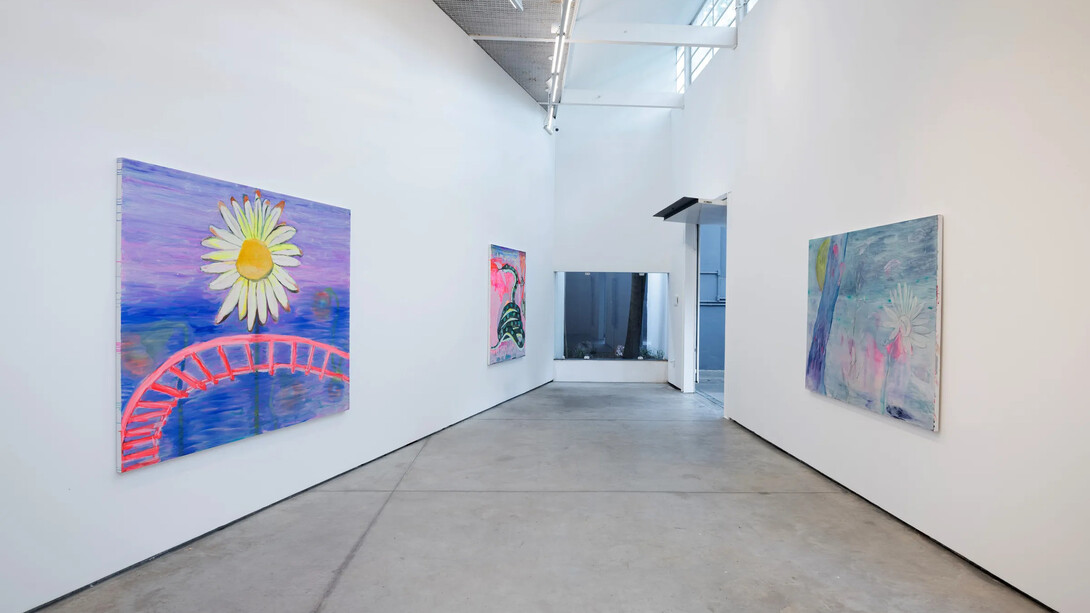
We look at the world once, in childhood.
The rest is memory.1(Louise Glück)
There is a moment in the artist’s painting that resists resolution, a way of holding time still long enough for it to be felt before it hardens into meaning. What moves us is how her disciplined painterly practice becomes inseparable from the political exercise of living. To insist today on simplicity, fragility, and enchantment without irony is already a form of refusal. Perhaps this is what draws us so intimately to her work: sustaining attention, allowing brightness to persist in the everyday.
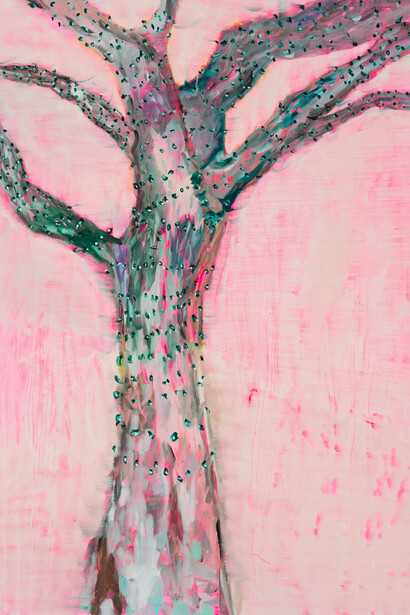
This exhibition, the artist’s second at the gallery, brings together recent works produced between 2025 and 2026. Unfolding across both large and small formats, it marks a shift toward a more openly figurative language. It is the first time she works with figuration on a large scale. Painting recognizable things has long been part of her daily exercises in pequenas pinturas, small-scale works she began in 2016 as an almost obsessional routine, a way, as she says, de não perder a mão, not to lose the hand. This practice functions like a diary, an intimate and historical archive.
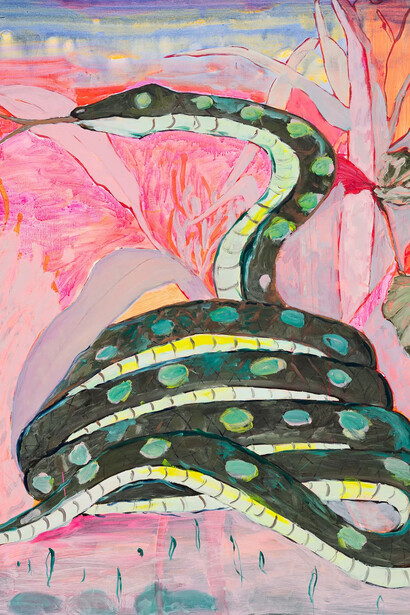
The artist moves within an intense chromatic universe. Neon colors, layers of shimmer, traces of glitter, and plays of transparency allow what came before to remain visible and what is coming to stay suspended.
Christmas decorations, small strings of lights, reflections caught briefly in puddles, shells, and the world of the circus. Things, moments, memories in which light and matter are simply felt, when the ludic, playful side of perception is activated and the gaze becomes more porous.
At last I crossed the clouds, borrowed from the title of one of the paintings depicting a circus lion, names a threshold rather than a theme. Growing up on a farm in Bananal, in the state of São Paulo, where the walls themselves were painted and became some of the first images she encountered, the artist recalls a coincidence from her rural childhood. In the month of July, the arrival of the circus was an event. Almost at the same time, the tsiganos passed through the village, and both occupied the square simultaneously. For a child, the world suddenly became extraordinarily rich, briefly reorganized by movement, color, and unfamiliar presences.
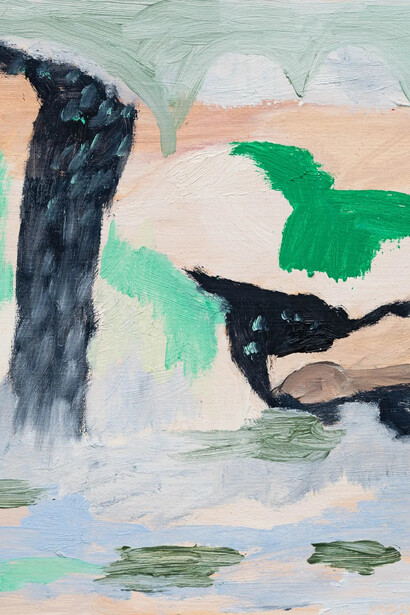
Although she does not recall the animals of the circus precisely, this memory became an invitation to research pictorial and historical images of circuses, often working from photographs as part of her painting process. These moments of encantamento, enchanting but also events, insist on their capacity to sustain the present. They return her to a first reading of the world, when the image has not yet separated from affect. She rehearses these states first in acrylic before finalizing in oil. “I need to know where to stop,” she says. Knowing when to stop becomes part of the temporality of the gesture, the instant when brightness ceases to be excess and becomes presence.
Here, the image does not ask only to be seen, but to be met. Roland Barthes described the punctum in photography as the detail that pierces the viewer. In the artist’s paintings, this piercing is not a detail, but a moment held in light, a process rather than a point, a sensation that keeps us in the suspended state of childhood, before the world settles into explanation.
In a psychoanalytic sense, what is held here is not the scene itself, but the feeling attached to it, something carried forward, returned to, and continuously reshaped between seeing and sensing.
This exhibition brings to mind a line from Forugh Farrokhzad’s powerful poem Another birth: “I feel the first vibration of light.”2 Here, that vibration is not only optical, but bodily. It is in the arm that paints, in the layer that settles, in the surface that both holds and loses luminosity at once.
When we met in her studio in Rio de Janeiro, discipline and repetition entered the conversation, along with the city we inhabit, the sea, the beach, surfing, and the way attention sharpens as exhaustion coexists with a heightened sensitivity to small things. The work speaks to our ways of seeing, to small events, acontecimentos, that rest in memory and reappear quietly in everyday encounters.
What these works ultimately hold is not childhood as a theme, but as a condition. A commitment to play, brightness, fragility, and attention as ways of remaining in the world. In a time organized by speed and a surplus of images, this painting proposes another temporality, that of the gesture, the layer, and the light that insists on lasting.
(Text by Amanda Abi Khalil)
Notes
1 Louise Glück, “Nostos,” in Meadowlands (Hopewell, NJ: Ecco Press, 1996).
2 Forugh Farrokhzad, Another birth, in Another birth and other poems, trans. Sholeh Wolpé (Costa Mesa: Mazda Publishers, 2007).
![Liliana Porter, Otros cuentos inconclusos [Other unfinished tales], exhibition view. Courtesy of Luciana Brito Gallery](/attachments/945b878672d5d798cfa94d9d996ce940089bab8f/store/fill/330/330/c58fb9c82156e4df14f9ee9cb40200c43b3eb10dc5d9ebbcfd6b6c30dc29/Liliana-Porter-Otros-cuentos-inconclusos-Other-unfinished-tales-exhibition-view-Courtesy-of.jpg)
![Various artists, Histórias latino-americanas [Latin american histories], exhibition view. Courtesy of MASP](/attachments/2ec1b7615df2d9b9c3f211de14c70faefd850aea/store/fill/330/330/8481e63599516249cba60f15e188644bb76fc1eec25547e2c4b88b8f1c92/Various-artists-Historias-latino-americanas-Latin-american-histories-exhibition-view-Courtesy-of.jpg)