English
 Español
 Français
 Deutsch
 Italiano
 Português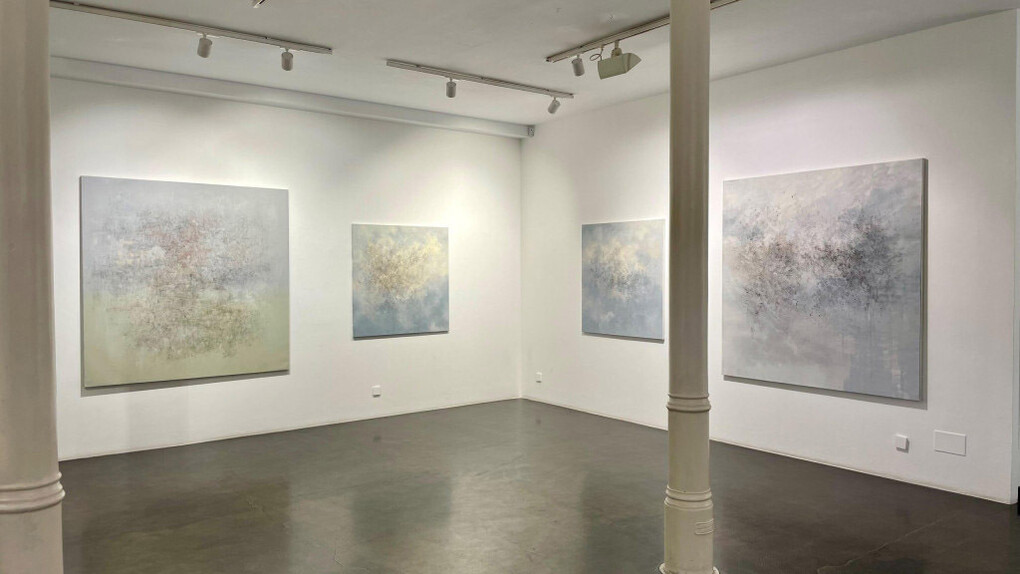
As she moves from Invisible Cities to her skyscapes, Marianna Gioka shifts her research from the structural noise of the urban environment toward a more unstable territory: that of inner perception. This is not a change of subject, but of focus. The city—previously understood as a network of visible forces—dissolves to give way to a mental landscape where time, sound, and color function as remnants of experience, as traces of something that can no longer be directly represented.
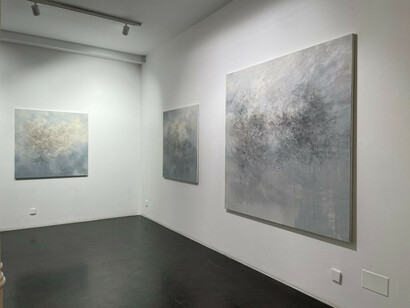
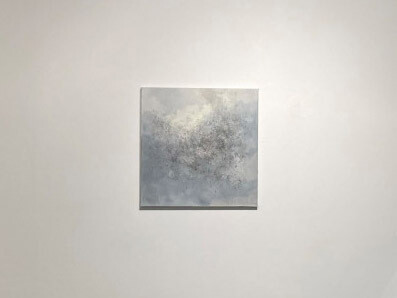
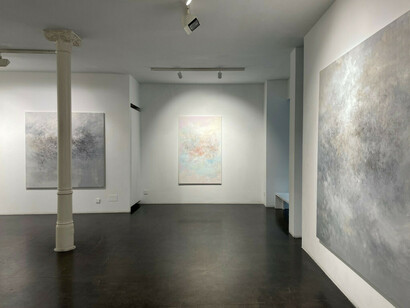
Gioka’s work articulates a non-linear understanding of time and space. Her abstract drawings, rooted in architectural training, operate as unstable cartographies: lines that do not describe, but rather suggest trajectories, vibrations, and inner displacements. Upon these structures, the painting is built in layers, superimposing oil paint with delicate interventions in India ink, as if each gesture left behind an emotional sediment. Whether working in intimate formats or large-scale compositions, her dense surfaces do not seek a final image, but a state: a precarious balance between control and drift, between form and dissolution.
In Invisible Cities, a series inspired by Italo Calvino’s novel of the same name, Gioka approached the city as an organism that conceals more than it reveals. Urban landscapes, traversed by strange and almost magical architectures, functioned as backdrops for a barely visible human activity. It was not the city itself that interested her, but what inhabits it: movements, affects, the latent anxiety of its inhabitants. This concern with what remains hidden persists in her later work, although the space is no longer urban, but mental.
It is at this point that her skyscapes acquire a particular depth. Drawing from the tradition of sky painting—from Constable’s empirical observation of nature to the theatrical Romanticism of Delacroix—Gioka understands the sky not as a natural landscape, but as a symbolic field. A place where light, clouds, and color operate as metaphors for cerebral and sensory activity. One may detect here a distant echo of Jean-Honoré Fragonard’s backgrounds, in which the landscape was not a mere accompaniment to the scene, but an emotional state that permeated the action. In Gioka’s work, this background fully emancipates itself: it no longer supports the figure—it replaces it.
Her skies do not describe atmospheric phenomena, but mental processes. They function as spaces of projection where calm, anxiety, and excitation intersect; where the visible becomes an imperfect translation of what occurs within. Expressive brushstrokes, flowing lines, and restrained yet tense chromatic ranges generate a sense of magnetism that dissolves conventional coordinates. The viewer does not confront a landscape, but enters into it.
Marianna Gioka’s painting does not propose an image of the world, but an experience of the mind. Her works operate as sensitive topographies in which time and space cease to be stable categories and instead behave as fluctuating states. In this transition, the artist does not seek to represent the subconscious, but to make it visible as atmosphere. A painting that does not illustrate, but thinks; that does not explain, but keeps open the mystery of what passes through us.