English
 Español
 Français
 Deutsch
 Italiano
 Português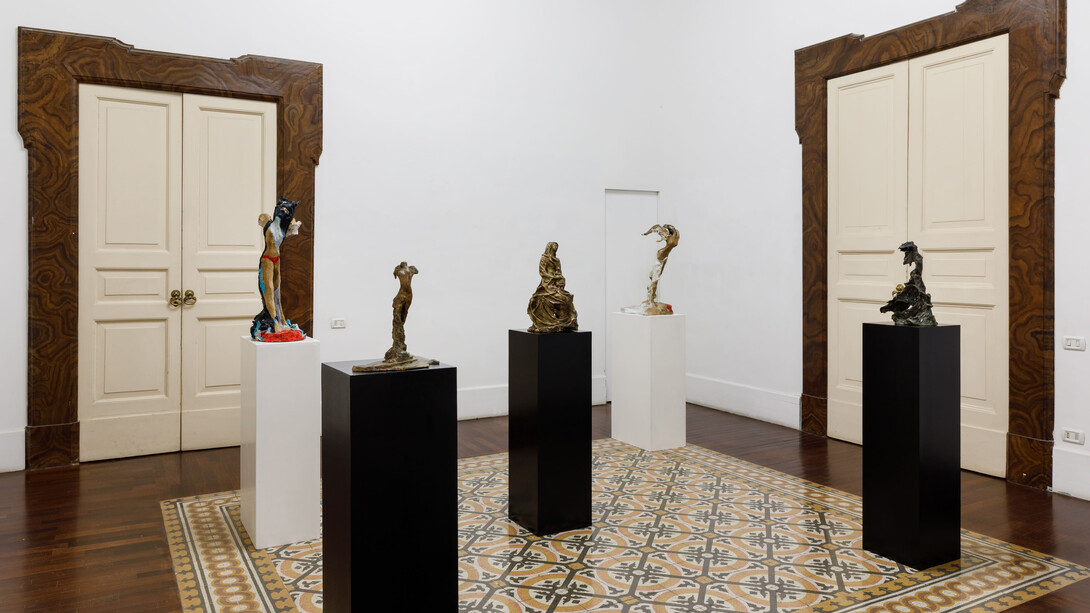
This project represents the result of a trajectory initiated in 2020, when Francesca Lacatena invited Rosa Panaro to present a selection of drawings and a sculpture as part of the group exhibition Parabasi. The exhibition features a body of work spanning from the 1970s to the 2000s, pivotal in delineating the artist’s versatility in her engagement with sculptural materiality. Concurrently, the selection highlights her audacious and ironic approach in addressing complex political, social, and spiritual themes.
Rosa Panaro received her formal training at the Accademia di Belle Arti in Napoli, where she specialized in sculpture, graduating in 1958. The 1950s and 1960s represented a period of profound experimentation for the artist, during which she engaged with a diverse range of media, including ceramics, concrete, resin, tuff, and asbestos. However, it was her encounter with papier-mâché (cartapesta) that led her to explore a singularly idiosyncratic creative path—one that positioned her within a unique research niche for the era, while remaining deeply rooted in the Neapolitan sculptural tradition. It was through promenades in the historic centre of Napoli alongside her husband, Tony Stefanucci, that Panaro reflected upon Late Baroque sculpture; she was particularly captivated by the papier-mâché drapery adorning the statues within the city’s numerous churches. The chromaticism and formal structure of this material—at once dramatic, occasionally grotesque, yet inherently fluid—proved transformative for her. Papier-mâché offered a medium that precluded external intervention: a substance she could devise and manipulate from inception to completion in total autonomy. Furthermore, the polychromy characteristic of ancient statuary, though eroded by time, could once again resonate with renewed vigor through this medium.
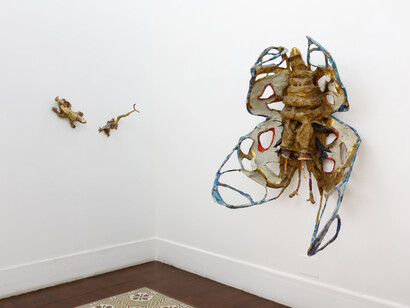
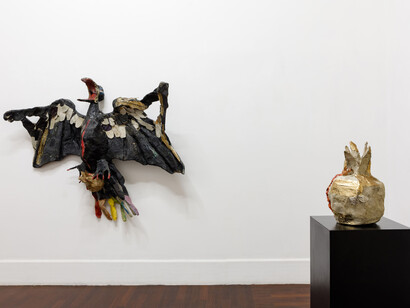
The exhibition opens with a subject that is non-recurring within Rosa Panaro’s oeuvre: la Farfalla (the Butterfly). Despite her affinity for working on a diminutive scale, Panaro renders a butterfly that is decidedly out of scale, thereby emphasizing its profound symbolic weight—specifically, the concept of mutation as a striving toward beauty and liberation. In contrast, a recurring motif in Panaro’s production is la Salamandra (the Salamander), represented here by a group of specimens from various periods. The significance of this amphibian lies in its paradigmatic value: according to legend, the salamander is impervious to fire, thus becoming an emblem of tenacity, resistance against adversity, and the capacity for self-renewal. Numerous themes characterize Panaro’s body of work, beginning with her fervent civic engagement for Naples. While this commitment originated and was realized within her native city, it far transcends local boundaries, ultimately attaining a universal and totalizing dimension. Cormocatrame (Tar-Cormorant) serves as a quintessential example: a large cormorant lies suspended and supine, yet it transcends mere naturalistic representation.
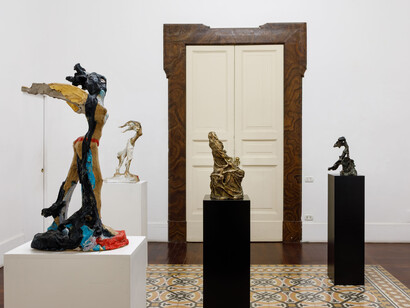
The bird is depicted drenched in a sea of tar, a condition of profound suffering; its beak is wrenched open in a visceral cry of agony, with the interior of its mouth rendered pitch-black. This sculpture functions as a manifesto of environmental urgency regarding the fate of the world. Nevertheless, Panaro’s disposition does not preclude hope; on the contrary, the cormorant’s tail retains its vibrant coloration, and nestled within its talons is a pomegranate—an enduring iconographic symbol of prosperity and fecundity. An underlying restlessness and trepidation regarding the future of the human condition manifest in other works, including one of poignant contemporary relevance: La colomba della pace (Dove of peace). Yet, in this iteration, the iconography deviates from tradition; Panaro presents La colomba della pace incazzata (The pissed-off dove of peace). The sculpture embodies a profound paradox: it remains an emblem of peace while simultaneously internalizing its failure, manifesting a state of righteous indignation. In the 1970s, Panaro aligned herself with the Feminist movement, a commitment that remained a cornerstone of her life and practice. The female figure became a lifelong focal point, through which she explored various archetypes. In these depictions, however, mythology takes precedence over chronicle. The exhibition features a procession of figures, diverse in both media and context: from Lilith—the primordial woman fashioned by God not from a rib, but from the earth—to Parthenope, the siren whose legend underpins the foundation and identity of Napoli; and finally, the Madonna, the ultimate icon of purity and the triumph over sin.
Rosa Panaro was a preeminent experimentalist, dedicated to a body of research that remained profoundly coherent throughout her life. She articulated the everyday, the mythic, and the 'anxiety of the fantastic' through a plasticism of striking and unexpected effects.
In my work, I have always combined the investigation of recyclable, multi-material, and polychromatic substances; I have modeled papier-mâché with the same rigor as ceramics, yet I have never eschewed incursions into other media—be they noble, such as bronze, or humble, such as concrete and plaster. I have long been preoccupied with both ancient and contemporary myths, drawn particularly to the multifaceted world of the feminine.