English
 Español
 Français
 Deutsch
 Italiano
 Português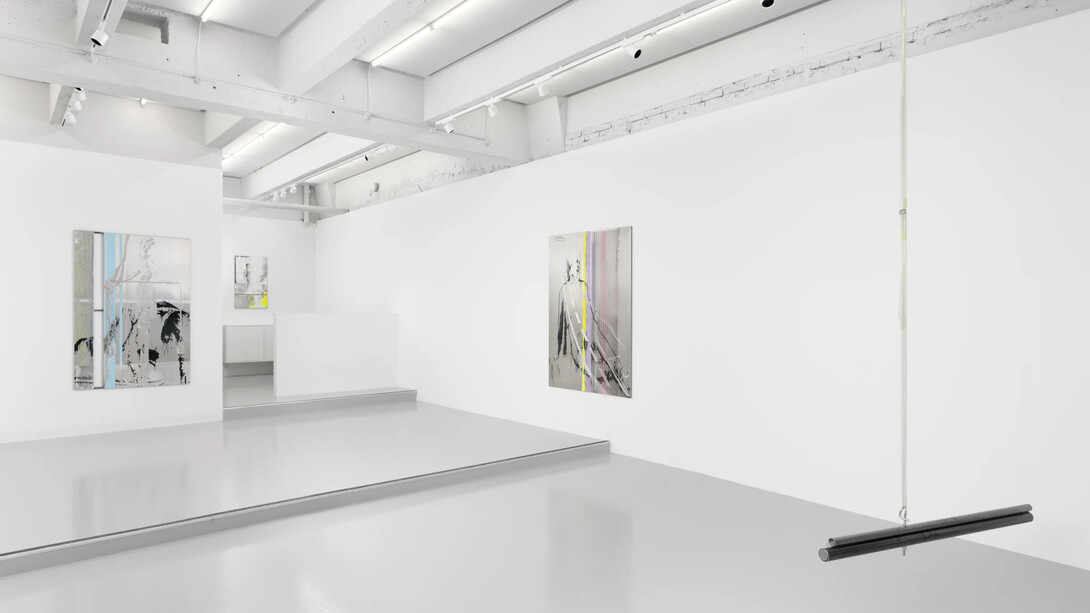
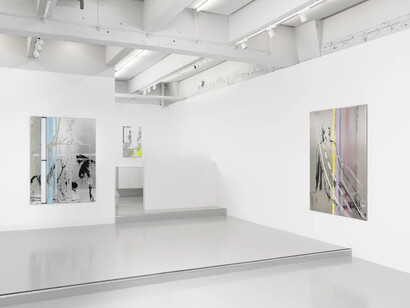
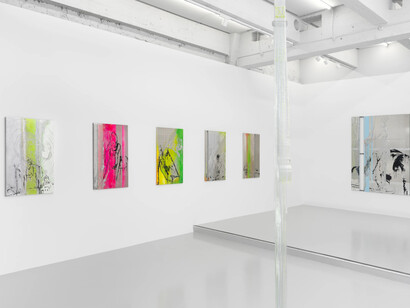
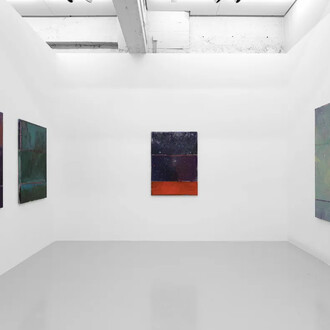
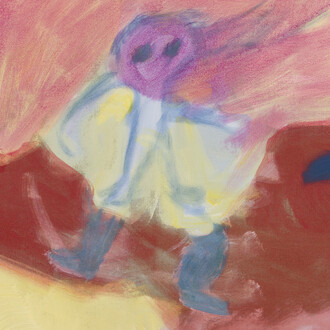
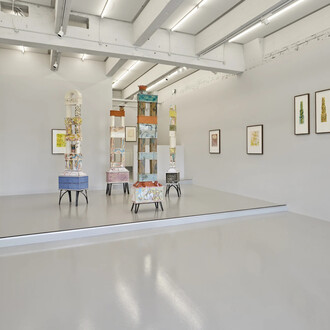
The exhibition A balancing act by visual artist and choreographer Miriam Kongstad presents ten new works: a series of paintings on engraved metal, a balancing sculpture, and a scent, all centering on the fall as a fundamental condition.
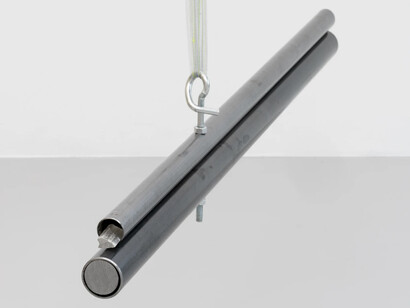
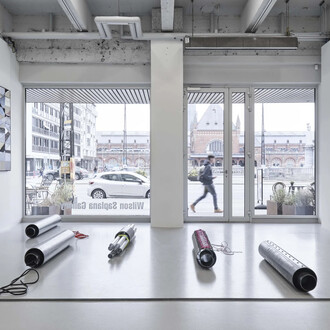
Kongstad’s paintings are made not only with brushes and saturated colours, but also through the use of industrial tools and physical manipulation. Angle grinders, polishing machines, engravings, blows, and pressure shape the aluminium surfaces through friction and collision. Aluminium’s contradictory nature - hard and cold, yet light, pliable, and vulnerable - mirrors the body’s own duality. The surfaces shift between smooth and rough, anti-slip and perforated textures, suggesting risk, stability, and safety. Their tactility becomes zones of potential movement: to slide, stop, sink, or support. This bodily tension continues in the sculpture: two steel pipes, held in offset balance, carry a delicate, milky-white mineral that references the microscopic crystals in the inner ear responsible for human balance.
Here, the balance between control and loss of control is negotiated, with the body as the exhibition’s anchor. Enveloping the exhibition is a scent, also shifting between lightness and gravity - from floating top notes to a deep base note that reminds the senses of gravity’s constant pull.
The body itself can be seen as a balancing act between birth and death, stretched from ascent to descent, growth and decay. Falling is inevitable - whether we physically lose balance, stumble and tumble, or metaphorically fall for someone, fall apart, or fall asleep. The fall is feared and destabilising, painful and embarrassing. Beneath this fear lies a shadow of death anxiety. From dust we come, to dust we return. One must crawl before they can walk.
A fall challenges our desire for control and demands surrender to life’s circular movement. Yet Kongstad frames the fall not only as failure, but as an opening toward cultural, social, and bodily complexity. In free fall, the body is guided by vulnerability, instinct, and potential. When we fall from a pedestal, a relationship, or an identity, the conditions that led to the fall are revealed. Here, the possibility for transformation emerges. This reflects a contemporary moment in which beliefs collapse, world orders shift, and values waver. Still, the exhibition insists that vulnerability holds strength, change holds hope, and that the fall may be met by a helping hand; an invitation to imagination, awareness, and empathy. The fall is not only brutal and destructive, but also a terrain of tenderness, pathos, and honesty.
If the fall is understood as a manoeuvre that breaks the script - deviation from the norm, a force majeure, or a withdrawal from social structures - it inevitably calls for attention, improvisation, and new connections. The fall insists on “an expansion of time, where the mind stretches between fiction and reality,” as Kongstad recites in her performance Free-Fall (2023), which forms the point of departure for the exhibition.