English
 Español
 Français
 Deutsch
 Italiano
 Português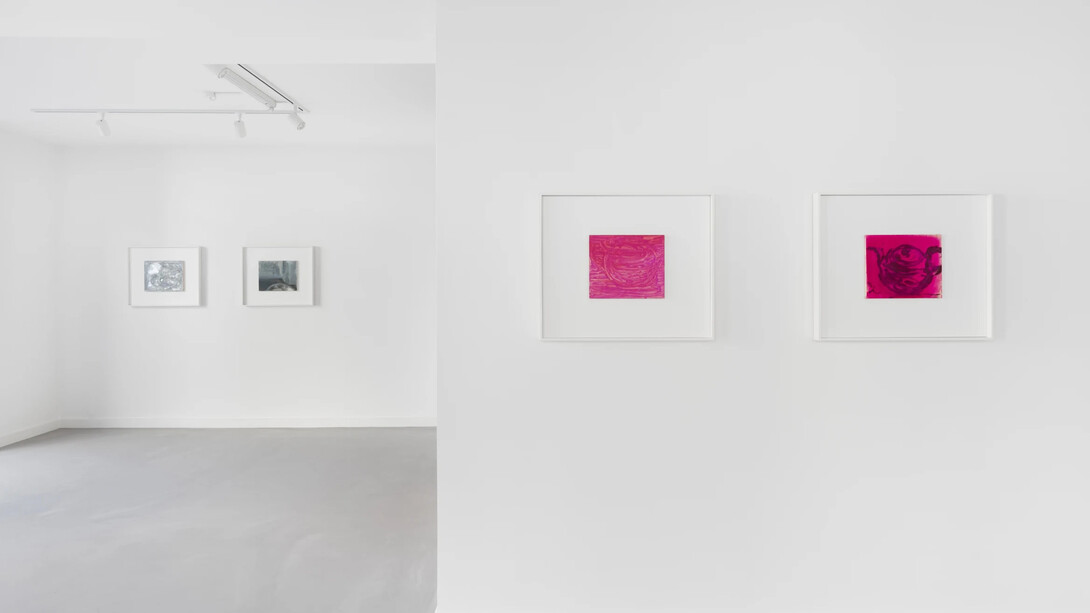
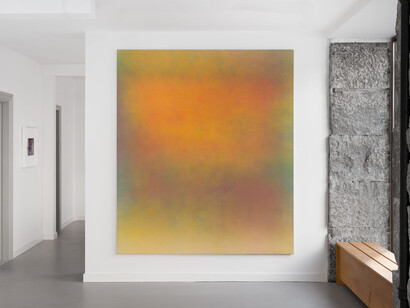
The colours flicker on my retina as I close my eyes on the S-train on my way home from Birk Bjørlo's studio in Måløv, where I have seen his new paintings for the upcoming exhibition Waste land at Brigade Gallery. As afterimages of sky blue, May green, sun orange, magenta, and violet surface, I think of art critic Kristian Vistrup Madsen's essay Mood over content (2024), where he reflects on the importance of making space for what art does to us. Instead of immediately searching for identifiable "themes," he argues to give room to the material and sensory qualities of art: tactility, perception, resonance: "What we register as mood is the totality of an object's presence - a presence that necessarily also makes demands of our own."
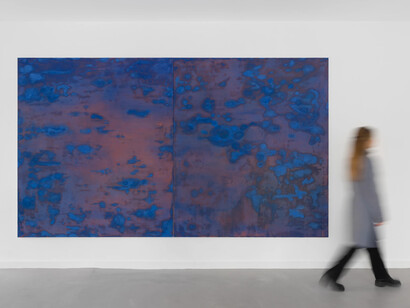
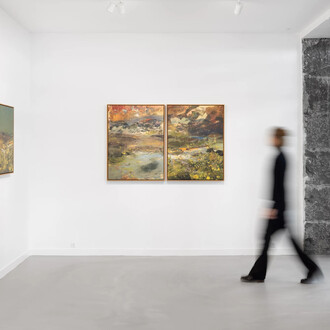
Bjørlo's paintings makes demands on my presence. In the large diptych Waste land, I & II (2025), dry blotches in blue tones of indigo and cobalt spread across the canvases against background nuances of Provence blue and cadmium orange. The image is alluring and mildly nauseating; I cannot settle on a single motif or find a stable point of orientation. For a moment it seems to conjure cloud formations over a quivering sea; in the next, the gaze is plunged into something microscopic, like mold or mildew seen under extreme magnification. Although the title of the paintings reads as an invitation to approach the images as a landscape, the reference to T.S. Eliot's modernist poem The waste land (1922) opens more sensuous and fragmented associations with a world in dissolution.
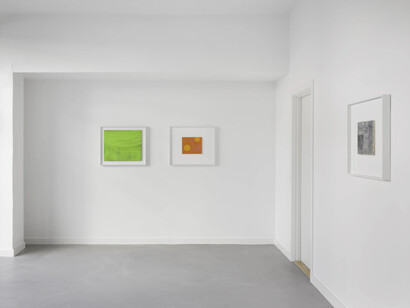
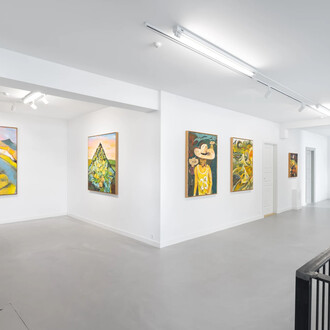
The modest formats of the Positions series do not make the paintings any less insistent. Although several of the works conjure recognisable elements from a kitchen, these too evade unambiguous readings. It is the colours and surfaces that dominate: the luminous green strokes that suggest the form of two zucchinis (Position III); the gestural brush movements in pink that form the contour of a teapot (Position VII); the glittering wax layers with crushed crystal that make the depicted drinking glass gleam like silver (Position VI).
In the Positions series, Bjørlo activates a still life tradition that modernist artists since the late nineteenth century have used for formal investigations. Here, the luxurious, symbolically charged table arrangements of the seventeenth and eighteenth centuries were replaced by simple, everyday objects that were rendered again and again in new ways. As with still lifes by artists such as Giorgio Morandi (1890-1964), it is not the motif that carries the image in Bjørlo's work, but the painterly labour. Yet in contrast to Morandi, who lingered over the same objects year after year through subtle variations in colour and arrangement, Bjørlo's paintings are marked by energetic leaps between motifs, materials, and colour palettes. Here, there is room for radical mood shifts.
"Where mood is concerned, what appears as the outcome is but a pause in the flow of practice," writes Madsen. This seems particularly apt for Bjørlo's works. Even though the paintings can stand on their own, they express an ongoing exploration of both painterly and human presence in the world - also beyond the studio. Kitchen utensils - as well as mold and mildew - are phenomena many of us encounter in everyday households. These overlaps between artistic and domestic practice emerge most clearly in Bjørlo's drawings, but I also see traces of family life in paintings such as the light and delicate Hode I and the dark, pastose Hode II, which echo his drawings of his sleeping children.
But it is the paintings' insistent presence - rather than their opening toward a lived life - that registers in the body. With their leaping energy of colour, the works offer a much-needed pause from the wasteland of information - less as tranquility than as sensory recalibrations.
(Text by Mathias Danbolt)