English
 Español
 Français
 Deutsch
 Italiano
 Português
There was a time when Kanye West felt like the very definition of genius. For many of us, he wasn’t just a musician; he was the architect of a generation’s emotional and cultural landscape. His music shaped the aesthetic, political, and spiritual language of millennial Black consciousness in the age of celebrity.
The College Dropout, Late Registration, Graduation, 808s & Heartbreak, and My Beautiful Dark Twisted Fantasy weren’t just albums. They were declarations. Intimate and grandiose, self-obsessed yet vulnerable. Kanye’s early work carved out a space where the strange, the spiritual, the wounded, and the ambitious parts of Black identity could coexist.
Kanye didn’t follow trends; he created and crafted them. He dismantled the binaries between mainstream and underground, between streetwear and haute couture, and between gospel prayer and profane confessions. He made music that felt like performance art and performance art that felt like prophecy.
Even his contradictions were compelling. He could sample Chaka Khan and Bon Iver in the same album, rant about the industry while profiting from it, kneel in prayer one minute, and stand drunk onstage to snatch microphones the next. He can elevate one artist while humiliating another. He was brilliant, erratic, self-serious, and satirical all at once. And for a long time, we embraced it. We celebrated the “genius” and forgave the mess.
But the signs were there.
Long before his public descent, before the MAGA caps and hate speech, before the antisemitic rants and violent misogyny, the red flags were flying. The messiah complex. The unfiltered outbursts. The cruelty toward peers and partners. We laughed. We mythologized. We called it “Kanye being Kanye.” We said it was part of the package. We excused it as eccentricity, the price of brilliance. We gave him a pass because he carried the heavy burden of “genius.”
And now, here we are.
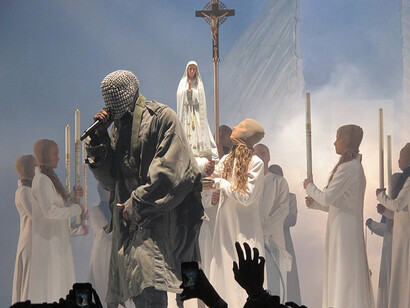
The man who once broke open pop culture now peddles hate from the stage he once helped build. He’s said slavery was a choice. He’s embraced Nazi iconography, declared his undying love for Hitler, and platformed white supremacists. He’s made Jewish people the target of conspiracy theories. He’s harassed women, denigrated past girlfriends, continues to humiliate his ex-wife, and styles misogyny as performance art.
And yet, how much of this is amplified because outrage sells?
Our media ecosystem rewards extremism; algorithms thrive on spectacle. Every rant becomes a meme, every tantrum a headline. Kanye has mastered the economy of controversy, and we are the consumers of his “collapse.” He plays both villain and victim, and we make it all content. The same machine that once celebrated him now profits from his “destruction.”
Still, defenders line up—the sales rise. The streams continue. We hear, “But he’s mentally ill,” or “He just needs help,” or “He lost his mother.”
F*ck, most of us are suicidal at the best of times, but we keep our shit together.
Mental illness is real. Kanye himself has spoken about living with bipolarity. But mental illness doesn’t manufacture hatred. It doesn’t explain antisemitism or misogyny. It doesn’t help arm white nationalists with a license to foster sustained abuse aimed at kids, women, peers, and minorities. That’s not an illness. That’s ideology.
Our failure to name that ideology for what it is, to see it clearly, even when it’s a Black man wearing a swastika...is part of the problem.
I also recognize another layer here: the industry’s exploitation of Black trauma.
His mother’s death and his subsequent unraveling weren’t just a personal tragedy; they were a structural failure of celebrity excess meeting a system that extracts fame but offers little support and no emotional safety net. Kanye’s unraveling mirrors the decline of Michael Jackson, DMX, Whitney Houston, and so many others consumed by the machine. The same culture that romanticizes tortured artists discards them when they need help and are no longer profitable.
But that doesn’t absolve Kanye; it implicates the ecosystem that raised him.
Some will say this is not an analysis but a takedown of Kanye, that it is too harsh and too dismissive of the weight Mr. West has carried. That we’re misreading the genius of Ye. That we fail to grasp what it means for a Black artist to rise, uninvited, to the pinnacle of an industry built to exclude him. That in a culture where Black brilliance is routinely exploited, erased, or commodified, Kanye simply demanded the freedom white artists have always had: to speak without filter, to break things, and to be seen as complicated geniuses.
And here’s the trap: Genius, as we’ve defined it nowadays, is often just influence wrapped in audacity. We conflate the two, as if cultural disruption alone equals brilliance. But Prince and Stevie Wonder were geniuses not only for their innovation but also for their ethical coherence.
Kanye’s brilliance was in aesthetic rebellion; the closer he got to white avant-garde provocateurs (Warhol, Bowie, and even Wagner come to mind), the more his flaws were pathologized rather than romanticized. The same industry that adores “troubled white geniuses” now watches Kanye’s unraveling with a mix of horror and hunger, feeding on his collapse like confetti.
Some will say my critique lacks context. That it flattens his struggle into word bites. That Kanye’s provocations are actually performance art and protests against an industry that profits off Black culture while denying its creators agency and ownership.
And yes, those tensions are real. Indeed, Black artists are often celebrated only once their innovations are safely in white hands, for white profiteering and consumption. That hip-hop, once radical and resistant, rooted in collective Black struggle, has been gutted by hyper-capitalism and sold back to us as caricature. That Black men are often not allowed to be strange, sensitive, angry, experimental, and powerful all at once. It is true that the industry feeds off Black creativity and then abandons it.
But here’s the cruel irony: Kanye’s recent rhetoric, “slavery as a choice,” and praising Hitler mirror the worst of respectability politics. Its bootstrap logic turned pathological. Essentially, he says, “If I could rise, why can’t you?” It ignores systemic oppression and, worse, blames the oppressed for their stagnation. The man who once sampled Lauryn Hill and uplifted Black women now humiliates them. The artist who gave us “Jesus Walks” platforms white supremacists instead of opening doors for others. This isn’t just hypocrisy; it’s the artist defecating on his own legacy.
The liberation and freedom Kanye once fought for cannot coexist with the ideology he now broadcasts. To romanticize his downfall as misunderstood rebellion is to ignore the actual damage he causes. Because we are not just talking about bad takes or artistic provocations, we’re talking about profiting from hate speech. We are talking about threats. About the normalization of misogyny and violence. About the elevation of supremacist rhetoric. About the weaponization of mental illness as a smokescreen for abuse.
Even as we wrestle with the racial double standards that haunt every Black artist’s career, we cannot exempt Kanye from accountability. His Blackness is not a shield for bigotry, just as his past innovations are not a license to say and do what he wants. We can celebrate what he created while condemning what he has become. These truths can coexist.
But this isn’t just about him. It’s about how we define genius itself. We’ve been so starved of institutional validation that we overcorrect, deifying disrupters without asking if disruption alone is enough. True genius requires more than innovation; it demands wisdom. And our refusal to expect both is how we got here.
Hip-hop, too, must reckon with its complicity. What once began as the poetics of resistance and giving voice to the voiceless has too often become a theater of domination. Where once there were nods to hood life, now we have endless loops of capitalist braggadocio, of women as props and products, and of violence as a substitute for influence.
Kanye epitomized both eras. He gave us “Jesus Walks,” a spiritual cry of defiance, and “Gold Digger,” a song that punts tired misogynist crap about Black women. He gave us “All Falls Down,” a critique on insecurity and consumerism, and then became the poster boy for unchecked excess. He warned us, “No one man should have all that power,” then hungered for it like a cult-like guru.
I told a friend I was writing an essay on Ye, and he said, “Treat it well. Don’t just write anything.” That instinct to protect the myth is telling. We want to preserve the legacy, even when the legacy turns toxic. But reverence must not outweigh accountability. Not when people are being harmed. Not when collective memory is being rewritten by volume, not truth. Not when genius becomes a mask for hatred.
It’s tempting to separate early Kanye from what he’s become and to time-capsule the art, to remember the feeling of 808s & Heartbreak without the ugliness that followed. But what we need now is not nostalgia. It’s a deeper reckoning with what we choose to celebrate, who we elevate, and how we define genius.
Because here’s where it gets even more complicated.
The defenders will say we’re overlooking the genius. Only a genius can recognize genius. They’ll point to his sonic evolution, his blending of rock and rap, gospel and autotune, his avant-garde fashion sense, and the cultural dimensions he shifted. They’ll tell us he didn’t just change music but changed the sound of an era, the look of an industry, and the language of Blackness.
And yes, Ye’s imprint is undeniable. He made the personal feel mythic. He made a design of a battleground. He made cultures collide. But that’s precisely the problem. We’ve grown so addicted to transformation that we stopped asking what it’s transforming into. We’re so eager to crown innovation that we no longer interrogate the impact.
Perhaps the real question is not whether Kanye is a genius, but whether we’ve been too quick to label things genius in the first place.
Were our standards so low, our hunger for novelty so great, that something bold and fresh automatically became genius? Have we conflated charisma with character? Audacity with depth?
This isn’t about diminishing what Kanye achieved. It would be foolish and unfair to do so. It is about asking how we receive these achievements and why we continue to defend the man and the artistry, sometimes at the cost of our own values.
Because genius, if it means anything at all, must be accountable to more than just itself.
We must stop confusing charisma with vision. We must stop worshiping the fallible just because they once showed us a possibility. This is not about cancellation. It’s about clarity. About identifying and naming what’s dangerous and refusing to let brilliance mask brutality.
It is also about building something better. If we learn anything from Kanye’s fall, it is the failure to build systems that don’t exploit Black genius until it breaks. We need a culture that doesn’t reward outrage over integrity. And we need a new definition of greatness, one that demands both innovation and humanity.
We owe that to the culture. We owe that to ourselves, our children, and their future.
Because if we keep feeding the myth of the untouchable genius, we’re not just watching Kanye fall. We’re watching ourselves go down with him.