English
 Español
 Français
 Deutsch
 Italiano
 Português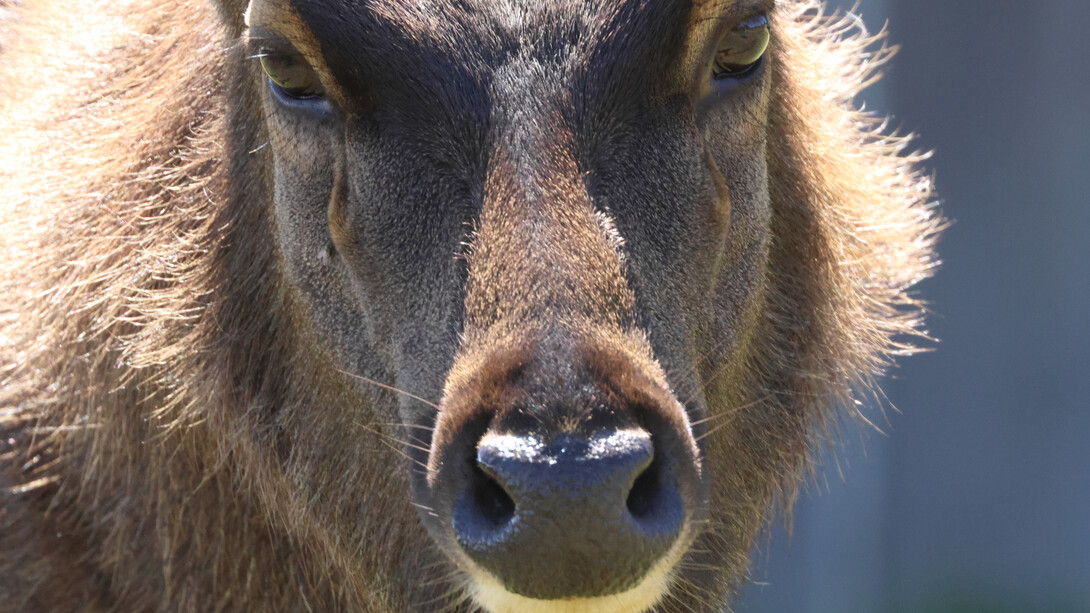
From Jetwing Surf on the East Coast of Sri Lanka, we journeyed into the cool highlands through Ella, reaching the green carpets of the tea country and finally the Uva Ben Head Bungalow, a tea estate managed by Jetwing. The former planter's bungalow has been converted into a villa. In the past, it was often visited by the late Thilo Hoffmann, a former chair of the Ceylon Bird Club. He is widely acknowledged as having led the campaign to halt the destruction of Sinharaja Rainforest for logging during the premiership of Sirimavo Bandaranaike. I was on a 5-day birdwatching press trip after the Galle Literary Festival (GLF) and in the company of fellow GLF invitee Helen Macdonald, who won both the Samuel Johnson Prize for Nonfiction and the Costa Book Prize for her book ‘H is for Hawk.’ Helen is also a keen birder. Our ascent to the highlands had begun on the East Coast, in the company of Helen and her friend Christina, our host, Hashan Cooray from Jetwing Hotels, and my wife, Nirma, a poet.
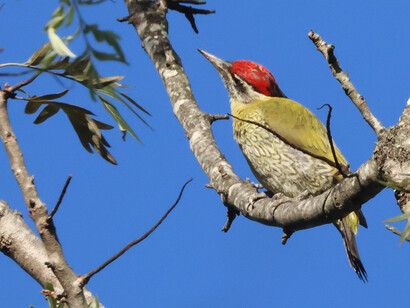
Having arrived in the evening, we set off on a short walk to explore the tea estate and to listen out for birds. Before long, we had good views of a pair of the endemic Sri Lankan lesser flameback and another special woodpecker, the streak-throated woodpecker. The latter is confined to the Uva hills. It often visits the bungalows of tea estates, but because of its restricted range, it is a bird that is often not seen by birders from the lowlands. Gayan Vithanage, the manager of the property, joined us on the walk and explained to us some of the behind-the-scenes work that goes into managing a tea estate. Back in the bungalow, we sat on the veranda and, with views of the tea plantation, participated in a tea tasting session led by Vithanage. The Uva teas are one of seven regional teas in Sri Lanka.
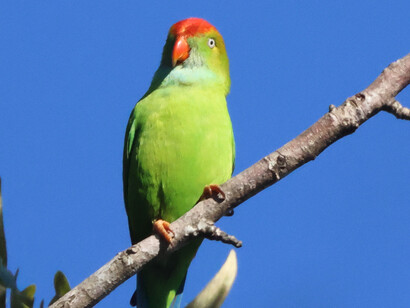
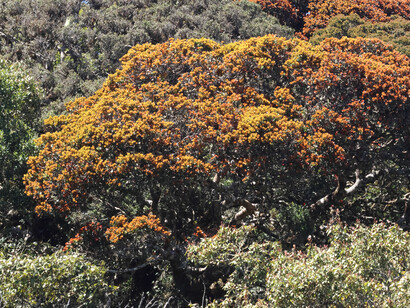
In the morning, before a delicious breakfast, I came out into the garden at daybreak. It was still cool, similar to an autumnal day in a temperate climate. I saw and heard around 34 species of birds, including the endemic Sri Lankan hanging parrot, several of which perched on an African tulip tree in bloom with vibrant red flowers. A native of Africa, it has been widely planted in the hill country. One of the reasons for staying at Hoffmann’s bungalow was that I was keen for Helen to see the Horton Plains National Park. This protects one of the most important stretches of Sri Lanka’s cloud forest, or upper montane forest. As a generalization, cloud forest occurs above 1,500 meters in elevation. Only an estimated 400 square kilometers of cloud forest are left in Sri Lanka out of its total area of land of 65,610 square kilometers. This works out to be just 0.6%, which highlights how little is left of this special habitat.
Cloud forest, also known as elfin forest, has always been one of my favorite habitats when I travel in countries with tropical mountains. They are evergreen forests, which means they receive around 2,000 mm of annual rainfall. But more important than the total quantum of rain is that for evergreen forests to exist, there should be no significant period of dryness. The forests around Nuwara Eliya and Horton Plains may receive less than 2,000 mm but support evergreen forests because there is no prolonged dry season. Furthermore, in cloud forests, precipitation is not just from rain or vertical precipitation; they also absorb moisture through fog stripping or horizontal precipitation. Sri Lanka’s wet lowland forests are even more special, as they are perhumid forests where even in the dry months the rainfall does not fall below 100 mm. As a result, they are aseasonal forests despite South Asia being a seasonal region for rainfall. Lowland rainforests such as those at Sinharaja in Sri Lanka’s southwest are the only perhumid forests between equatorial Africa and Southeast Asia.
The landscapes in Horton Plains are stunning and include the 800 m high escarpment known as World’s End. Surprisingly, there is no accepted geological theory on how Sri Lanka’s highlands formed. One theory is that the highlands were recently (in geological timescales) uplifted. Another theory gaining ground is that the Sri Lankan highlands are one of the highest stable shield regions in the world, and the landscape has been formed by escarpment retreat and rapid downwearing. Thus, the highlands go back to 130 million years ago, when the Sri Lanka-India plate rifted from Antarctica and created a geomorphic block that was uplifted.
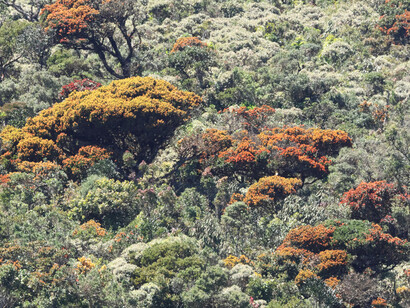
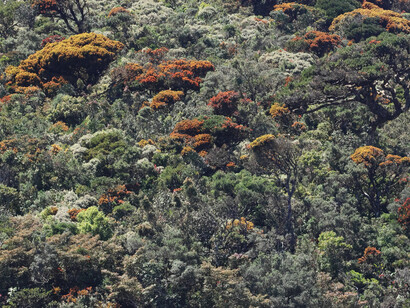
As the rising sun warmed the highlands, we entered Horton Plains National Park from the Ohiya entrance and were soon studying Oriental Honey-buzzards, which were soaring on thermals. The light in the thin mountain air is different, and familiar birds can look different, and we examined a perched honey buzzard to make sure it was indeed one. Horton Plains is also a good place to see birds that are confined to the highlands. Montane birds, including the Indian Blackbird and Pied Bush-chat, gave good views. A small flock of Sri Lankan white-eyes, an endemic bird, threaded their way through the lichen-draped Callophyllum trees. The elfin forests here are gnarled and stunted and festooned with lichens and moss. In the morning, tiny droplets of water condense on the lichens and glint like little jewels backlit by the rising sun. It is one of my favorite landscapes on the island, and the birdwatching became almost secondary to enjoying the special landscape. Sambar were present in good numbers, and we listened for any alarm calls that might signal the presence of its main predator, the leopard.
Being in Horton Plains is to watch a continuously changing landscape as the plains and stunted forests are hidden and revealed intermittently as swatches of mist drift in and shroud the landscape, only to drift away to unveil the forest again. On a previous visit, I heard the drama unfolding of a leopard closing in on a herd of Sambar (a type of large deer) in thick mist. The leopard’s presence was betrayed by the alarm calls of its intended prey. This time the focus was on birds, to watch them leisurely and enjoy them, and the forest setting with its many species of plants, which are confined to upper montane forests. A leisurely approach seemed to have worked well, as when Helen’s article was later published in the Financial Times, she wrote that Sri Lanka had reignited her love of birds.