English
 Español
 Français
 Deutsch
 Italiano
 Português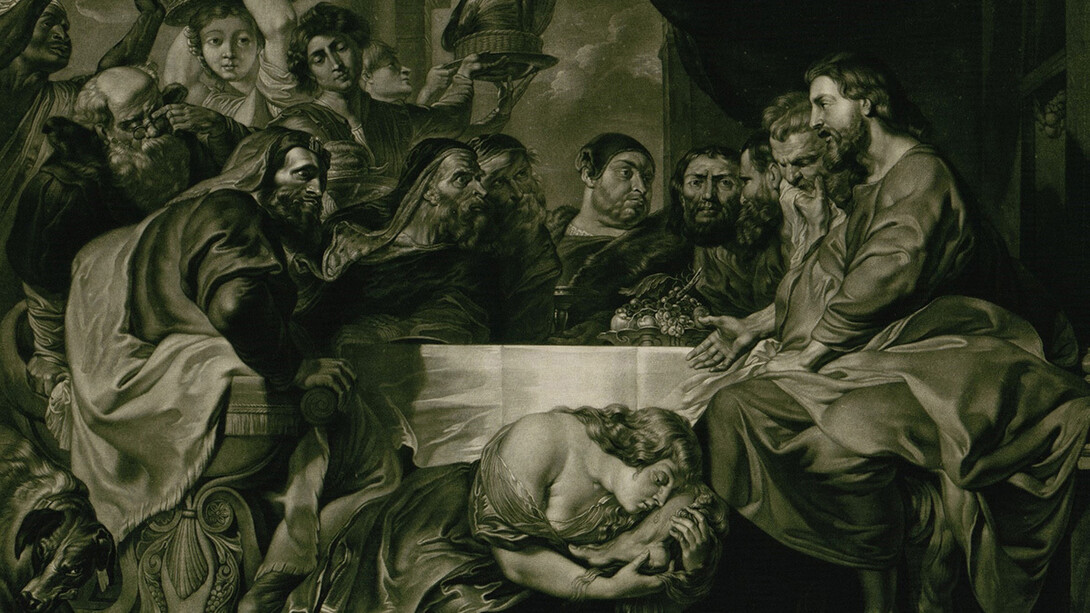
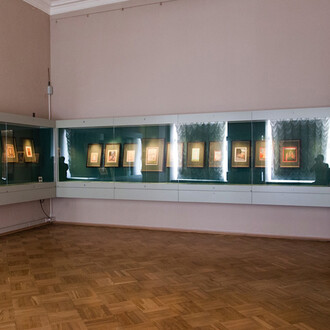
On 8 October 2025, the exhibition The hermitage picture gallery in prints, drawing and miniatures begins its run in the State Hermitage’s Gallery of Graphic Art. Visitors will see around 100 works of graphic art from the 18th and 19th century taken from the museum collection. Some have never been publicly displayed before.
The Picture Gallery can justly be called the foundation of the stocks of the Hermitage, one which underwent a long course of evolution, from the private collection of Russia’s monarchs to one of the largest museums in the world. The display covers the first 100 years of that course and invites visitors to view it through the lens of graphic art – prints, drawings, watercolours and miniatures.
The display opens with a section devoted to the story of the appearance in 17th–18th-century Europe of engraved galleries – publications reproducing masterpieces from major art collections that belonged to monarchs, senior statesmen and wealthy art-lovers. The exhibition features engraved reproductions from such publications of paintings that Catherine II acquired as part of the large collections of Gotzkowsky, Brühl, Crozat, Cobenzl and Choiseul, as well as a 1788 presentation copy of the publication of The Walpole collection from the library of Catherine II that recently returned to the museum’s possession. These reflect the character of the Hermitage picture gallery in the second half of the 18th century.
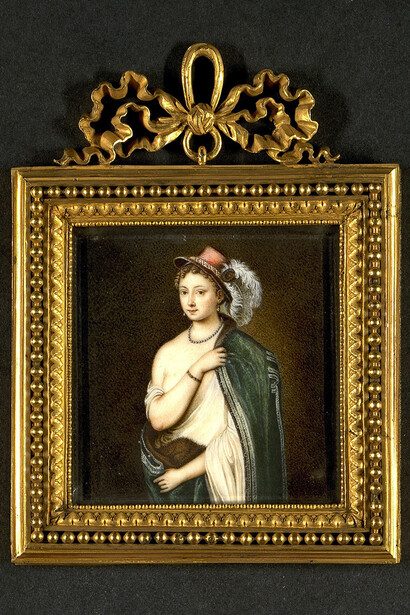
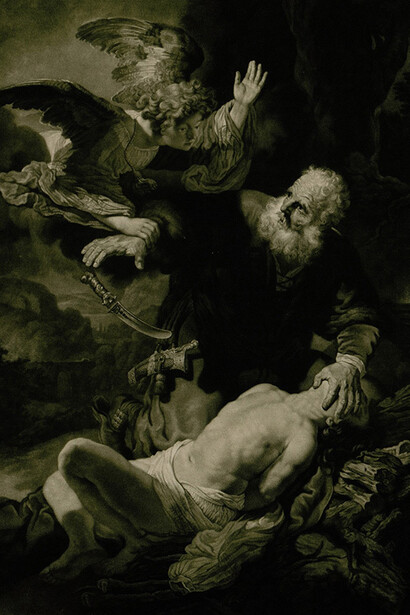
The following section traces the story of the creation of illustrated catalogues of the Hermitage’s painted masterpieces in the 18th and 19th centuries, beginning with the making of engraved reproductions and miniature copies of pictures to commissions from Catherine II and ending with the lithographed gallery. the pages of which were censored by Nicholas I personally. This section not only gives an idea of the composition of the collection at different times, but also shows the evolution of aesthetic preferences that manifest themselves in the selection of paintings and also in the choice of technique for their reproduction. On show here will be hitherto unexhibited mezzotint engravings by James Walker and miniatures from Catherine II’s collection, the first catalogue of the Hermitage gallery (1805) and the engraved plates used to print its illustrations, a lithographed catalogue (1844–52), and also individual pages from those publications, including rare trial impressions.
The incessant growth of the Hermitage’s collections demanded continual expansion of the premises that they occupied and the construction of new buildings, something that coincided in time with the gradual transformation of the imperial collection into a public museum.
That process found reflection in the technical drawings of architects enlisted to design the Hermitage buildings – Yury Velten, Giacomo Quarenghi, Leo von Klenze, which are presented in the next section of the exhibition. Although many projects remained unrealized, they still show how the museum was seen by those who commissioned and those who produced them. The paintings in these drawings are depicted schematically and are rarely identifiable, but the actual principle of their arrangement on the walls and the interaction between the pictures and the decorative finishing of the halls provides evidence of how people’s conception of an “ideal gallery” altered over time.
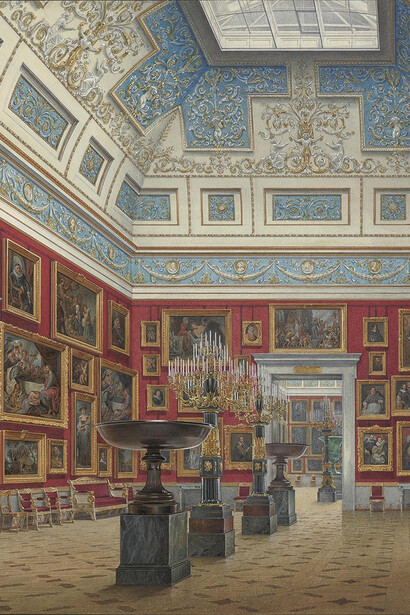
The final chord in the display is struck by the watercolour views of the halls of the New Hermitage produced by Eduard Hau, Luigi Premazzi and Konstantin Ukhtomsky, which demonstrate the authentic way the paintings were hung in the 19th century. These views form an image of an ideal museum, whose halls are filled with extremely precious works of art, selected with taste to be shown and carefully preserved for generations to come. The photographic precision and high degree of detail in the watercolours invariably arouse the admiration of viewers and attract the interest of specialists.
The display clearly demonstrates the unique role of graphic works, which, while possessing an artistic value of their own, form a very important source of knowledge about the history of one of the world’s greatest museums: from the first tentative attempts to catalogue the masterpieces to the creation of a public art collection of world rank.
The exhibition curators are Sergei Sergeyevich Orekhov, head of the Prints Sector in the State Hermitage’s Department of Western European Fine Art, and Yekaterina Mikhailovna Orekhova, a researcher in that department and keeper of the collection of architectural graphic art.
The State Hermitage Publishing House has prepared a scholarly illustrated catalogue for the exhibition – Kartinnaia galereia Ermitazha v graviurakh, risunkakh i miniatiurakh with scholarly texts by Sergei Orekhov, Yekaterina Orekhova and Yelizaveta Abramova.