English
 Español
 Français
 Deutsch
 Italiano
 Português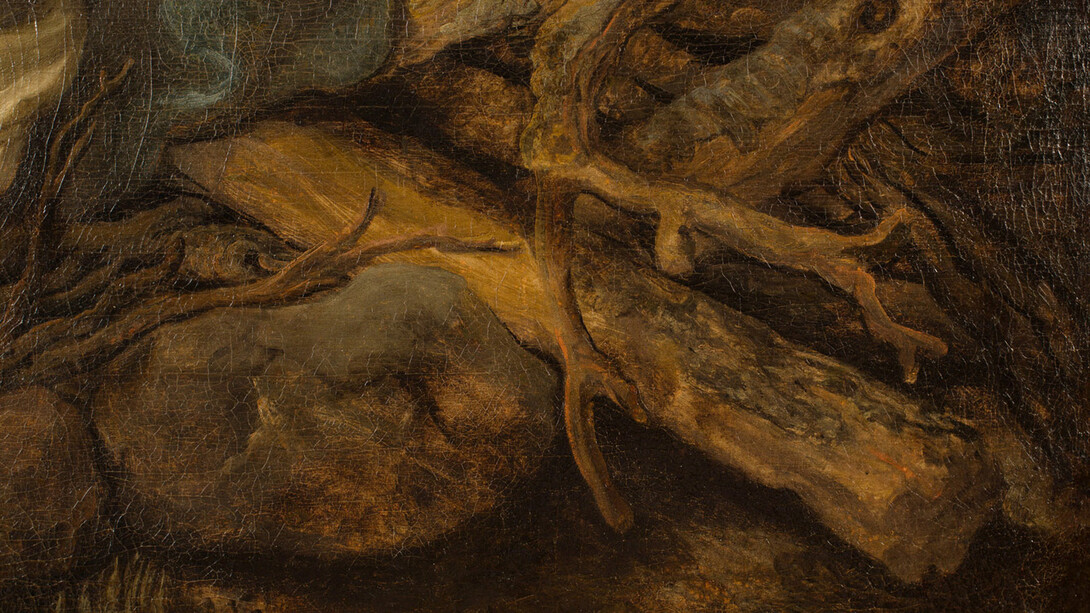
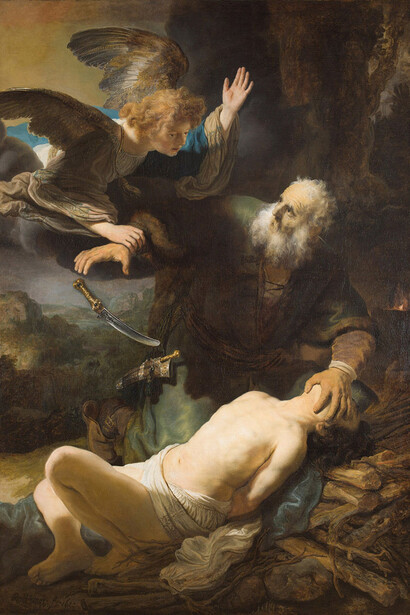
An exhibition titled Rembrandt: the sacrifice of Isaac. Conservation completed opened in the Apollo Hall of the Winter Palace on 10 December 2025. The Hermitage is presenting one of its most precious Rembrandts for the first time following a major conservation project: a large history painting depicting the famous Old Testament subject from the Book of Genesis (Gen. 22:1–19).
"We are presenting one of the Hermitage's principal masterpieces, one of Rembrandt's principal masterpieces, and a masterpiece of the whole of world art," Mikhail Borisovich Piotrovsky, General Director of the State Hermitage, commented. "It is now also a brilliant example of Hermitage conservation, where what prevents the viewer from engaging with the work is removed, while what many others would remove is left untouched: this is not 'commercial' conservation, the aim of which is to make a painting look pretty.
"The sacrifice of Isaac is not only a great painting by a great artist; it is a great story that lies at the foundation of the whole of European civilization; the biblical account of God preventing Abraham from carrying out the command to sacrifice his son, a story that defined stylistic features of European literature. In the Rembrandt Hall, The sacrifice of Isaac hangs opposite The return of the prodigal son (that is the Gospel's take on the father-and-son theme), further on is The descent from the cross (God the Father and God the Son), and Danaë, whose son kills his grandfather. This is the Hermitage's narrative about Rembrandt – an entire composition of highly diverse meanings. And we are very pleased to be helping visitors to read them."
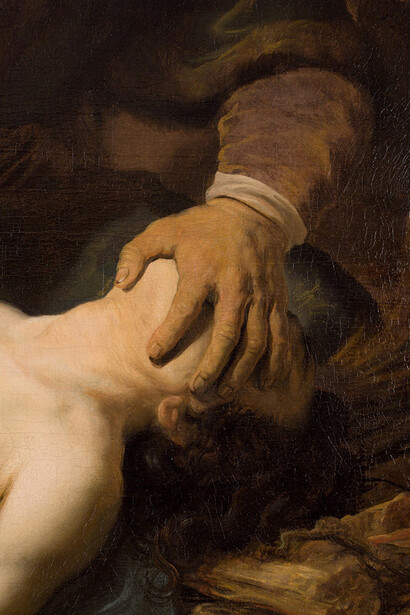
According to the biblical account, God set the pious patriarch Abraham a final test, commanding him to sacrifice his only son, Isaac. The composition presents the most complex, climactic moment of the narrative – Abraham has already raised the dagger over the submissive, defenceless body of his son, but an angel who suddenly appears stops the patriarch and declares the sacrifice unnecessary: God is now convinced of his faithfulness.
The sacrifice of Isaac is among the finest examples of Rembrandt's manner of the 1630s. It was created in 1635, when the young painter was taken with the Baroque style. The composition was influenced by works on the same subject by Pieter Lastman, Rembrandt's teacher, and his celebrated Flemish contemporary Peter Paul Rubens.
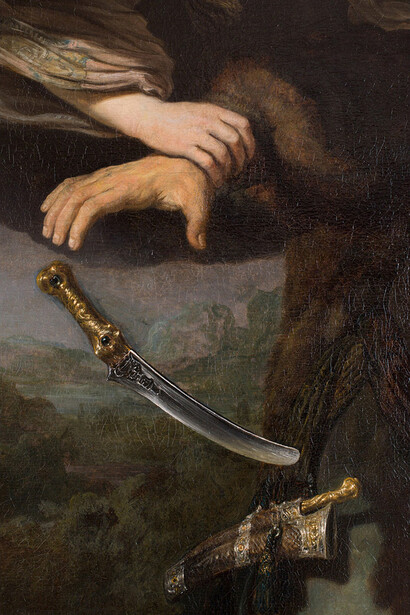
Rembrandt's interest in his predecessors' work was combined with a search for new expressiveness. The artist rejected a literal interpretation of the textbook subject: the angel does not merely exhort the prophet from heaven but actively intervenes in the action, grabbing Abraham by the wrist. Through the immediate connection between the three figures – the angel, Abraham and Isaac – a concentration of the dramatic effect is achieved.
With astonishing painterly power and clarity, Rembrandt captured the protagonist's profound perturbation in the face of divine intervention. The complex pose of the patriarch and the minutest details of his face (slightly reddened eyelids, traces of tears still damp on his cheek and a solitary teardrop caught in his grey beard, his mouth slightly agape) convey the dichotomy of his emotions: a mixture of despair and unwavering faith. The figure of Isaac, with his hands tied behind his back, lying submissively at his father's feet, is among the most impressive depictions of the nude in the Dutch master's painting. The falling blade emphasizes the suddenness of the event, while simultaneously demonstrating the incredible power of the artist's creative imagination.
With its rich composition, this history painting signalled the emergence of a painter who surpassed all his Dutch contemporaries. In the first half of the 18th century, the canvas was in the famous picture gallery of the British Prime Minister Sir Robert Walpole (1676–1745). Then in 1779 Empress Catherine II purchased the Prime Minister's collection from his descendants, and The sacrifice of Isaac entered the Imperial Hermitage. A partial copy of the painting, made by one of Rembrandt's pupils in 1636 and now in the Alte Pinakothek (Munich), is also known.
As an inscription on the reverse of the canvas attests, in 1850 the Hermitage painting was transferred from its old, decayed canvas to a new one by Feodor Tabuntsov (a restorer's name and the date were only recorded in the case of flawless work). In the 20th century, The sacrifice of Isaac was evacuated twice during the world wars.
Over the years, old retouchings that had changed in tone became visible on the painting's surface, along with a prominent seam at the join between pieces of canvas and various forms of stiff craquelure with raised edges threatening to flake. Only after scrupulous technical and technological studies confirmed the preservation of the original primer did the Hermitage specialists decide to begin conservation.
The step-by-step methodical work of uncovering the original paintwork from thick, yellowed varnish and later overpainting, as well as consolidating and conserving it, was carried out over four years. The highly complex conservation was undertaken by Victor Anatolyevich Korobov, Head of the Laboratory for the Scientific Restoration of Easel Paintings at the Hermitage, an restorer-artist of the highest category.
The results achieved have exceeded expectations. The sacrifice of Isaac once again appears in its original, cool, harmonious colouring, emphasizing Rembrandt's phenomenal painterly technique, while now clearly seen details of the composition permit a deeper understanding of the work's concept.
The exhibition displays photographs of the painting under ultraviolet and infrared light, as well as through a stereomicroscope, and electronic microphotographs taken at various stages in the research and conservation work.