English
 Español
 Français
 Deutsch
 Italiano
 Português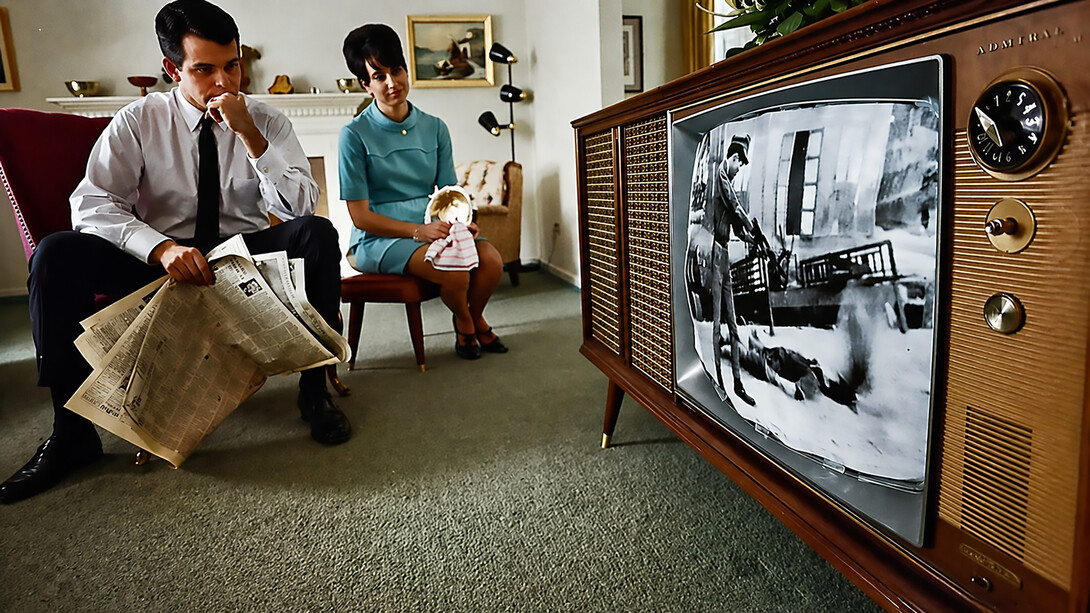
The Gulf War in 1991 did not happen. At least, if you listen to French philosopher Jean Baudrillard.
That sounds like intellectual provocation, and it partly is. But Baudrillard wasn't denying that bombs fell or that people died—over 100,000 Iraqis, by most estimates, with many more following from the sanctions regime that crushed the country afterward. He was pointing at something far stranger: the Gulf War marked the moment when the spectacle of war became more real than the war itself.
The explosions on screen, the guided missile footage, and the choreographed press briefings where General Norman Schwarzkopf performed the role of strategic mastermind—all of it created a simulation so compelling that the actual carnage simply disappeared from view. War had been domesticated, made safe for primetime consumption. And in its wake, he argues, something terrible was born from the already existing terror of war.
I've been thinking about this lately because the legacy of that 'dead 'war—that is, war stripped of its reality and packaged for entertainment—didn't end when the last tank rolled out of Kuwait. It metastasized. And its blowback, when it came, arrived in forms that America never saw coming and in weird and eerie ways: first in Oklahoma City, then in Manhattan, then in a thousand smaller violences that we've since learned to live with.
The image of war
Wars have always been fought with images, by the image, and for the image. From the Alexander Mosaic of pre-Christian antiquity, depicting Alexander the Great chasing a fleeing Darius at Gaugamela, to Joe Rosenthal's carefully staged 'Raising the Flag on Iwo Jima,' the image has always been a tool of power. As Susan Sontag observed, war images 'simplify, they agitate... create the illusion of consensus.' They bind the viewer to the will of their creator, elevate the joint experience of conflict, or denounce it. They create a spectacle.
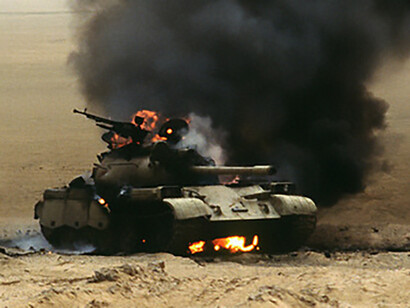
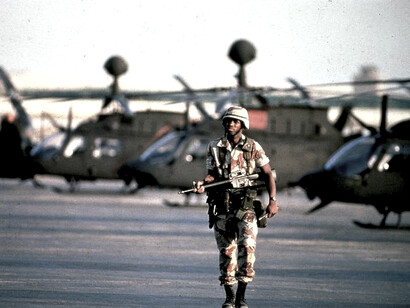
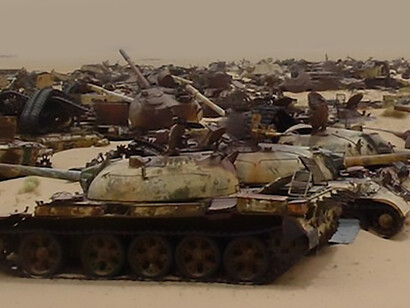
But the Gulf War represented something qualitatively different. Here was a conflict explicitly designed for visual consumption. It was a war whose primary battlefield was arguably the television screen itself. The stunning display of American technological supremacy was the point. In 100 hours, the premier army of the Third World had been routed, and images of mass Iraqi surrenders flooded the press. A testament, we were told, to the folly of opposing American techno-warfare.
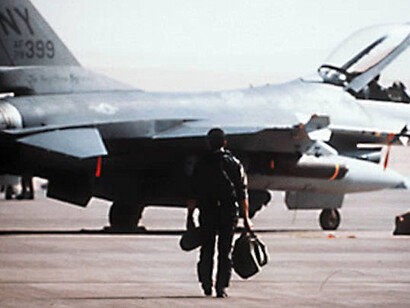
Recall the most famous images: the fury of jet fighter squadrons over a burning landscape, columns of advancing Coalition infantry wandering through a ghostly terrain without foes, and the lights and lasers of satellite-guided cruise missiles hitting their pixelated targets. The pure power of the American unipolar moment, exhibited for all to see. The US military operated, as one historian put it, with 'almost impunity.'
"Our wars have less to do with the confrontation of warriors than with the domestication of the refractory forces on the planet." —Baudrillard.
The myth of the smart war
In this, it’s important to differentiate between what actually happened versus what America watched happen. Military theorists in the late 1980s had developed concepts like the 'Revolution in Military Affairs' and 'Network Centric Warfare'—doctrines emphasizing that information was the key to lifting the 'fog of war.' Smart technology would enable surgical precision, minimal casualties, and clean victories.
Defense contractors pushed the phrase 'one target, one bomb' like it was gospel. The creator of the Paveway III laser-guided bomb claimed exactly this utility, which in turn became a phrase eagerly adopted by the Department of Defense when speaking to the media.
The reality? Only 7.5% of munitions dropped were actually precision-guided. The rest were conventional bombs raining down from B-52s, the same as they had over Vietnam, Korea, and the whole blood-stained 20th century. One navigator described it simply: they 'opened the bomb bay doors and dropped the weapons into the dark.' More kilotons fell on Iraq than in previous American conflicts combined when you adjust for duration. The official evaluation of the air campaign later noted that 'no fewer than two laser-guided bombs were dropped on each target' and 'six or more were dropped on 20 percent of the targets.' So much for one bomb, one target.
But none of that made it to American screens. What made it to the American screen was a carefully curated light show, warfare as a fireworks display, and even killing as a Nintendo game. The only tangible difference from previous wars was simply the sheer volume of firepower delivered, condensed into a tiny geographic area, at a foe who could do little to retaliate.
The CNN effect
CNN pioneered something unprecedented in this with the emerging configuration of a 24-hour war as entertainment. They deployed mobile ground uplinks to newly launched satellites, stationed reporters, and ordered transponders—a vast infrastructure project designed for continuous coverage. When the first bombs fell on Baghdad on January 16, 1991, destroying all power and communications in the city, anchor Bernard Shaw delivered that iconic line, 'The skies over Baghdad have been illuminated,' and so a new era of media warfare began.
The Guardian called the coverage a 'hypnotic spectacle' of 'moving graphics and death-dealing explosives,' comparing it to 'a desensitizing, addictive arcade game.' They weren't wrong. Americans couldn't look away. CNN achieved the largest rating ever won by a basic cable network in primetime.
Peter Arnett, CNN's reporter who remained in Baghdad after other Western journalists were expelled, was actually filming the war's reality on the ground. The destroyed infrastructure, the civilian casualties, and the Amiriya bombing, where American precision weapons struck a civilian shelter and killed hundreds. He captured all of it. His footage was actively suppressed by his own network.
CNN received around 2,000 daily complaints, be they calls, letters, or faxes, from American viewers who didn't want to see such suffering on their evening news. They wanted the fireworks, not the funerals. They wanted the spectacle, not the suffering. Much of Arnett's work explored themes unpopular to the viewer back home: the experience of living under sustained US bombardment, the systematic destruction of national infrastructure, and the impending humanitarian crisis. Little of it ever made it out, except in snippets.
Meanwhile, the US government had learned well from Vietnam. No more embedded reporters wandering into uncomfortable truths. The Department of Defense implemented strict media accreditation and access protocols. So restricted was access to actual combat that one CBS journalist wondered aloud if he was 'with the Soviet Army.' The Washington Post noted that 'the largest armored movement in history' occurred, and essentially no one saw it.' One reporter, Vaughan Smith, actually infiltrated events by impersonating a British officer and being adopted by a US unit. His videos remain the only ones of their kind depicting actual combat in the war.
What remained for press briefings were desperate reporters who became points of derision. Even NBC's Saturday Night Live satirized their efforts to 'elicit information helpful to the enemy.' The ideal of reporting objectivity had been replaced by subjective impressionism, and General Schwarzkopf could perform as the master strategist who crushed Iraq in but a few days of battle.
General Colin Powell summed it up perfectly: a 'clean win.' And Americans watching at home could take solace in that.
The bill comes due
Violence, once sanitized, doesn't simply evaporate. It accumulates interest. Baudrillard called this 'symbolic exchange.' In short, it is the idea that mediated violence eventually demands a real reckoning. If the Gulf War represented an essentially simulated conflict where America 'fought the same war in respect of world opinion—via the media, censorship, and CNN—as they fought on the battlefield, thereby denying the agency of real suffering, then the return of violence to the American heartland represented the unmediated blowback.
Consider this: a young Saudi named Osama bin Laden watched the Gulf War unfold from house arrest in his home country. He'd offered his mujahideen fighters to defend Saudi Arabia from Saddam Hussein's Iraq. Instead, the House of Saud invited American soldiers—to them, Christian soldiers, bearing religious symbols—to station themselves on sacred Muslim land. The bombing sorties took off every hour from Saudi airports.
Despite regarding Hussein as a 'Scotch-drinking, woman-chasing apostate,' bin Laden saw the destruction of a Muslim nation by American forces as an unforgivable indignity. He later called it 'a clear declaration of war on God, his messenger, and Muslims.' The sheer influx of American weapons and units only reinforced the powerlessness he and other Sunni radicals felt in the face of this war waged on their Muslim neighbors. The seed was planted.
Bin Laden understood something crucial about America: its addiction to spectacle. So when he planned his response, he chose the most media-saturated city on Earth and turned America's own media apparatus into an amplifier of terror. The commandeered Boeing 767s were, in a grotesque way, human-guided precision missiles, a dark mirror of the smart bombs Americans had celebrated a decade earlier. By 'placing upon the media the demand that it report and thereby spread their gift of death,' bin Laden forced the spectacle to consume itself.
September 11th was the return of the real. Nearly 80 million Americans watched it unfold on cable news, and for once, the language people reached for was revealing: 'unreal,' 'surreal,' 'like a movie.' The simulation had so thoroughly colonized American consciousness that actual mass death felt like fiction. The paradigm had inverted itself.
The monster next door
But the first blowback wasn't foreign. It was homegrown, in the form of a decorated Gulf War veteran named Timothy McVeigh, and his story reveals something perhaps even more disturbing about what sanitized warfare does to those who actually fight it.
McVeigh served as an infantry sergeant and saw things that never made CNN. He called in an airstrike on a truck, something 'no one could possibly have survived,' then watched Army officials deny on television that any such strikes had occurred. The lie dismayed him. 'I hated to hear the Army lie,' he later said, 'to soldiers or the public.' The seed of his cognitive dissonance had been planted.
His platoon received friendly artillery fire that left him feeling 'extremely helpless'—'random death from above,' he called it. And at the 'Highway of Death,' where the retreating Iraqi army was trapped and annihilated in what many called 'the grisliest scenes of the war' and which entailed carnage so severe that some credited graphic descriptions with catalyzing George Bush's cease-fire declaration, McVeigh confronted what the American viewer never had to: 'unspeakable carnage, hideously charred bodies, some of them with their heads or limbs blown off. Some bloated to the size of cows as they rotted in the sun.' These were experiences he would ruminate over bitterly in his diary for years, amongst other disaffections with modern American life.
He came home broken, suffering from what we'd now recognize as Gulf War Syndrome, and increasingly convinced that the gap between America's mediated self-image and its actual violence was a form of propaganda. When federal agents killed civilians who had holed up with the Branch Davidian Cult at Ruby Ridge and Waco, 76 Branch Davidians, including two dozen children, were massacred in the latter—McVeigh saw the same playbook in the use of overwhelming force, sanitized for consumption. It does bear pointing out at this point that McVeigh, in the aftermath of the war, had become subsumed in a burgeoning Neo-Nazi and White Power movement that sought to exploit his grievances and disaffection through their extreme identitarian practices.
'These experiences gave me a very unique and personal experience with, and perspective on, Wartime propaganda,' he wrote. 'Returning home from war, I recognized the same propaganda being utilized against American citizens—first Ruby Ridge, but really bad at Waco. Wartime propaganda being used against Americans!'
His forensic psychologist, Dr. John Smith, assessed that McVeigh wasn't deranged or mentally ill. His terrorism was 'a conscious choice on his part, not because he was deranged, but because he was serious.' When he bombed the Oklahoma City Federal Building on April 19, 1995, killing 168 people, he believed he was returning the 'real' to an America that had forgotten what its violence actually looked like. He proudly went to the executioner's chair, where he died with his eyes open.
The wheel keeps turning
Susan Sontag once observed that 'we don't get it... We can't imagine how dreadful, how terrifying war is... That's what every soldier, every journalist and aid worker, and every independent observer who has put in time under fire and had the luck to elude the death that struck down others nearby stubbornly feels. And they are right.'
But the Gulf War's innovation wasn't just failing to communicate war's horror; it was actively constructing a palatable alternative, a war-as-entertainment that American audiences could consume without discomfort. The decisions that shaped this spectacle were cast, as Sontag noted, 'as judgments about good taste—always a repressive standard when invoked by institutions.' They denied the agency of real suffering and death.
Both bin Laden and McVeigh, in their own monstrous ways, understood the power of this symbolic exchange. They understood that sanitized violence creates a debt that eventually comes due. They turned America's own media machinery against it, forcing viewers to confront what had been hidden behind green-tinted footage and choreographed press briefings.
Yet even these cataclysmic returns of the real were eventually absorbed. The media, understandably hesitant to portray viscera despite Ground Zero resembling a battlefield, with 'body parts and luggage scattered on the ground, a human hand pointing at me on the pavement,' as one first responder recalled, found ways to sublimate the horror. A 'strange dialectic of trauma and triumphalism' emerged, as photographers captured the iconic image of firemen raising the flag at Ground Zero—a conscious echo of Iwo Jima—and editors at the Bergen Record exclaimed, 'That's not a picture... It's a fucking icon.'
America found a way, once again, to transform disfigured bodies into spectacle. The exceptionalism of the nation merged with an exceptionalism of the event, sublimating the reality of horror into a narrative of its own suffering.
The uncomfortable truth is that McVeigh's 'aberration' has since been normalized. Young American men committing stochastic violence is now as much a symbol of our current moment as the smartphone in your pocket. His 'unrecognizable monster' label and the attempt to cast him as 'Oswald's ghost' were really just another form of sublimation—refusing to recognize that this was simply a human who could no longer tolerate what he perceived as violent contradictions at the heart of American power. Ascribing the supernatural to such a man is to misunderstand his and bin Laden's reverence for symbolism.
Baudrillard warned us that violence mediated and sublimated doesn't simply dissipate. It circulates, returning in ever more unpredictable and devastating forms. The Gulf War's legacy isn't merely military or political. It's a cultural and psychological rupture, a distortion of reality, that inevitably keeps inviting its own correction—and those fatal consequences that accompany it.
Sources
Buncombe, Andrew. "'He Died with His Eyes Open': Inside the Execution of Timothy McVeigh." The Independent, October 12, 2021.
C-SPAN. "A Clean Win in the Persian Gulf," February 21, 1991.
CNN. "The Skies Have Been Illuminated." CNN, January 1, 1991.
Katovsky, Bill, and Timothy Carlson. Embedded. Globe Pequot, 2003.
Laden, Osama Bin. "Declaration of War against the Americans Occupying the Land of the Two Holy Places" (August 23, 1996).
Laden, Osama bin. "World Islamic Front Statement Urging Jihad against Jews and Crusaders," February 23, 1998.
McLean, Nicola. "Ground Zero 360," 2014.
Loyn, David. Frontline: Reporting from the World's Deadliest Places. Summersdale, 2011.
The Alexander Mosaic (University of Oxford Cabinet).
Bond, Lucy. Frames of Memory after 9/11. Springer, 2015.