English
 Español
 Français
 Deutsch
 Italiano
 Português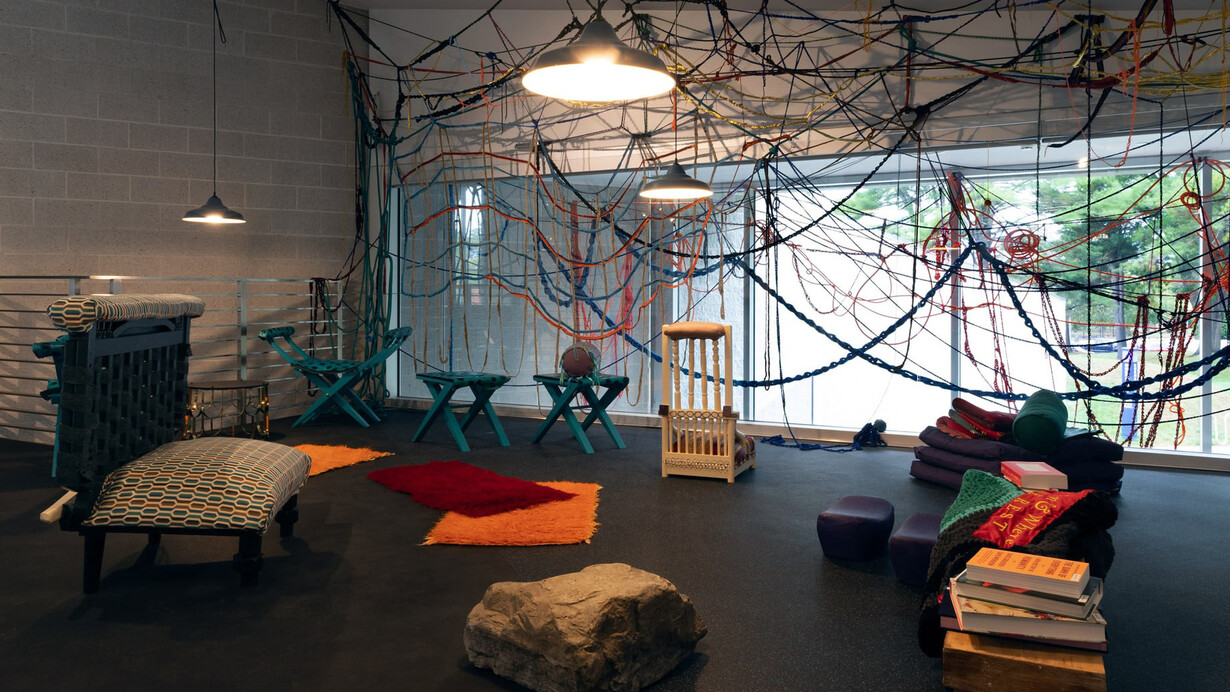
Everyone rests in one way or another. But what does rest look and feel like—inside each of us and to the outside world around us? Must we steal moments to be able to rest, and when we do so, what parts of our bodies or minds are still active? Do we rest too much or too little? And who decides what’s enough or too much? These questions are universal, but the answers are as individual as each of us.
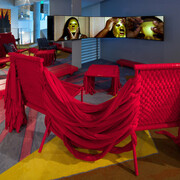
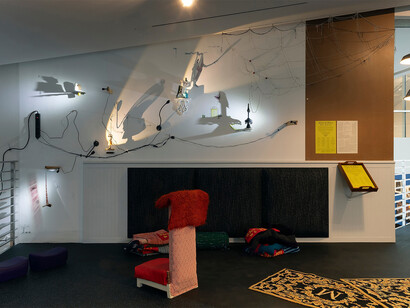
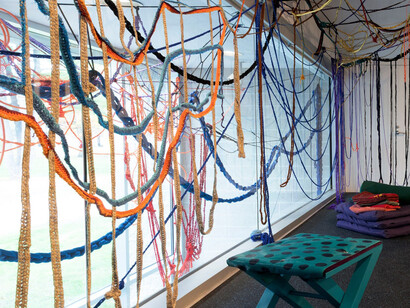
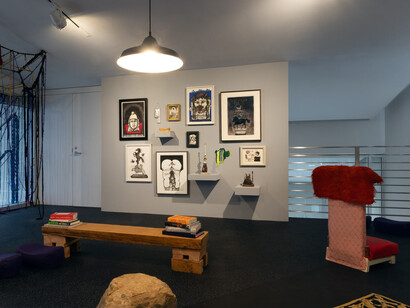
These questions and many more are at the heart of Sheila Pepe’s new immersive installation on the Tang Museum’s mezzanine. Drawing on Pepe’s ongoing interest in the material culture of religion, sociology, queer theory, ancient Greece and Rome, and the Silk Road, When and where we rest presents the objects that support our bodies during contemplation, ritual, and sleep. The installation is furnished for visitors to gather as individuals or groups, providing space for both rest and discourse. An exploration of the meanings and implications of rest in the past, present, and future, the project invites us to consider rest’s complexity, subjectivity, and multiplicity—and the rest is up to you.
A key element of the installation is a broadsheet that serves as both a takeaway for visitors and as a visual element of the exhibition, wheat-pasted to the wall. The broadsheet’s recto provides an overview of the exhibition, while the verso is dedicated to exploring ways of thinking about sleep. Excerpts from Sappho, Walt Whitman, and Salman Rushdie are reflected on and responded to by fellow poets and writers April Bernard, Peg Boyers, Selby Wynn Schwartz, Aliza Wong, Moe Angelos, and Raffaela Silvestri.
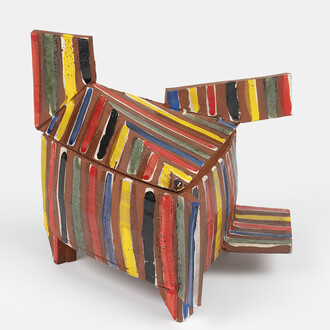
Sheila Pepe is best known for crocheting large-scale, ephemeral installations and sculpture made from domestic and industrial materials. For more than 30 years she has accumulated a family resemblance of works in sculpture/installation/drawing, and other singular and hybrid forms: sometimes drawings that are sculpture, or sculpture that is furniture, fiber works that appear as paintings, and tabletop objects that look like models for monuments and stand as votives for a secular religion. The cultural sources and the meanings that are intertwined draw from canonical arts of the 20th century, home crafts, lesbian, queer, and feminist aesthetics, 2nd Vatican Council American design, an array of Roman Catholic sources as well as their ancient precedents. The constant conceptual pursuit of Pepe’s research, making, teaching, and writing has been to contest received knowledge, opinions, and taste. Among her recent honors, she is the 2024-25 Henry W. and Marian T. Mitchell Rome Prize Fellow at the American Academy in Rome. She lives and works in Brooklyn.
![Nan Goldin, Mark tattooing Mark, Boston 1978 [from The ballad of sexual dependency] (detail), 1978. Courtesy of Tang Museum](/attachments/ff50b31f2f7bf5b10e6278ea274caccdd3a14e38/store/fill/330/330/10a8130fdd2df7b01aa074ed826351e332aeb7f661fffe953660cbd616ee/Nan-Goldin-Mark-tattooing-Mark-Boston-1978-from-The-ballad-of-sexual-dependency-detail-1978.jpg)