English
 Español
 Français
 Deutsch
 Italiano
 Português
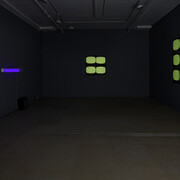
Cosmos falling includes works by Xin Liu, (The white stone, 2021); Lawrence Lek (Geomancer, 2017); Yuyan Wang (The moon also rises, 2023); and Angela Su (Cosmic call, 2019), which employ pseudo-documentary and speculative fiction as filmic techniques to re-animate the afterlives of technical objects, while also questioning an aesthetics of failure that surrounds the cosmic, technological frontier. From missiles, rockets, comets, satellites, to artificial moons, each narrates what has been left in their wake and what emerges in the terrestrial ruin. Bordering on science fiction with Sinofuturist underpinnings that push beyond cyberpunk tropes, these works also enact a kind of embodied performativity between various bodies and subjectivities that reflect a reverse trajectory: falling from the heavens, cosmic frontier, lower orbit, sky, back to earth.
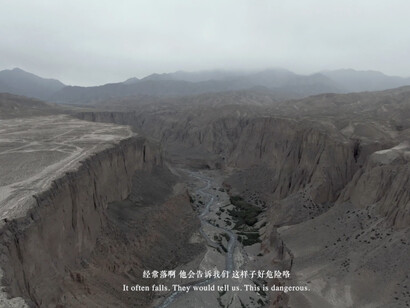
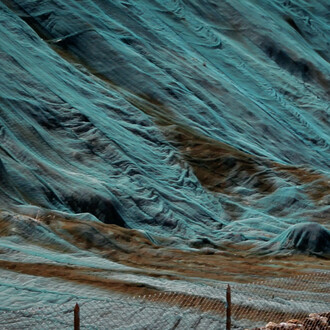
For centuries, humans have built worlds and cities on top of the ruins of the old ones. Now, we are entering an age where civilization is building a world at the highest point from the planet's surface, the lower Earth orbit. In The white stone, Xin Liu (b. 1991 Xinjiang, based in London) postulates a future history of rocket debris abandonment and recovery through a “hunt” for abandoned rocket debris in remote areas. The protagonist sets off across valleys and villages and into the desert in the southwest of China in a search for the debris of rockets fallen since the 1990s. Shifting our gaze from the sky back to the ground, this filmic work reexamines the life span of technologies, marking the terrestrial death of an extraterrestrial object.
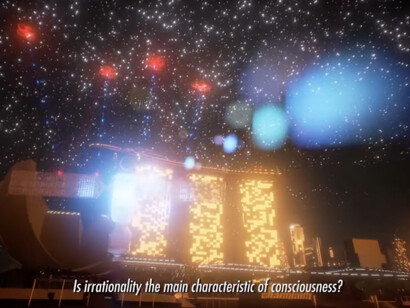
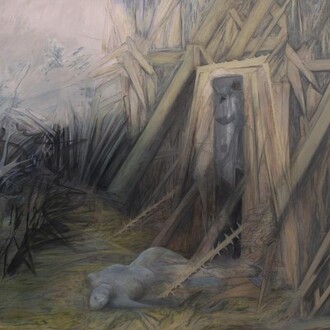
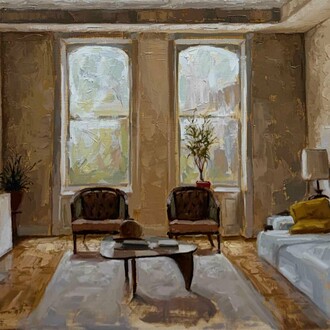
Lawrence Lek’s (b. 1982 in Frankfurt, based in Berlin) Geomancer is a computer-generated animation about the creative awakening of artificial intelligence. Set in Singapore on the eve of the island nation’s centennial in 2065, the film tells the story of a decommissioned environmental satellite that wishes to become an artist. Geomancer imagines the crisis that might happen when the world has become a techno-industrial complex run by a posthuman intelligence, and creative originality is no longer be considered novel.
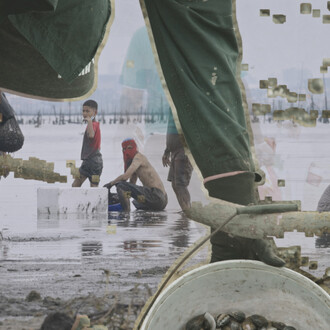
Yuyan Wang’s (b. 1989 in Qingdao, based in Paris) The moon also rises portrays a nocturnal community based on overpowered efficiency – a community active, available, connected, where the mysterious zones are replaced by a homogeneous brightness. Set just before the launch of artificial moons into space to eliminate the difference between day and night, a retired couple finds their harbor in the fading darkness. Trying to catch up with the pace of modernity, their daily life traces this forthcoming brightness back to its earthly origins.
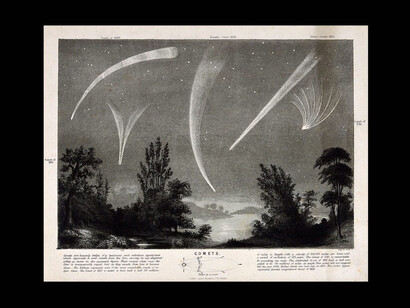
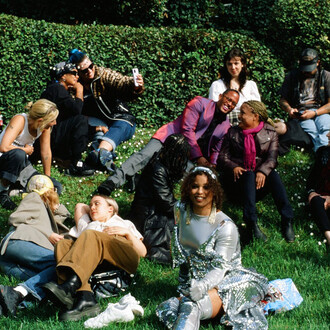
In Cosmic call by Angela Su (b. 1985 in Hong Kong, based in Hong Kong) a documentary voiceover proposes a series of facts and fiction woven together to create an alternative understanding of epidemiological outbreaks, while pointing to the danger of reducing all knowledge to scientific terms. Assembled from a variety of historical and imaginary sources—such as comets, satellite initiatives, and TCM archives—the work indeed brings forward all sorts of accusations, conspirations, affinities, and illusions, which culminate in a transformative, gothic action involving deliberate exposure to a series of viruses.
Cosmos falling is curated by Danni Shen, Senior Curatorial Assistant, Carpenter Center for the Visual Arts at Harvard University. A gallery guide accompanying the exhibition features a commissioned essay by Yutong Shi, Curatorial Assistant in the Department of Contemporary Art at the Museum of Fine Arts, Boston.