English
 Español
 Français
 Deutsch
 Italiano
 Português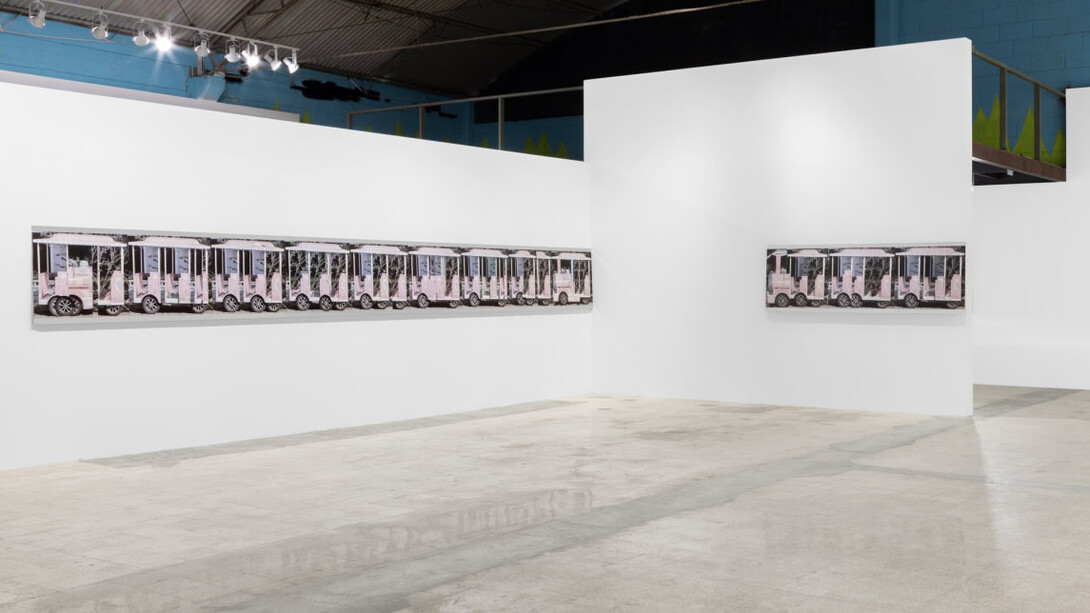
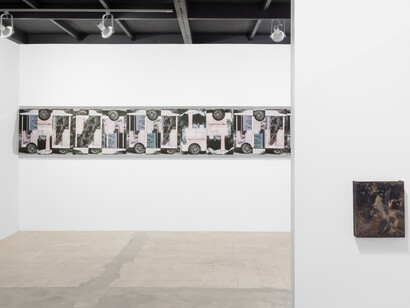
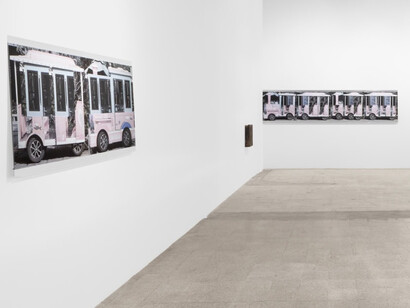
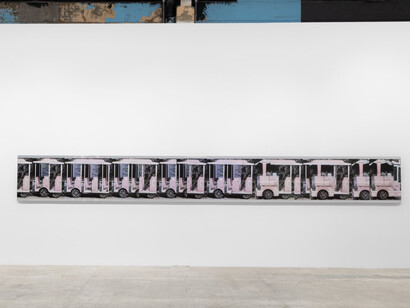
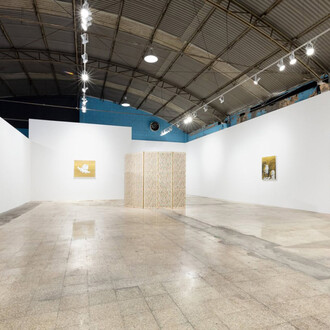
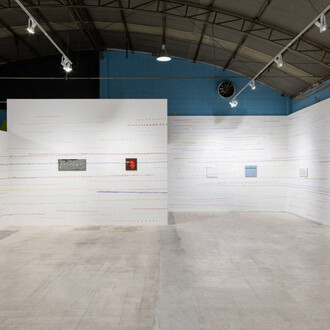
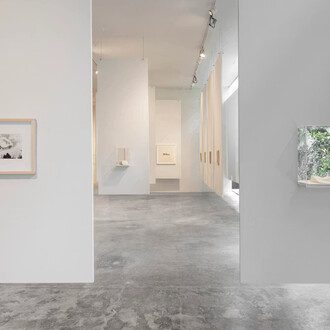
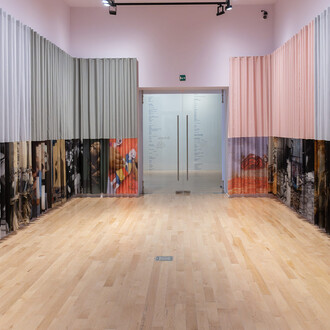
For his third exhibition at Gaga, Peter Fischli begins with arrivals. On entry, peculiar trains roll into view. Trackless trains (2025), each composed of two motifs—a locomotive and a coach—are reproduced and coupled into elongated, modular formations. Some of Fischli’s trains seem to stand still while others rush past—collaged as if compressed—creating illusions of speed and artistry. Even as they follow a single linear metal guardrail fixed to the wall, the composition runs in double tracks—train composition and artistic composition—each turning the other into its subject. Since its emergence in the nineteenth century, train travel has symbolized not just physical journeys but mental voyages along imaginative routes. Today, fitted with street-legal tires, the tank locomotive shuttles tourists from one location to another. Within its windowless cars, the external world itself becomes the main attraction, ideal for photographs unobstructed by any reflection. A single loop around the Zócalo—passing the National Palace, the Metropolitan Cathedral, and the giant flag—transforms these landmarks into prime backdrops for the “I’m-in-Mexico-City” selfie. The nostalgic design of these tourist vehicles has become a global standard. This skeuomorphic feature reflects a universal longing, akin to smartphone filters that emulate vintage aesthetics. Yet these trains are merely empty shells, visual echoes stripped of steam and rails. That absence invites reflection on authenticity and nostalgia, and the absence prompts us to consider what remains once form is severed from function. As the train completes its circuit of the gallery, the question returns to us as a loop: what’s left to see when originality has run out of steam?
Picking up on this very question, the video Cinema (2024) traverses scenes captured in the subway networks of Hangzhou, New York, and Zurich, at times inverted or anonymized. Although some sequences were shot on location, the recurring moiré patterns indicate that other film material was recorded indirectly from screens. Jump cuts between a personal travelogue and found footage let one’s sense of direction falter. The film interrogates the camera’s transformative impact on our perception of reality while referencing foundational moments in cinema history, notably Arrival of a train at La Ciotat (1897), the 50-second silent film by the Lumière brothers. Cinema also echoes Dziga Vertov’s dynamic train sequences in Man with a movie camera (1929) by employing skewed angles and fragmented perspectives. By appropriating avant-garde cinematic techniques, Cinema presents a topsy-turvy exploration of the contemporary, globalized metropolis, a critical reflection that highlights circulation, repetition, and the relentless energy of perpetual flux. Like the trackless trains, the film runs in a loop, a gentle whirl of transit, mostly underground, whose spa-soft soundtrack works like a sonic undertow, transporting us away from what is depicted: the draining reality of the daily commute.
From subway to subculture, this double track sets the stage for Rehearsal (2023), a sound installation in the gallery courtyard, heard as faint, muffled audio rising through a steel grate from the access shaft below. The sound suggests a band practicing in a basement, as if something underground were about to surface. Barely audible, the piece tests what counts as “underground,” spatially and culturally, crossfading between the perceived and the impending, between the present and what has yet to surface in the city’s cultural landscape. A fleeting, poetic moment for the ear, Rehearsal hints at the private, often overlooked space of artistic becoming: practice before performance, process before product. The imagined jam space belowground stands in for the infrastructure that sustains not only creative labor but also urban life itself.
In the new vitrine sculpture, Silhouettes (2025), narrow paper strips stand upright on spread-out sheets of A4 office paper. Using this standard stock as its base, the vitrine stages a room within a room, less a white-cube model than an office mock-up. At first glance, the stencil-like slips could be an audio trace, a failed polygraph, or a pocket Rorschach test. Look again and they resolve into ninety-degree rotations of mirrored skylines. The mirroring makes sense for Manhattan, ringed by water, and seems faintly absurd for other cities until one recalls how metropolitan real estate everywhere aspires to “waterfront” status. What is reflected in this artwork is the template nature of cities themselves: crisp silhouettes of signature buildings ready for coffee mugs, tote bags, or forearm tattoos—the metropolis as trademark outline. The term “silhouette” matters here. It traces back to the French finance minister Étienne de Silhouette, whose 1750s austerity measures made his name shorthand for all things cheap. Shadow portraits—affordable when painted likenesses were not—carried the term into popular use. Silhouettes turns back to Étienne by offering an economy of outlines for cities that, having branded themselves alike, now coexist as shadows of what they once were.
(Text by Andreas Selg)