English
 Español
 Français
 Deutsch
 Italiano
 Português
New Zealand’s export sector offers a compelling case study for global observers. Despite its small size, the country saw total goods exports reach NZ$74 billion in 2025, with meat surpassing NZ$10 billion for the first time. The United States overtook Australia as a key destination for beef, dairy, wine, and niche manufacturing products.
Yet strong export figures have not fully translated into domestic prosperity. Households face ongoing cost-of-living pressures, the New Zealand dollar remains sensitive to global shocks, and productivity gains lag international peers.
This paradox is familiar to many European and North American markets where smaller or mid-sized economies face similar structural constraints.
Countries such as Ireland, Portugal, or the Baltic states often rely on a few high-value exports or multinational investments. Even when export revenues grow, domestic income and productivity can lag, exposing vulnerabilities in household resilience and broader economic stability. Yet for New Zealand and its peers, the next phase of growth—moving decisively from price takers to value shapers—offers a pathway to reconnect export strength with rising domestic incomes.
At the core of this challenge is New Zealand’s structural position as a price taker. Primary exports—meat, dairy, forestry, and horticulture—are commodities traded in highly competitive global markets, leaving margins largely determined offshore. Beef exports to the US reached NZ$2.6 billion in 2024, yet pricing followed global benchmarks and US tariff policy. Dairy and other agricultural exports remain sensitive to supply shocks and regional demand swings.
Quality and provenance differentiate New Zealand products, but they do not confer unilateral pricing power. Strong exports alone do not automatically strengthen the currency or lift widespread prosperity. In 2025, the NZD remained volatile due to global market conditions, divergence from the US Federal Reserve, and a structural current account deficit driven by high imports of energy and capital goods.
-2020-2025.jpg)
NZ Trade Balance: Exports vs. Imports (FOB vs. CIF) 2020–2025.
The US tariff environment in 2025 highlighted vulnerabilities. A 15% reciprocal surcharge on many imports initially squeezed margins, but later relief for beef, offal, and kiwifruit restored competitiveness. Small economies cannot dictate global policy—they must adapt through pricing strategies, contracts, and market diversification. Positive steps include expanding free trade agreements via CPTPP, the UK, and the EU; negotiating US tariff relief; and enhancing NZ’s global brand through provenance and sustainability certifications.
Monetary easing has brought relief: cuts to the Official Cash Rate are placing downward pressure on mortgage rates, boosting investment, and sustaining R&D growth. However, structural challenges remain—higher-value industry development, productivity gains, and deeper innovation investment are still required for long-term prosperity.
Supplemental research highlights steady progress. Since 2010, non-primary manufactured exports have remained flat, but high-value categories—MedTech, nutraceuticals, and cosmetics—have grown 4–11% annually. Business-funded R&D is responsible for 75% of manufacturing investment, with government making up 14%, while in primary sectors government provides 40%.
Overall R&D spending has roughly doubled since 2018, reflecting sustained commitment by NZ innovators even if sales are still catching up—a normal cyclical trend where innovation precedes commercial scaling.
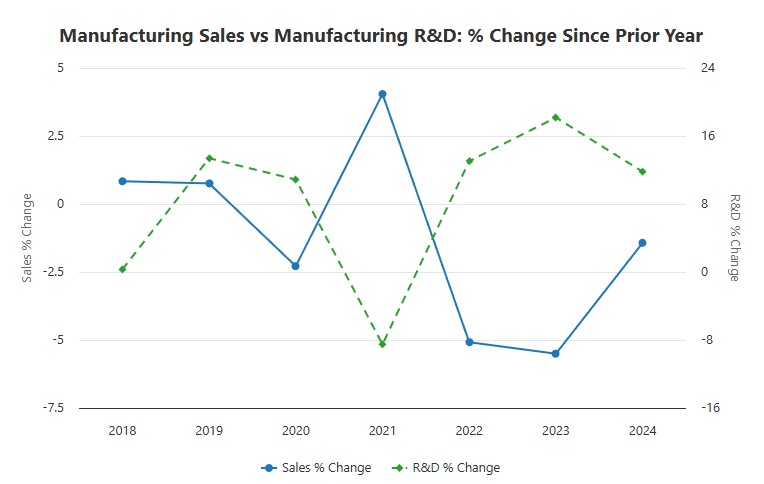
Manufacturing Sales vs. Manufacturing R&D: Annual % Change.
New Zealand demonstrates that moving from price takers to value shapers requires upgrading comparative advantage, leveraging clean energy, bundling services with products, and building export-oriented clusters. Innovative firms are already showing progress: dairy is evolving into bio-ingredients and functional foods; forestry is producing engineered timber and composites, and renewable energy powers low-emissions manufacturing.
Bundled services—traceability systems, sustainability certifications, and industrial software—add value, expand revenue, and stabilize cash flows.
This shift unlocks three critical benefits that directly address the income-productivity paradox:
Greater margin control: by exporting differentiated products and IP-rich services, New Zealand firms gain pricing power and escape commodity-cycle volatility—creating the financial space to raise wages and invest in talent.
Productivity spill overs into the labour market: advanced engineering, MedTech prototyping, climate-tech manufacturing, and bioproduct design lift New Zealand’s productivity frontier. Skilled workers capture part of this uplift through higher earnings, especially in roles that blend biological, digital, and regulatory expertise.
Higher domestic value capture: when New Zealand exports not just proteins but bioactive + digital tools + traceability systems, more value stays onshore. This strengthens the fiscal base, improves household resilience, and broadens the wage-earning opportunities across regions.
Leading New Zealand companies are driving value-added export innovation across advanced manufacturing, precision engineering, sustainable apparel, and bioactive marine ingredients. Co-manufacturing with US and EU partners allows New Zealand firms to combine biological and algorithmic IP with overseas scale, while regulatory alignment accelerates MedTech and nutraceutical exports.
Export-oriented clusters in AgriTech, MedTech, climate-tech, and creative industries concentrate talent, capital, and research, generating productivity gains.
Crucially, these innovation-intensive sectors build wage ladders that the commodity economy cannot. Roles expand into mechatronics engineering, data-driven quality systems, industrial software development, regulatory strategy, advanced materials research, and automation design. These occupations command significantly higher earnings and reinforce domestic income growth.
Government support remains essential. Export credit guarantees and growth funds prevent early sell-offs, public procurement validates advanced materials and MedTech domestically, targeted immigration brings in regulatory and go-to-market specialists, and vocational training aligns the workforce with industry clusters. Mission-oriented R&D programs linked to commercialization milestones in low-carbon process heat, pasture-to-protein, and ocean renewables accelerate innovation. Policy alignment has improved, though public investment still trails private sector ambition, highlighting areas for further enhancement.
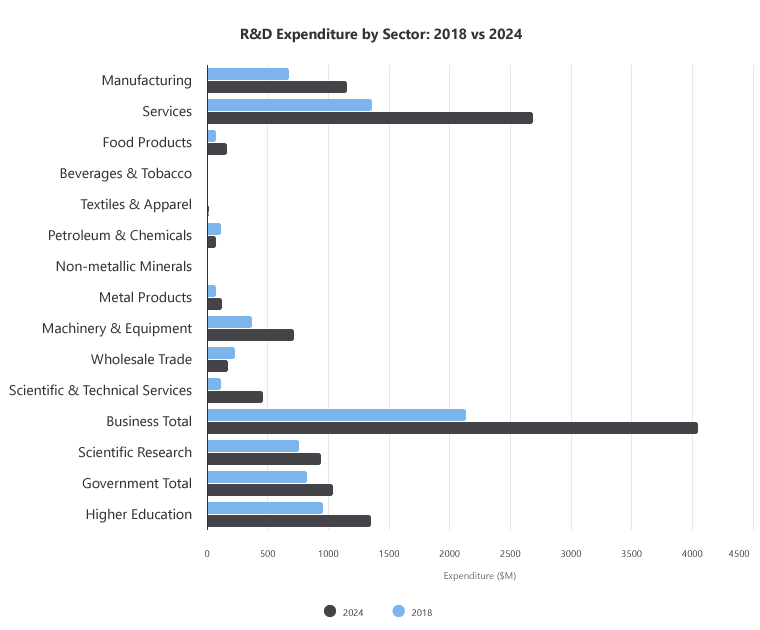 R&D Expenditure by Sector: 2018 vs 2024.
The paradox of strong exports but weaker domestic prosperity is not unique. Ireland and Singapore faced similar dilemmas and pivoted successfully: Ireland attracted multinationals through low corporate taxes, while Singapore executed a 10-year advanced manufacturing plan. Australia’s Modern Manufacturing Strategy illustrates how coordinated public investment accelerates private innovation.
New Zealand can emulate these strategies by further strengthening links between research institutions and businesses, targeting R&D funding, and implementing mission-driven industrial policy to capture more value from its natural resources and talent.
New Zealand’s pivot is rooted in clean energy, natural resources, and creative talent. In a volatile, geopolitically shifting world, smaller economies cannot simply accept global prices—they must continuously create value through innovation, partnerships, and services. Over the past five years, New Zealand innovators have steadily increased R&D investment, laying the foundation for higher-value outcomes even as manufacturing sales and broader economic results take time to fully materialize.
Ultimately, innovation is the mechanism that converts external demand into internal prosperity. Where commodity exports create exposure, value-shaping exports create resilience—for firms, for skilled workers, and for the broader economy. New Zealand’s path forward lies in capturing more of what it creates and ensuring the returns flow not only to exporters but also to the households and communities that support them.