English
 Español
 Français
 Deutsch
 Italiano
 Português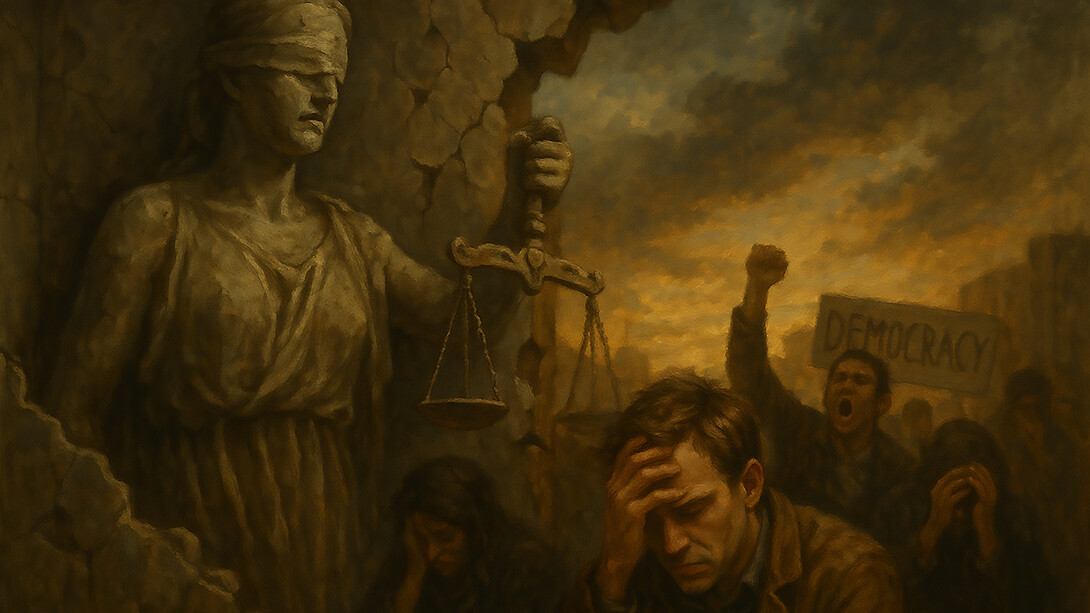
More than once, whether from friends, family, or my own colleagues, I’ve been asked who I think is the most relevant author for trying to make sense of the present moment. Whenever I hear this question, the answer that immediately comes to mind is Judith Shklar. Beyond the fact that she writes in a way that is accessible to both specialized and non-specialized audiences, Shklar offers remarkable keys for understanding and/or evaluating many of the challenges we are currently facing. I hope I can convince the reader of this below.
Judith Shklar (1928–1992) was a political theorist born in Latvia who taught at Harvard throughout her career. She is best known for developing her own conception of liberalism, the so-called “liberalism of fear,” whose central ideas appear in an essay of the same name published in 1989.1 Broadly speaking, the liberalism of fear seeks above all to avoid the worst, or the summum malum: cruelty, the fear it generates, and the fear of fear itself. For this reason, the content of this liberalism is non-utopian and avoids the kinds of abstractions in which, starting from an imagined situation, one attempts to sketch the principles of justice that should guide a society’s institutions.
Although Shklar had a distinguished academic career and was well regarded in her close intellectual circles, her broader recognition only began in the last decade. From her early death in 1992 until the late 2000s, although there were important publications in which she was the central figure, there was never anything like the current “Shklar boom,” reflected in the abundance of journal issues, conferences, books, translations, and more that we see today.
So the question we should ask is: what happened—or is happening—that explains this turn to Shklar? The answer is simple: from her earliest to her latest writings, it is clear that she is an author more relevant than ever.
The aforementioned liberalism of fear—one of her final writings—resonates across the world: from Ukraine to Gaza to Nigeria and far beyond, cruelty and fear are daily realities. And if we think carefully about these conflicts, something paradoxical emerges: we do not necessarily seek the ideal solution to them, yet even when we aim merely for a “less-than-ideal” solution, that too seems to slip out of our hands.
It is no coincidence that George Kateb, commenting on Shklar’s work, identifies a fascinating ambivalence that strongly resonates today. In one sense, she asks very little of us: no transformation, no perfection, no grandeur, nothing spectacular or especially well defined. But in another sense, she asks too much: a society rid of the worst, rid of fear, rid of physical cruelty and moral humiliation.2
But as I mentioned earlier, Shklar’s relevance can be found already in her earliest writings. For example, in November 2024, the University of Frankfurt hosted a workshop titled The Liberalism of Fear in Times of Democratic Distrust. Its premise was that Shklar’s political thought can offer important resources to democratic theory for confronting our current moment of uncertainty, in which “liberal democracy finds itself under serious pressure from authoritarian populism, polarization, and ideological illusions of the heart and the head.”3
If one visits the workshop’s website, one finds that its description begins with a quote from Shklar’s first book (After Utopia, published in 1957), a passage frequently cited elsewhere as well—for example, in Fernando Vallespín’s recent book Judith Shklar y el liberalismo del miedo, published in 2025. In it, Shklar writes: “By now it is only too well known that democracy is not inevitable, that it may be destroyed from within, and that even the most successful constitutional democracies are not the models of social perfection that the Enlightenment had dreamed about.”4 Despite being written almost 70 years ago, the quote sounds more relevant than ever and alone helps explain why contemporary scholars are so focused on Shklar’s work.
However, Shklar’s relevance is not limited to extreme cases in which thousands of lives are at stake or democracy is in danger. It also extends to the everyday problems of democratic life. Consider her theory of injustice and her discussions of the concept of the victim.
For those unfamiliar with Shklar’s political theory, one of her most important ideas is that injustice is not simply the absence of justice. In other words, injustice is not exhausted by the breaking of rules that determine what is owed to each person. There is an entire subjective dimension to injustice that goes beyond what any rule can capture.
Thus, listening to those who claim to be victims of injustice makes it possible to explore terrains that were previously thought to lie outside the realm of injustice—those that were labeled mere misfortune. This can be illustrated with discrimination on the basis of gender or race. Many expressions of such discrimination were once considered natural, something unthinkable today. Moreover, many forms of discrimination still affect women or racialized groups and are rightly perceived as unjust by them, yet remain overlooked by existing rules or norms.
But this is where things get complicated: how can we know whether someone who claims to be a victim of injustice truly is one? How can we know whether their claim is motivated by a desire for justice and not revenge? How can we prevent the term “victim” from being abused if it involves a subjective element? Shklar was not indifferent to these difficulties. In fact, she herself warns in Ordinary Vices (1984) that today’s victims may be no better than their persecutors, and may simply be waiting to reverse roles. Faced with such questions, Ordinary Vices and The Faces of Injustice (1990) offer valuable insights for illuminating our current condition and public debate.
In sum, we are dealing with a political theorist who, although she never achieved the renown of other twentieth-century thinkers (Hannah Arendt, John Rawls, Friedrich Hayek, to name just a few), can help us think through many of today’s most pressing challenges. And if that weren’t enough, new translations of her work continue to appear in multiple languages, making access easier than ever for those interested in getting to know her better.
References
1 Shklar, J. N. (1989). The Liberalism of Fear. In N. L. Rosenblum (Ed.), Liberalism and the Moral Life (pp. 21–38). Harvard University Press.
2 Kateb, G. (1998). Foreword. In S. Hoffman (Ed.), Political Thought and Political Thinkers (pp. vii-xix). University of Chicago Press.
3 This workshop was organized in the context of the research initiative ConTrust from the University of Frankfurt.
4 Shklar, J. N. (2020). After utopia: The Decline of Political Faith. Princeton University Press.