English
 Español
 Français
 Deutsch
 Italiano
 Português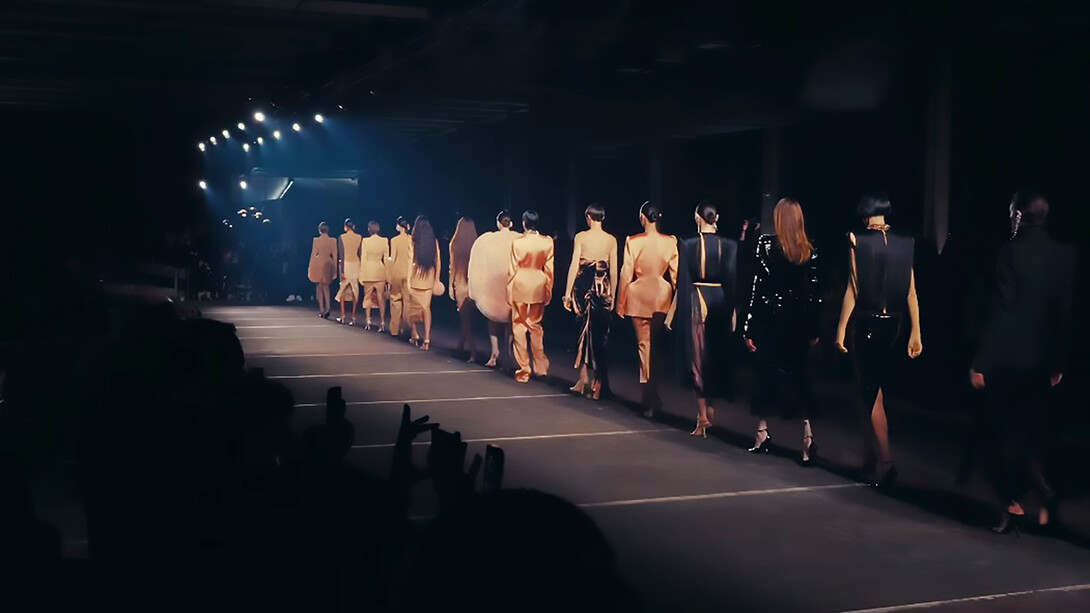
When Portuguese-born designer Miguel Castro Freitas made his debut as creative director of Mugler, he did more than step into the founder’s headspace—he excavated it. In his Spring/Summer 2026 ready-to-wear collection, he undertook what he describes as “an archaeological dig into the essence and ethos of the house. For Mugler, a brand whose very DNA is fused with power shoulders, hyper-silhouettes, and theatrical spectacle, this moment signals a pivot: from unabashed erotic display to a new lexicon of “sensuality” over “sexy,” from sheer and body-sculpt to tailored restraint and archival resonance.
In this article, we trace how the collection lays out the new era for Mugler—what remains, what changes, and what the brand is becoming. We explore the historical framework, the formal evolution, the thematic undercurrents of the show, and the broader commercial and cultural implications of the transition.
Heritage revisited: Mugler’s legacy and the new custodian
To understand the shift, we must first keep in mind the legacy that Miguel Castro Freitas inherits. Manfred Thierry Mugler (1948-2022) built a house defined by grand theatrics, bold silhouettes (especially the hourglass shoulder-waist-hip triangle), fetish gloss (latex, vinyl, skin), and a showgirl aesthetic rooted in fantasy. His fashion shows were events, his muse was spectacle, and his brand identity was immediately identifiable.
When Castro Freitas arrived—formally announced in March 2025 as the successor to Casey Cadwallader after his seven-year tenure—he brought with him decades of fine tailoring, couture, and luxury experience. The brief was distinct: “honor and celebrate the incredible legacy of the house… but also find a way to add your name above the door” (in the words of one observer).
The appointment arrives at a time of change in luxury fashion: audiences are more discerning, value-led, and less interested in spectacle for spectacle’s sake. In this context, Mugler needs to reposition itself without losing its identity—a tricky balancing act.
Show overview: SS26: a trilogy begins
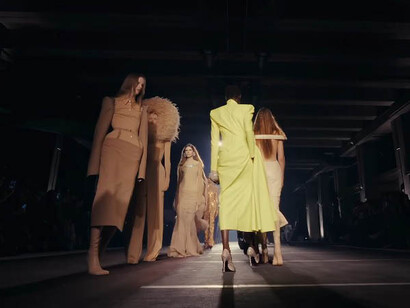
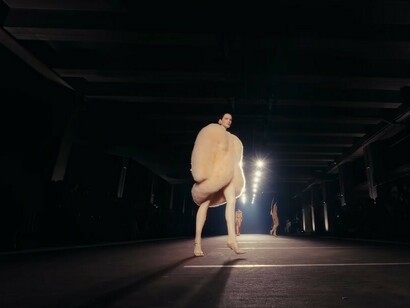
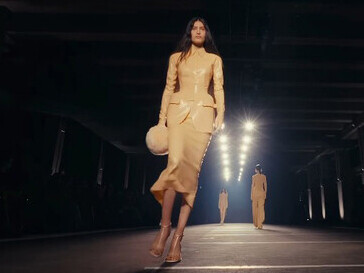
The show for Spring/Summer 2026—dubbed part one of a “trilogy of glorified clichés” by Castro Freitas—was staged in a subterranean car park in Paris’s 11th arrondissement. The statement of venue—industrial, stripped back, raw—was itself part of the design logic: a contrast between heritage glamour and contemporary grit.
From the runway:
A palette of concrete greys, flesh-toned beige, and powder-pink hues rather than heavy black starting points.
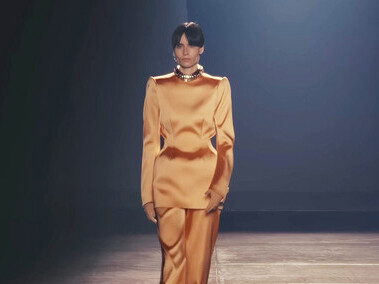
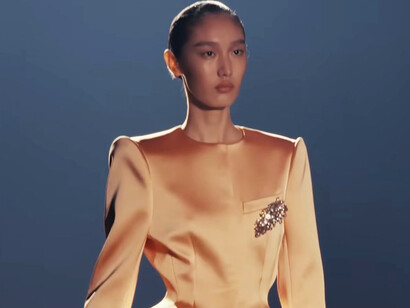
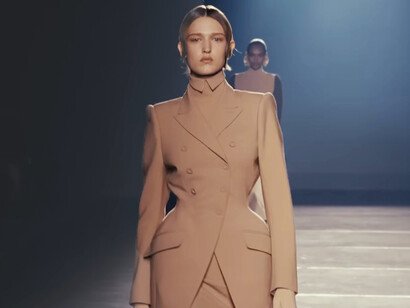
Hourglass tailoring remains—sharply cut jackets, cinched waists, amplified hips—but anchored in double-face wool, satin, and tailored fabrics rather than sheer bodysuits alone.
Material-play: Latex and vinyl still appear, but now positionally alongside suiting rather than replacing it entirely; feathers and plumes (via Maison Février) create a touch of showgirl but in matte, muted tones.
Accessories and product categories expand: snakeskin clutches, square-toe high heels, statement jewelry, and nude tones—hinting at a new commercial direction beyond eveningwear.
In sum: the show communicates continuity (archive codes, silhouette vocabulary) but with new modifiers: restraint, elegance, and wearability.
Formal language: what changes, what remains
What remains:
The hourglass silhouette: still central to Mugler’s identity.
Sculptural tailoring, structured shoulders, dramatic hips: the DNA is clearly intact.
Materials associated with spectacle (latex, feathers, vinyl) continue to play a role, reminding us that this is still Mugler, not another house.
What changes:
Tone: the previous vibe under Cadwallader emphasized clubwear, overt sexuality, and sheer constructions. In contrast, Castro Freitas reportedly banned the word “sexy” in the atelier.
Color: black is no longer the default beginning point; flesh tones, beiges, muted pinks, and greys dominate.
Wearability: suits, high-neck dresses, and daytime logic appear alongside evening glamour. “Fashion for the daytime” becomes a keyword.
Tone of spectacle: while theatricality remains, it’s balanced with tensions of tailoring, restraint, and precision—a “softer” glamour. From the newsroom: “lighter in make… ornate but matte and graphic.”
This shift signals a repositioning of Mugler: not abandoning its fantasy, but reframing it as something more accessible, less “otherworldly creature” and more grounded in everyday luxury.
Thematic underpinnings: showgirl, cliché, glamour revisited
One of the strongest threads in the collection is the motif of the showgirl—revisited rather than replicated. The show references past showgirls of Paris cabaret, the archive of Mugler’s own “Mugler Follies” ethos, and the surrealism of artists such as Hans Bellmer (whose “La Poupée” series was referenced in teaser posts).
Castro Freitas describes the mood-board keywords as “Kitsch Glamour,” “Stardust,” “Poetic Camp,” “Nocturnal,” and “Purist Maximalism.” The idea is to turn the showgirl stereotype on its head: from high-voltage spectacle to something more peeled-back, more sculptural, and more refined. In one article, he states:
“Mugler was known for this idea of women as otherworldly creatures—intimidating; you couldn’t touch them. I wanted to reconfigure that for today’s world and make everything more relatable to more people.”
Hence the trilogy metaphor: the first chapter is “Stardust Aphrodite” (as the teaser reads)—the idea of glamorized cliché, but reimagined. The buried car park, the feast of feathers, and the hourglass tailoring all act as narrative devices: the past in custody, the future in motion.
Commercial & cultural implications
Commercially, this shift is both timely and strategic. The fashion landscape has changed: “quiet luxury,” wear-more-often luxury, and investment pieces are preferred over instant spectacle. The earlier sexy-clubwear emphasis may feel less aligned with what today’s consumer wants. Industry commentary after the show notes that the collection is “refined and grown-up” and points to wearability and craftsmanship as strengths.
Expanding accessories, introducing new bag silhouettes, and soft-launching a broader product category under “Mugler” suggest the house is diversifying beyond the red-carpet showpiece. From the article:
“He introduced new accessories like snakeskin clutches and square-toe heels … expanding Mugler’s product range.”
Culturally, the move echoes a recalibration of the house’s stance on sensuality, identity, and accessibility. By shifting away from sheer erotica and towards sculpted elegance, Mugler may open new dialogues: the empowered body, the hybrid of daytime/dress-time wear, and the reinterpretation of legacy rather than its replication.
Moreover, with Miguel Castro Freitas’s less flamboyant but technically rich background (Dior, YSL, Dries Van Noten, Sportmax), there is a signal that the house places craft and substance at the heart of this era.
Critical reflections: strengths and risks
Strengths:
The house retains recognizability while showing a desire to evolve—credentials in tailoring, archive codes, and narrative.
The pivot is timely: aligning with current luxury market sentiment, expanding product categories, and increasing wearability.
The show’s narrative and venue choice demonstrate a purposeful reinterpretation of legacy.
Risks:
There is a fine line between evolution and dilution: if the drag-queen camp and sheer fantasy that once defined Mugler fade too much, the house may lose part of its unique edge. Indeed, some critics see the collection as “taking aesthetics a backseat” in favor of wearability.
Market expectations for Mugler are still strongly set on the extraordinary—deviating too far towards everyday may confuse the brand’s high-voltage identity.
A debut is one thing; sustaining the momentum across the trilogy and commercializing the refreshed identity is another. Execution will matter.
Visual politics: the clothes as statements
Let’s look more closely at some of the key visual statements:
The flesh-toned high-neck dresses and pastel tailoring challenge the black-leather-latex default of previous seasons. By doing so, they remap the “Mugler woman” as someone who inhabits daylight as much as the after-party.
The use of feathers and plumes, still present but in muted tones and integrated into tailored silhouettes, speaks to the showgirl legacy but with restraint—the costume becomes clothing, not pure spectacle.
Vinyl and latex are used, but they sit alongside fully tailored garments rather than purely replace them. In this way the fetish becomes a texture choice rather than a full look.
The accessories (snakeskin clutch, square-toe heel) signal a shift in product strategy—and the brand’s willingness to be interpreted beyond runway drama.
Venue and staging underline the concept: a former costume workshop turned car park in the 11ᵗʰ arrondissement, reinforcing the idea of “archives beneath the surface” and “glamour in the everyday.”
Together, these visual choices reflect an updated aesthetic politics for Mugler: bold but wearable, iconic but accessible, and architectural but human.
The Spring/Summer 2026 collection of Mugler under Miguel Castro Freitas announces a new chapter—one that honors the house’s mythic past of showgirls, power suits, and sculptural bodies, yet reinterprets its codes through the lens of present-day luxury, wearability, and refined glamour.
Rather than leaving the “sexy clubwear” destination entirely behind, the collection repositions it: sculptural tailoring replaces spectacle as its core logic; a muted palette replaces black dominance; accessories expand to a fuller lifestyle proposition; and the narrative shifts from overt fantasy to grounded glamour.