English
 Español
 Français
 Deutsch
 Italiano
 Português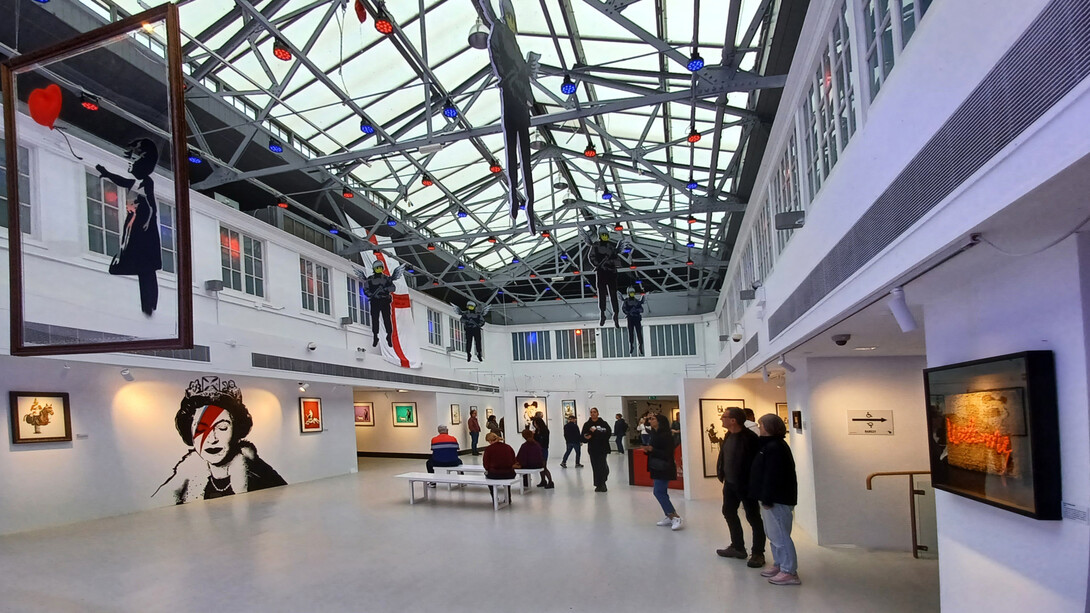
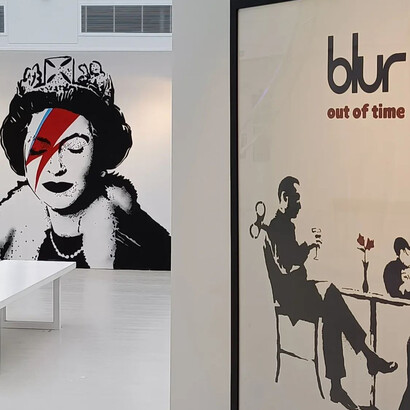
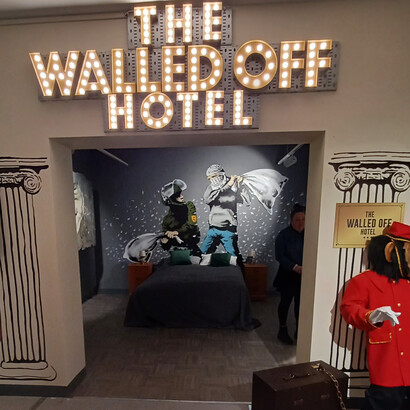
The irony of encountering a Banksy exhibition behind the classical doors in one of London’s most affluent postcodes is almost too neat. “Limitless,” staged in a simply vast, Tardis-like building on South Ken’s Old Brompton Road, is an expansive, crowd-drawing display of reproductions and reimaginings of the artist’s best-known works. But while the exhibition’s allure is to enable access to Banksy’s rebellious world, it also exposes the tensions that have long haunted his trajectory: the uneasy marriage between street-level art/political dissent and the art world’s appetite for commodification.
In this slightly run-down but high-rent corner of Kensington, the artist who once sprayed rats and riot police onto crumbling walls is re-presented under gallery lights, overseen by security and the strangely non-ironic ‘exit through the gift shop.’ The result is a show brimming with contradictions—between rebellion and respectability, anonymity and celebrity, and satire and spectacle. It is, in short, Banksy out of context and in a context that is spectacular, but in the final analysis, it doesn’t quite work in his intended spirit.
The exhibition brings together a range of iconic works, albeit in reproduction form. The infamous Girl with Balloon, now retitled Love is in the Bin after its partial self-destruction during a Sotheby’s auction in 2018, is perhaps the centerpiece. Even in reproduction, the image of the red heart balloon floating from the small, stencilled girl retains a certain melancholy charm. But when placed behind glass, its mechanisms laid bare, it is stripped of its shock and the thrill of transgression; it feels embalmed. The shredded version—symbolic of Banksy’s gleeful sabotage of art-world elitism—remains his most theatrical prank, but its inclusion here, as a static exhibit, dulls the sharpness of the original moment. Much like the Mona Lisa, we now know this image through a million postcards, franchised posters, and tee-shirts. What was once a touching, live critique of commodification now becomes another repro commodity for Getty Images et al.
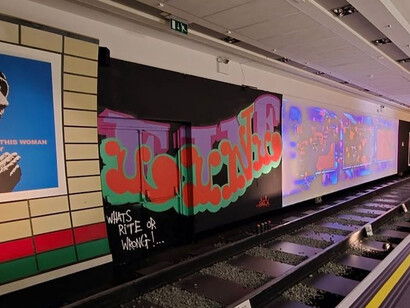
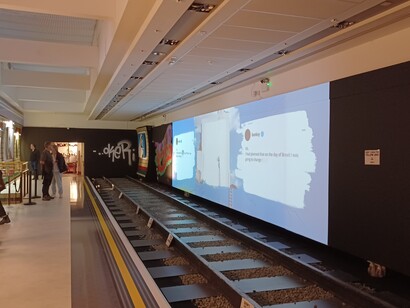
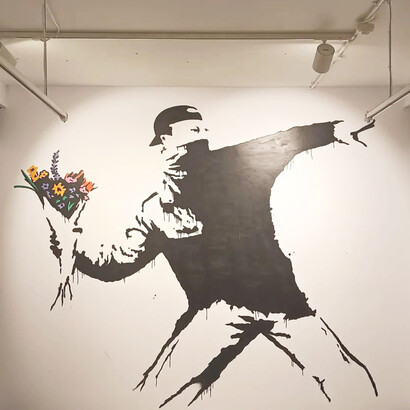
Other works, too, have lost their meaning in the process of relocation. Banksy’s mock underground station, with its characteristic rats and anti-establishment slogans, has been faithfully and spectacularly re-created but feels strangely sterile. In the Tube, the rats once scurried across forbidden territory; they were insurgent, anarchic, and alive. Here, their presence feels domesticated—props in a spectacle that invite selfies rather than suspicion and edgy discomfort. Banksy’s Shop Until You Drop and Flower Thrower remain visually compelling, but the setting neutralizes their intended dissonance. In the street, these images confront; in a gallery, they decorate. The sheer volume of Banksy’s body of work and potency of his imagination are enthralling, and one cannot help but be inspired by his output. Unfortunately, though, the comments I heard from visitors (mainly tourists) were disappointingly about the spectacle rather than getting the barbs of the messaging stinging their individual or group perceptions.
Yet the contradictions extend beyond the presentation to the ethics of Banksy’s evolving identity. This is, after all, an artist whose works now command astronomical sums at auction—sometimes reaching millions—while he publicly decries the very market that sustains him. The show nods to his philanthropic side, particularly his funding of the M.V. Louise Michel, the rescue boat that patrols the Mediterranean saving migrants. This act of radical compassion complicates the narrative of the artist, reassuring us that Banksy’s critique has not entirely been co-opted by commerce. Still, the contrast between his activism and the comfy, ticketed experience of “Limitless” is hard to ignore. Admission prices have drawn criticism, as has the overwhelming volume of visitors, with occasional queues for artworks originally meant to be stumbled upon opportunistically or by chance.
Banksy has always played with paradoxes—visibility versus anonymity, protest versus profit—but “Limitless” renders these tensions literal. The show’s location, immersed in London’s museum throng, speaks to the absorption of counterculture into consumer culture. It’s an irony Banksy himself might appreciate, though not necessarily endorse. His works derive power from their context: a spray-painted policeman on a Bristol wall, a protestor beaten by a judge’s gavel on the walls of the Royal Courts of Justice. Removed from their urban fabric, they risk becoming aesthetic souvenirs of rebellion—much like my collection of Clash tee shirts of the 1970s and ‘80s.
The exhibition’s curators have tried to address this by contextualizing his works with documentary footage, installation environments, and explanatory panels. Some of these succeed—particularly the section recounting Banksy’s Dismaland project, a darkly comic anti-theme park in Weston-super-Mare, which reminded visitors that art could be both spectacle and critique. Yet even this feels muted by the gallery setting. What was once a pop-up dystopia born of seaside decay is here flattened into video screens and captions that are aesthetically dull when compared to the spectacle of the range of the ‘real’ objects.
One of the more difficult questions raised by the show is, what happens to a movement when its most famous figure transcends it? For every Banksy, there are countless would-be rebels painting walls, sometimes brilliantly, sometimes appallingly, in anonymity, many struggling to gain recognition without the mythology or market power that props up his name. “Limitless” unintentionally underscores this disparity.
Indeed, the show’s merchandising area—a pricey shop selling everything from mugs and hoodies to branded tote bags—feels like a parody of Banksy’s own satire. One half expects a new stencil to appear overnight mocking the very existence of such a space. It recalls the artist’s own Gross Domestic Product stunt, where he opened a pop-up shop selling absurdist homeware in Croydon, exposing the absurdity of art-as-commodity. Here, however, the self-awareness seems absent. The rebellion has been packaged, the critique monetized.
It would be simplistic, though, to dismiss “Limitless” entirely as hypocrisy. There remains something magnetic about Banksy’s imagery, even in reproduction. His visual language—concise, ironic, and emotionally resonant—continues to speak to audiences across generations. His figures, often small and human against vast, impersonal backdrops, embody a yearning for innocence and honesty amid political mendacity. This universal quality may explain why his work endures and why people still flock to see it even in such incongruous surroundings.
Still, the overriding feeling leaving the show is ambivalence. One can admire some of the craftsmanship and cultural influence on display while mourning the loss of immediacy and danger. Banksy’s power lies in his ability to disrupt the everyday—turning an alleyway into a gallery, a wall into a manifesto. “Limitless” confines that impulse within walls both literal and metaphorical. It celebrates the artist’s rebellion while neutralizing its bite, transforming dissent into décor.
Perhaps this is inevitable. Street art, by its nature, resists containment, and any attempt to institutionalise it risks contradiction. But “Limitless” also reveals the paradox at the heart of contemporary culture: that even the most radical and insightful political gestures that hit institutional nerves can be repackaged for consumption. In that sense, the exhibition is unintentionally faithful to Banksy’s worldview. It demonstrates precisely what he has long mocked—the commodification of rebellion, the complicity of the viewer, and the absurd dance between art and capital.
As visitors file out through the gift shop, clutching their postcards and T-shirts, one can’t help but imagine Banksy watching from afar, wryly amused. He has always thrived on contradiction, and perhaps this exhibition, in its shoddy yet glossy incoherence, is just another chapter in that story. “Limitless” may not capture the raw vitality of Banksy’s original interventions, but it does reveal the uncomfortable truth that the art world, like the systems he critiques, is inescapably self-consuming.
In the end, “Limitless” is a paradoxical homage: a wonderful celebration of a provocateur that somewhat neutralizes his provocation. Banksy, the invisible vandal, has been turned—or has turned himself—into a brand, his rebellion framed and the audience corralled. Yet even here, in this sanitized version of street art, echoes of his subversion linger—in the awkward laughter, the uneasy admiration, and the lingering awareness that something vital has been lost in translation. Perhaps that, too, is part of his plan.