English
 Español
 Français
 Deutsch
 Italiano
 Português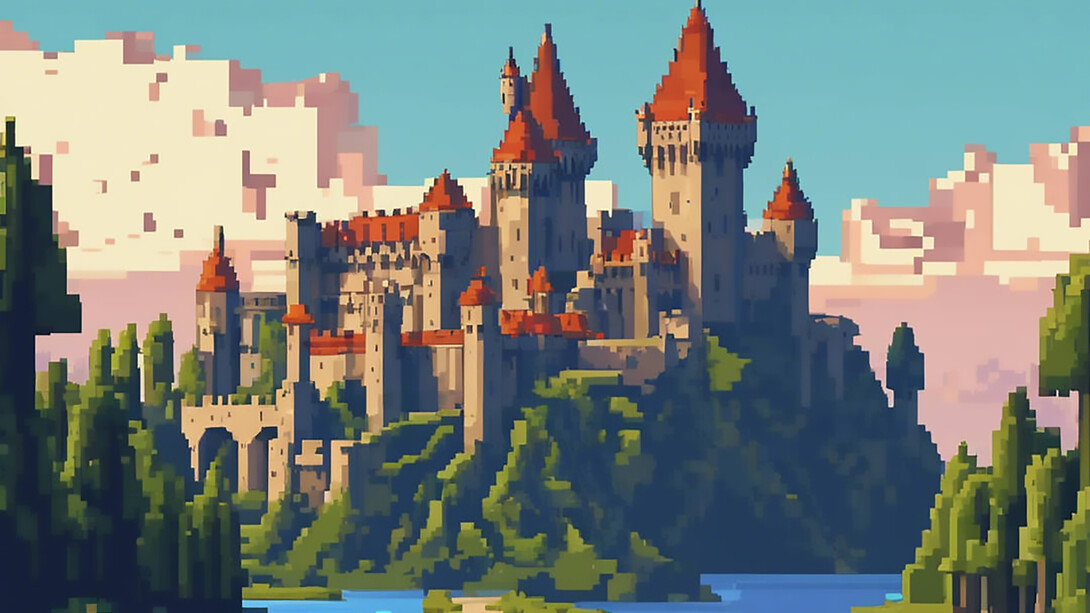
The aesthetic aspect of architecture is one of the primary goals of any design. Given the extensive need for design and architecture, their importance can even be observed in gaming designs. At this point, we're not referring to modern gaming, which employs high-definition rendering software, but rather to retro and pixel art styles.
As Brown (2019) states, in light of global internet access to diverse cultures and collections, along with advancements in digital technologies for the arts and humanities, the traditional pillars of culture are being redefined.
Videogame spaces offer new directions, embracing interactive fictional worlds that can affect reality and that crucially require people. Games can have an agency that can be applied towards social change and engaging people in the design processes of cities. Synthesizing game spaces will offer architects new possibilities for speculating on the meaning and experience of architecture, both in the design of their virtual spaces and the ways in which users can inhabit them (Pearson, 2019).
compositional patterns and echoes, texture and color contrasts, depths of fields and focus, sounds and their relationships to the imagery and movement. Coherence comes from both addressing the visual preoccupations and attending to visual rhythms (McDonnell, 2011). And by understanding these rhymes and reasons, we can affect the user on a deeper scale.
A key point that many people overlook when examining pixelated art is its potential to enhance critical thinking and understanding, especially for those at a younger or developing stage of life. Burdick and Willis (2011) highlight that principles from game design—such as promoting innovation, discovery, strategic thinking, and play—are fundamental to the school curriculum. They also emphasize that contemporary students are deeply immersed in media and technology, making these principles highly relevant.
The aesthetic value of retro and digital art
The aesthetic aspect of design serves as the fundamental attraction of any form, and digital art is no exception. According to Cubitt (2016), digital aesthetics aim to transport us beyond the limits of human perception. Rather than focusing solely on realistic representations that mirror how humans see the world, they encourage us to perceive in ways that are not centered on human experience.
This aesthetics would have to extend the field of ontological inquiry of computation from the sensible to the intelligible (Fazi, 2018). Of course, the aesthetic experience involves the integration of neurologically separable sensory and emotional reactions in a manner linked with their personal relevance. Such experiences are (Vessel et al., 2012).
Advancements in pixel art and digital design over the past few decades have opened up numerous new opportunities. As Samuelson (2020) notes, pixel art remains valuable because it continues to engage both audiences and creators, making it a worthy subject for further academic study. Its relevance lies in how its technical limitations foster creativity; the simple pixel grid is accessible to beginners, allowing them to learn essential artistic skills such as color usage and composition through community-driven constraints. While it is easy to get started, mastering pixel art remains a challenging pursuit.
What is pixel and retro art?
Many of the new fields of design that have emerged over the past two decades have focused upon the uptake of designed things and systems and the ongoing relationships between designs and their users. This represents a shift from the focus on production, functionality, and semiotic significance of Stewart (2011).
Retro art builds upon the concept of simplicity, offering a fresh perspective on how we view the world. This artistic style emerged in the 1970s and continued to develop through the end of the 20th century. Despite the rise of advanced computational software and hardware, many anticipated that pixel art would become extinct. However, to many people's surprise, retro art remains a beloved and nostalgic form, continuing to resonate with audiences today.
Pixel art is an art style with low resolution consisting of a precise placing of pixels, the smallest unit of color that a screen can display. Pixel art has the potential of being cheap, easy to make, and nostalgic, but it takes some skill to handle. Creating partially transparent images to use in video games is commonly referred to as spriting. The images are usually used for foreground and character animations or stills, which are called sprites. In early pixel art this was a problem of file size and available colors. Today, the retro look and the impression that every pixel was placed for a reason disappear if the sprites are too big and detailed (Grahn, 2013).
The relationship of architecture and retro design
To understand the relationship between architecture and retro design, we need to trace its origins back to around 1985. Prior to this period, pixelated games and designs existed, but in many cases—such as Atari or Pong—the limitations were so severe that little to no detailed design could be discerned.
One of the earliest examples of simple yet compelling retro art can be seen in the Super Mario Bros. video game. The developers skillfully used hardware limitations to create aesthetically pleasing yet straightforward forms and shapes, such as the castle at the end of each level. These designs are easily recognizable as buildings, demonstrating how constraints can inspire creative architectural expression within retro art.
They use these types of pattern shapes and formats to help the viewer get immersed in the world. Understanding how patterns are constructed and reconstructed can tell us a lot about the design problems of organizing space, either in ways that are unambiguous and clear or in ways that are subject to multiple interpretations (Ware, 2008). Which can be understood easily in the figure below.

Figure: The binary digits of pixels to our ability to understand the patterns. (Source: Author)
With advancements in hardware and software, creating sprite sheets with more detail and clearer elements became much easier. For example, games like Castlevania, which started modestly on the Nintendo Entertainment System and continued into the 3D gaming era, exemplify this aesthetic evolution. These games showcase how the development process became more refined and visually appealing over time, reflecting both technological progress and artistic growth.
Conclusion
Retro arts represent a uniquely aesthetic form of human interaction with the digital world. As Moradi (2004) explains, in many cases, visual information is broken down into basic components such as pixels, color layers, or graphite particles during recording or transmission. The term "glitch" can refer to various phenomena; scientifically, it describes an unexpected malfunction, originally identified in 1962 during the space program as a sudden change in electrical voltage. Glitch art specifically involves digital artifacts that imitate the visual effects of these technical glitches.
Through a range of artistic practices that critically engage with media technologies as acts of resistance, post-digital aesthetics navigates between the infrastructure of digital mediums and their cultural and social impacts on everyday life (Ferreira & Ribas, 2020).
Hodgson (2019) argues that the pixel orientation in the New Aesthetic highlights both the pervasive presence of pixels and the way humans perceive the world through digital patterns. More importantly, it demonstrates how these patterns have become integral to modern understanding, transforming pixels from mere technical elements into embodied aspects of how people interpret and experience their environment in the digital age.
Ultimately, by understanding the potential of this art form, we can expand its possibilities for representing various types of information, whether for creating aesthetically pleasing designs, expressing cultural ideas, or serving educational purposes.
References
Bowen, J. P., Giannini, T., Ara, R., Lomas, A., & Siefring, J. (2019). Digital Art, Culture, and Heritage: New Constructs and Consciousness. In: Electronic Visualisation and the Arts (EVA 2019), London, United Kingdom.
Burdick, A., & Willis, H. (2011). Digital learning, digital scholarship, and design thinking. Design Studies, 32, 546-556.
Cubitt, S. (2016). Aesthetics of the Digital: Paul/A Companion to Digital Art. ResearchGate.
Fazi, M. B. (2018). Digital Aesthetics: The Discrete and the Continuous. Theory, Culture & Society, 0(0), 1-24.
Ferreira, P., & Ribas, L. (2020). Post-Digital Aesthetics in Contemporary Audiovisual Art. Computation, Communication, Aesthetics & X.
Grahn, E. (2013). Modern Pixel Art Games: a study in GUI aesthetics for modern pixel art games. Blekinge Tekniska Högskola.
Hodgson, J. (2019). Post-Digital Rhetoric and the New Aesthetic. The Ohio State University Press.
McDonnell, J. (2011). Impositions of order: A comparison between design and fine art practices. Design Studies, 32(6), 557-572.
Moradi, I. (2004). Glitch Aesthetics (Publication Number 01484 322 366). University of Huddersfield.