English
 Español
 Français
 Deutsch
 Italiano
 Português
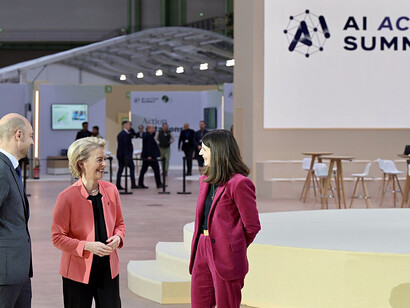
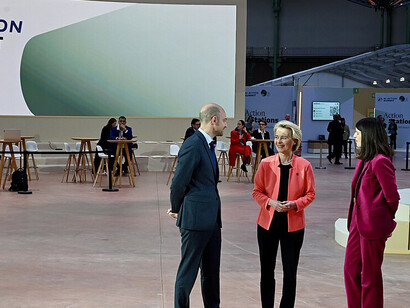
Europe has no intention of lagging behind in the global artificial intelligence (AI) race, European Commission President Ursula von der Leyen declared at the AI Action Summit in Paris. While the United States and China are often seen as dominant players, von der Leyen made it clear that the race “is far from over,” emphasizing that Europe possesses unique strengths that position it as a leader in AI.
“This is the third AI safety summit in just over a year,” she noted. “During the same period, three new generations of increasingly powerful AI models have been introduced. Some experts predict that within a year, models could approach human reasoning.”
Von der Leyen set the summit’s tone by contrasting previous discussions on AI safety with the urgency of taking action now.
“Earlier summits laid the foundation for AI safety. Together, we established a shared understanding that AI should be safe, uphold our values, and serve humanity. But this summit is about action—and action is exactly what we need now.”
With AI’s transformative impact becoming more evident, she urged Europe to define a clear vision for its future role in AI, not only in economic sectors but also in addressing major global challenges.
Europe’s unique AI strategy
Von der Leyen rejected the idea that Europe has fallen behind in AI innovation. “Many say that Europe is late to the race while the US and China lead. I disagree,” she stated. “The frontier is always shifting. Leadership is still within reach.” Rather than mimicking other regions, she advocated for capitalizing on Europe’s strengths and forging a distinct AI path.
“Too often, people suggest that we should follow others and replicate their strategies,” she said. “Instead, we should invest in what we do best—our excellence in science and technology, which we have shared with the world.”
Von der Leyen outlined three defining elements of Europe’s AI strategy:
Specializing in high-complexity, industry-specific AI applications.
Fostering collaboration and cooperation in innovation.
Promoting open-source principles.
“This summit highlights the emergence of a uniquely European approach to AI,” she stated. “It is already driving innovation and adoption, and its momentum is accelerating.”
Boosting AI innovation: factories and gigafactories
To remain competitive, Europe must ramp up its AI innovation, von der Leyen emphasized.
A crucial part of this plan involves investing in computational infrastructure. Europe is home to some of the world’s fastest supercomputers, which are now being harnessed through the creation of AI factories.
“In just a few months, we have established 12 AI factories,” von der Leyen revealed. “We are investing €10 billion in them. This isn’t just a promise—it’s happening right now. It represents the largest public AI investment worldwide, expected to unlock over ten times more in private funding.”
Building on this foundation, she announced an even bolder initiative: AI gigafactories. These large-scale facilities, comparable in ambition to CERN’s Large Hadron Collider, will provide the computational power needed to train AI systems on an unprecedented scale, fostering collaboration among researchers, businesses, and industry leaders.
“We are creating the infrastructure for vast computational power,” she explained. “We welcome talent from around the world, and industries will have the opportunity to collaborate and pool their data.”
This cooperative model reflects Europe’s broader commitment to balancing competition with collaboration. “AI thrives on competition but also requires cooperation,” she stressed, describing the gigafactories as “safe spaces” for joint innovation.
Building trust through the AI act
Von der Leyen reaffirmed Europe’s dedication to ensuring that AI is both safe and trustworthy. She pointed to the EU AI Act as a key instrument in achieving this, replacing fragmented national regulations with a unified European framework.
“The AI Act will establish a single set of safety rules across the European Union—covering 450 million people—rather than 27 different national laws,” she explained, while also acknowledging concerns about regulatory burdens. “At the same time, I recognize that we must simplify processes and reduce bureaucracy. And we will.”
A €200 billion investment in AI
Funding these ambitious initiatives requires substantial investment. Von der Leyen praised the newly launched EU AI Champions Initiative, which has already secured €150 billion in commitments from investors, industry leaders, and financial institutions.
At the summit, she introduced the InvestAI initiative, which will contribute an additional €50 billion. In total, these efforts will mobilize €200 billion in public and private investments for AI development.
“Our focus will be on industrial and mission-critical applications,” she stated. “This will be the largest public-private partnership in the world dedicated to developing trustworthy AI.”
Ethical AI as a global responsibility
Von der Leyen concluded her address by framing Europe’s AI ambitions within a broader ethical context, underscoring the global responsibility to develop AI that benefits all. “Collaborative AI has the potential to be attractive beyond Europe, including to our partners in the Global South,” she said, emphasizing inclusivity.
She voiced full support for the AI Foundation launched at the summit, which aims to ensure equitable access to AI advancements. “AI can be a tremendous asset for humanity. But we must ensure its benefits are distributed widely and fairly,” she remarked.
“Our goal is AI that serves the common good—AI built on collaboration, where everyone contributes and everyone benefits. That is the European approach.”