English
 Español
 Français
 Deutsch
 Italiano
 Português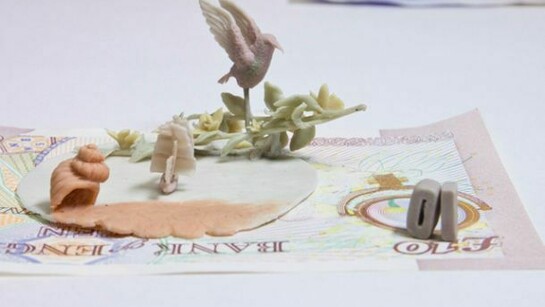
ICN gallery proudly presents “ Every popular thing is beautiful” by artist Saya Irie from 25 July - 10 August 2013. This is her first solo exhibition in UK.
Andy Warhol said, “Everything is beautiful. Pop is everything.” However, in a market economy the more popular something is the more demand there is for it, and the more expensive it becomes. Historical figures have long been portrayed on paper money to enhance its value and ensure our trust in it. Their portraits become part of the visual beauty of currency.
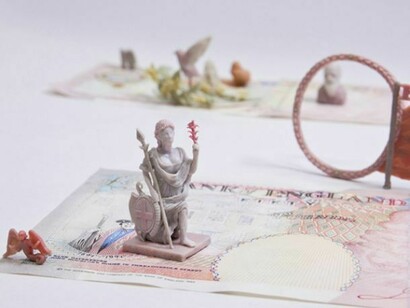
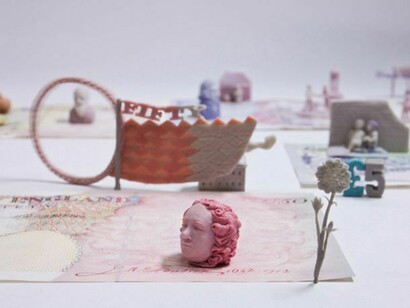
Saya Irie reverses this process by restoring the subjects of these portraits to their original three-dimensional forms. Her elaborately realized art works deftly amplify the value of the original bank notes.
"Despite the universal principle that flora, fauna and minerals have limited life, I believe that even after losing its shape there is no end to life inhabiting any matter. My concept is based on the idea that life continues to exist in an unperceivable sphere, even when the outer shape changes. For instance, by re-shaping a dinosaur out of a shoe sole made of fossil fuel I express the journey of the material from past to present. Further, by erasing the image printed on bank notes and using the rubber leftover to accurately resculpt the figure, I want to show how easily the absolute value of the bank note can be eliminated.
The uniqueness of my work lies in the constant search of the essence in the subject. As seen in the fundamental idea of reincarnation in Buddhism, things too may continue to circulate by endlessly changing their outer appearance. I receive inspiration for my works from everyday life and their ties to the distant past". - Saya Irie
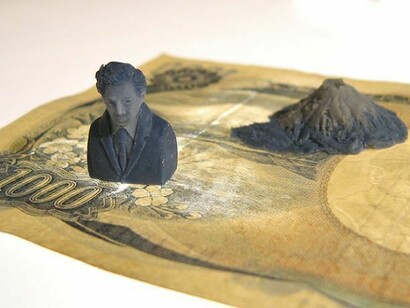
"Irie's signature 'dust' series are the three-dimensional replicas of portraits and landscapes on banknotes, such as Hideyo Noguchi, the Mount Fuji and the crane. The images are intentionally erased with rubber by the artist, and then moulded into sculptures with its dust. Exquisitely detailed portraits and landscapes prevent banknotes from counterfeit, and at the same time, icons such as the reputable Hideyo Noguchi, traditional Japanese landscapes of Mount Fuji and the crane secure its authenticity.
Irie has accidentally found out that images on banknotes can be easily removed with rubber, and that the security is vulnerable to simple everyday action. Banknotes do not have physical value like coins. They only exist as a form of non-convertible currency under the current currency system. Photographic images are firstly transferred onto a metal plate with a needle by technicians using the etching technique, and then printed onto paper, where they acquire the aspect of ‘beauty’. Following this process, Irie then reverses this banknote-making process and tries to three-dimensionally recreate the iconographical beauties. The three-dimensional iconographies appear almost humorous as if they were suddenly forced to come out from the two-dimensional world.
The precisely made rubber crumb sculptures by Irie are the metonymy of elaborately made banknotes. This exposes concerns for the banknote value as well as for the sculptures, for the fact that they are just a piece of moulded rubber crumbs. Irie explores the true value of banknotes not only by erasing images but also by playing with the metonymy of sculptures made from its dust. Because of their sizes, Irie’s works appear almost un-sculpture-like, however, despite its delicate appearance, the concept behind the work is social, grandiose, and scandalous. This difference fascinates us and at the same time challenges our stereotypical image for shiny, bronze sculptures. You will need a magnifying glass to enjoy the vibrant piece of art by Saya Irie. Through the lens, you will feel the sensation and the metabolism of ordinary life." - Hisami Omori, Exhibition Curator
ICN gallery
96-98 Leonard Street
London EC2A 4RH United Kingdom
Ph. +44 (0)20 77297977
info@icn-global.com
www.icn-global.com
Opening hours
Tuesday - Friday from 12pm to 6pm
Saturday - Sunday from 12pm to 5pm