English
 Español
 Français
 Deutsch
 Italiano
 Português

Miguel Hernández’s poetry comes to life once again in Orihuela through A batallas de amor, campos de pluma (To battles of love, fields of feathers), a contemporary exploration of shadow theatre inspired by the poet’s life and work. Conceived by Chilean painter Kristian David and artist Paloma Gordián Montalva, the production will premiere on 19 December 2026, as the centenary of Spain’s Generation of ’27 approaches.
Beyond its literary inspiration, the project brings together different forms of contemporary artistic practice: INM (Investigación natural en movimiento — Natural investigation in motion), the pictorial research developed by Kristian David, and Paloma Gordián Montalva’s exploration of new theatrical and audiovisual languages aimed at bringing cultural heritage to new audiences.
The premiere will take place at 8:00 p.m. at the Auditorio La Lonja in Orihuela, the poet’s birthplace, with the support of the Miguel Hernández Cultural Foundation.
The production invites audiences to discover the literary world of Miguel Hernández (1910–1942), one of the most important figures in twentieth-century Spanish poetry. Born into a modest family in Orihuela, Hernández developed a poetic voice deeply rooted in nature, love and human experience. His social and political commitment during the Spanish Civil War, followed by his imprisonment and death under Franco’s dictatorship, made him a symbol of dignity and freedom.
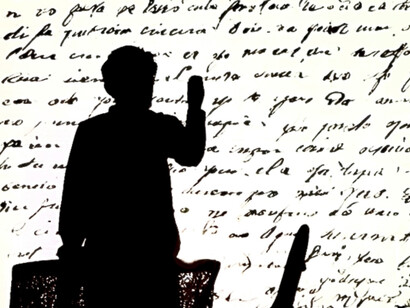
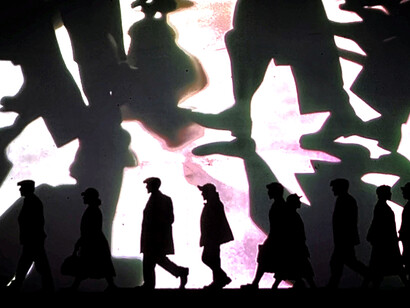
Running for approximately 40 minutes and intended for family audiences, the production combines silhouettes, objects, transparencies, painting, music and projected imagery. Rather than following a conventional biographical narrative, the poet’s own verses guide the audience through different moments of his life and work.
Poetry as image
One of the central elements of the project is the relationship between poetic language and visual expression. Rather than illustrating Hernández’s poems literally, the production seeks to create a visual world that enters into dialogue with his words, evokes atmospheres and opens up new possibilities of interpretation.
Silhouettes, objects and transparencies are integrated with projections and audiovisual elements. Music and narration accompany the journey, while light and shadow take on an expressive role that extends beyond the representation of characters or landscapes.
The audience cannot always distinguish between images created through live performance and those prepared in advance. This ambiguity is part of the theatrical exploration: technology is not presented as a display of technical possibilities, but as an integral element of the artistic language.
At the same time, the production preserves the simplicity and evocative power of shadow theatre, bringing poetry to audiences of different ages through a visual and auditory experience.
Echoes of a generation
The title establishes a connection with one of the most significant movements in twentieth- century Spanish literature. The year 2027 marks the centenary of the Generation of ’27, which included poets such as Federico García Lorca, Rafael Alberti and Vicente Aleixandre, among others, who helped transform Spanish poetry.
The movement takes its name from a tribute held in 1927 to Luis de Góngora, a poet of Spain’s Golden Age. The verse A batallas de amor, campos de pluma (To battles of love, fields of feathers) comes from Góngora’s poetry and was later taken up by Miguel Hernández in Perito en lunas. Through personal and literary relationships with several of these writers, Hernández became part of their literary circle while developing a distinctive poetic voice that engaged with their legacy.
The subtitle, Miguel Hernández y los ecos del 27 (Miguel Hernández and the echoes of ’27), refers both to this historical connection and to the enduring relevance of poetry today. A century later, the questions explored in those works — love, freedom, inequality, violence and human dignity — remain part of our reality. Their echoes continue to reach us.
From canvas to stage
The production emerges from the meeting of two artistic careers that have explored the possibilities of visual and audiovisual languages in the performing arts and in bringing literature to wider audiences.
Kristian David, a Chilean painter and scenographer with an international career, develops his painting practice alongside his work in the performing arts. Trained in Fine Arts at the Pontifical Catholic University of Chile and specialising in opera scenography at the Academy of Fine Arts in Bologna, Italy, he has worked as a scenic painter and set artist with institutions including the Ballet National de Marseille, the Grand Théâtre de Genève, the Teatro Nazionale di Genova and the Palais des Festivals de Cannes.
His experience has fostered an ongoing dialogue between painting and theatrical space. While the canvas concentrates the image on a single surface, the stage introduces other dimensions: time, movement, light and the relationship with the audience. In A batallas de amor, campos de pluma, these possibilities unfold through a contemporary exploration of shadow theatre, where figures and objects handcrafted in the studio coexist with digital imagery in a hybrid staging that seeks to blur the boundaries between live performance and audiovisual composition.
Paloma Gordián Montalva, a Chilean-Spanish artist and producer, has an international career spanning television, theatre, audiovisual creation and multidisciplinary cultural projects, with work developed in Chile, France, Italy and Spain.
In Chile, she served as production director of the animated television series Los pulentos and worked on productions for the theatre company Querubines, directed by Vasco Moulian. She subsequently developed projects through her own company, Escénica teatro mágico, including Papelucho historiador, inspired by one of the most iconic characters in Chilean children’s literature, and Super Don Quijote, selected for the Almagro International Classical Theatre Festival in 2020.
In France, she created Pablo Neruda, las siluetas del alma (Pablo Neruda: silhouettes of the soul), her first multimedia shadow theatre project, accompanied by cultural outreach activities with schools. In Italy, she has developed video projection projects with ArteMedios Hub Italia, a partner organisation also involved in the international development of A batallas de amor, campos de pluma. More recently, in Spain’s Marina Alta region, she participated in the creation of Teixint la memòria (Weaving memory), a performance combining video projections and live performers.
Her experience with visual media and new technologies contributes to an artistic collaboration focused on bringing literary heritage to contemporary audiences. Through PGM Art Production, she develops projects combining artistic creation, audiovisual resources and educational outreach for audiences across generations.
INM and experience as the origin of creation
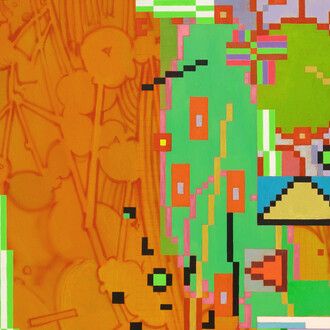
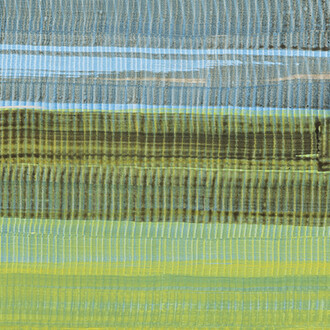
Alongside his theatrical career, Kristian David pursues a personal pictorial investigation known as INM (Investigación natural en movimiento — Natural investigation in motion), an artistic approach that places intuition, observation and everyday experience at the centre of the creative process.
INM approaches painting as a space of discovery, where the image does not necessarily follow a preconceived composition but may emerge through an open process of exploration. Individual experience, memory and the observation of contemporary life thus become elements of a visual investigation that seeks to move beyond literal representation.
His series Los hijos del laberinto (Children of the labyrinth), represented internationally by Meer Gallery, embodies this exploration. Through it, David develops a pictorial universe centred on the human condition, its contradictions and its relationship with a constantly changing reality.
Within this universe, painting does not merely reproduce what is visible. The image becomes a space for interpretation, bringing together personal experience, intuition and the questions raised by contemporary existence. Each work forms part of an evolving investigation, open to new connections and discoveries.
This artistic pursuit maintains a dialogue with his experience in scenography while retaining its autonomy as a pictorial investigation. The stage allows him to explore other dimensions of the image — movement, time and light — while painting remains the central territory of his visual research.
From this perspective, his approach to Miguel Hernández takes on particular significance. The Orihuela-born poet’s writing emerged from a direct relationship with his lived experience: nature, love, work and the historical events that shaped his life became the substance of his poetry.
Certain affinities can be recognised between Kristian David’s artistic investigation and the poet’s work: attention to everyday life, the relationship with nature and intuition as ways of approaching human experience. The aim is not to equate two artistic languages or historical periods, but to recognise a shared capacity to transform individual experience into artistic expression that transcends the creator.
Between Spain and Chile: the unexpected paths of art
Kristian David’s approach to Miguel Hernández also reveals a remarkable network of encounters spanning generations, geographical boundaries and artistic disciplines.
In Madrid during the 1930s, Hernández developed a close friendship with the Chilean poet Pablo Neruda, a relationship that influenced his literary development and his understanding of the artist’s commitment to the world around him.
Neruda was born in Parral and grew up in Temuco, a city in southern Chile where Kristian David also spent his formative years. This provides one of the first connections in the story.
In 1939, at the end of the Spanish Civil War, Miguel Hernández had an opportunity to seek refuge in Chile with the help of Chilean diplomat Carlos Morla Lynch. However, that opportunity never materialised. In June of the same year, already imprisoned, he wrote to Chilean diplomat Germán Vergara Donoso, once again requesting assistance to travel to Chile and asking him to forward a letter to his friend Pablo Neruda. This correspondence, now preserved in Chile’s National Archives, bears witness to a journey that was never realised.
That same year, Neruda played a decisive role in organising the voyage of the Winnipeg, the ship that carried more than two thousand Spanish Republican refugees to Chile. Among its passengers was José Balmes, then a twelve-year-old boy who would later become a major figure in contemporary Chilean painting and a teacher of Kristian David.
The story seems to trace a series of paths that intersect, diverge and meet again. For Hernández, that journey was never possible. Balmes, by contrast, found a new life in Chile and developed an artistic career that would influence subsequent generations.
More than eight decades later, a Chilean painter shaped by that artistic tradition, having recently settled in Spain, joins Paloma Gordián Montalva in creating a theatrical production dedicated to the poet who once sought refuge on the other side of the Atlantic.
What might have happened if Miguel Hernández had managed to reach Chile?
The question belongs to the realm of imagination, yet it reveals the human dimension of a history shaped by war, exile and encounters between artists.
From the perspective of INM, these coincidences acquire a particular resonance. Intuition and observation make it possible to recognise unexpected connections between seemingly unrelated events. Without assigning them any predetermined meaning, they reveal how personal experience, memory and historical events can converge unpredictably and become material for artistic creation.
The story of these encounters thus becomes another way of approaching the creative process: observing, discovering connections and allowing experience to open paths that had not been anticipated.
An artistic project with international reach
Conceived for cultural and educational venues, A batallas de amor, campos de pluma will begin its journey in Orihuela, Miguel Hernández’s birthplace. Produced by PGM Art Production, with international collaboration from ArteMedios Hub Italia, the production is scheduled to tour Europe and Latin America in 2027 and 2028, with a staging format adaptable to different venues and performance conditions.
Hernández never reached Chile, but his poetry crossed the ocean. Nearly a century later, it returns to light and shadow in his native Orihuela, brought to life by a Chilean painter from Temuco — the very city where his friend Pablo Neruda grew up.