English
 Español
 Français
 Deutsch
 Italiano
 Português
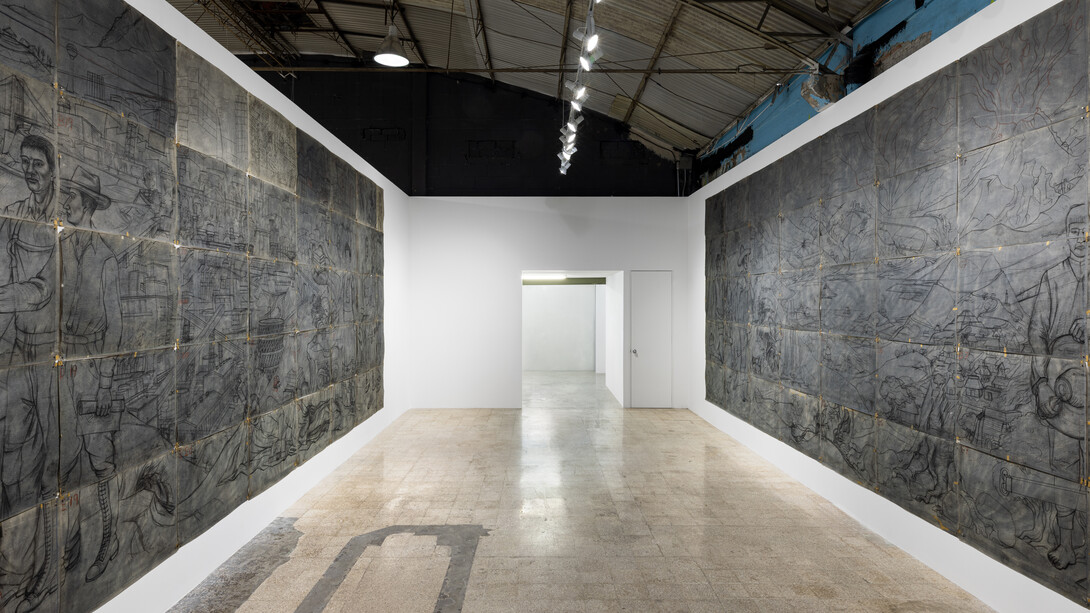
Juan O’Gorman painted the mural El crédito transforma a México (1964-1965) as a commission from the former Banco Internacional. The fresco, executed in the style of a frieze, was painted on a frame separate from the building’s architecture to protect it from earthquakes or other events that might damage the walls. The work’s dimensions are monumental, measuring 3 by 21 meters. O’Gorman described this piece as a landscape, a predominant genre in his easel paintings and murals. According to his account in his Autobiografía (1973), this work is divided into two sections. In the first half, he painted a pre-revolutionary landscape, in which rural development took place under a feudal system. In the second half, he depicted “the introduction of industry into the national landscape, its transformation through large factories, highways, bridges, dams, and irrigation systems for agriculture... into capitalist and industrial Mexico.” At the center of these two sections, which function as opposites, stands the bank—a neoclassical building that unfolds behind it like an enormous fantastical structure, a sort of eclectic and imaginative palace or castle.
El crédito transforma a México can be considered one of the artist’s later murals and, as such, encapsulates various interests he developed throughout his career, going beyond his preferred genres of landscape and portraiture. This work also reveals his fascination with geology, the life of volcanoes, and natural disasters; with an architectural repertoire ranging from factories and functionalist structures to utopian or dreamlike buildings; as well as an aesthetic sensibility capable of reconciling 19th-century self-taught Mexican painting with 20th-century realist avant-garde and surrealism. His style and color palette are reminiscent of other works he created during the 1960s, such as the murals he painted at Chapultepec Castle or the portraits of Ángela Gurría (1964) and the boy César Martino Servín (1963). The various critical considerations that characterized O’Gorman’s early work are neither present nor explicit in this mural; some are hidden among the composition’s many details, while others are merely suggested. During the 1960s, O’Gorman’s political stance was peculiar and somewhat controversial, to say the least. For example, during that decade he joined the Partido del Estado (PRI) and made other decisions that can be seen as part of a broader disillusionment with the progressive political and social ideals he had held during the first half of the 20th century.
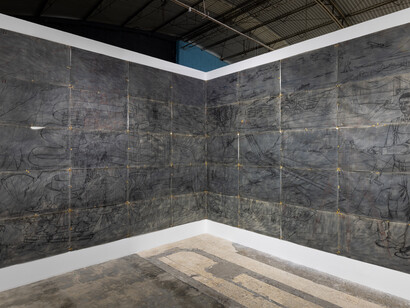
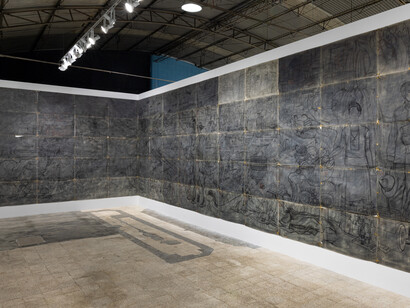
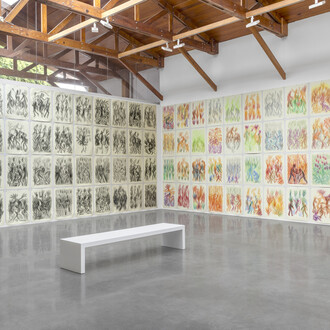
The work on display comprises the drawings that served as the original sketches for the mural and, as such, maintains a 1:1 scale with the monumental painting that has been on display since 2000 at the HSBC building on Paseo de la Reforma. On the one hand, this work allows viewers to appreciate aspects and details of the composition that would otherwise be nearly impossible to perceive in the mural at its current location. On the other hand, it allows us to imagine a moment in the mural’s creation when O’Gorman used each sheet as a sort of carbon paper to trace the lines of his composition onto the surface on which he worked. In fact, this piece—assembled from all those sheets—highlights the importance the artist placed on drawing within his body of work (as both an artist and an architect), as well as the outstanding mastery he demonstrated in this discipline.
(Text by Daniel Garza Usabiaga)