English
 Español
 Français
 Deutsch
 Italiano
 Português
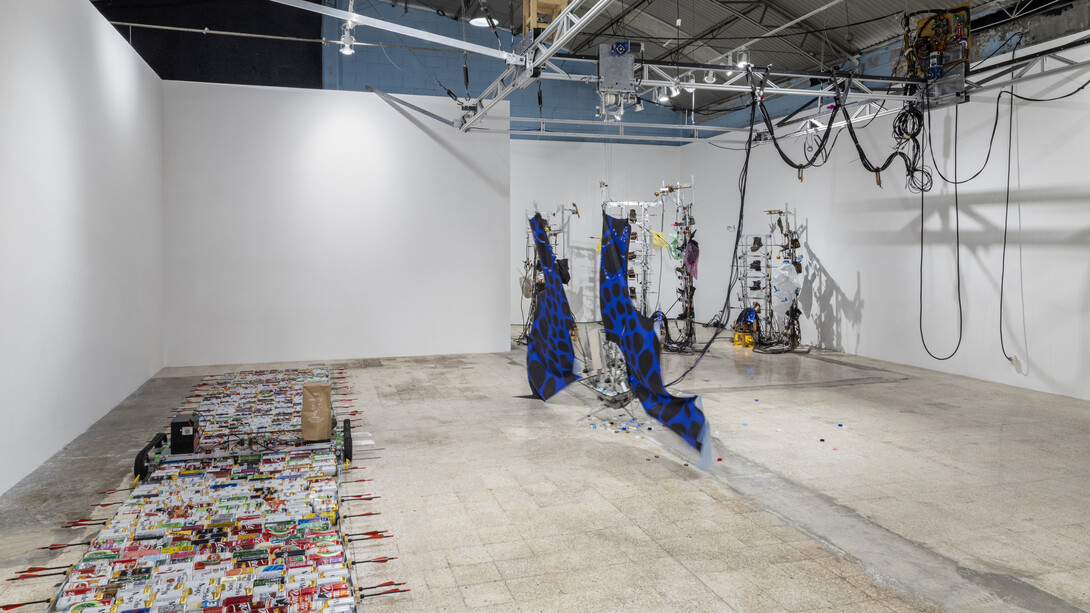
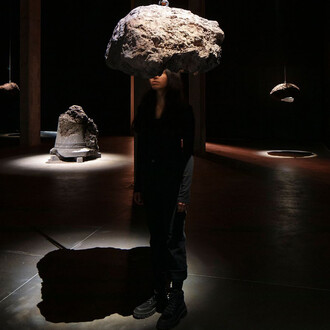
Fernando Palma Rodríguez’s sculptural work is characterized by the creation of mechatronic beings, assembled from everyday objects and discarded materials. Interested in exploring and reflecting on the natural world, his works allude to animals, geological formations, plants, and various forms of agriculture— motifs that he also employs symbolically or by imbuing them with multiple meanings, some of which are drawn from his Nahua culture.
His projects result in scenes that are difficult to categorize, in which various beings move and wander, repeating specific actions in an almost ritualistic manner. His mechanized sculptures expose their inner workings, with cables and circuits coexisting alongside conventional objects and waste materials. The sculptures’ designs recreate natural elements, plants, and animals, as well as other symbolic beings found in Mexico’s diverse cultures. The artist’s sculptures can be related to these imaginaries while simultaneously drawing attention, in various ways, to the consequences of environmental degradation and damage to the natural world.
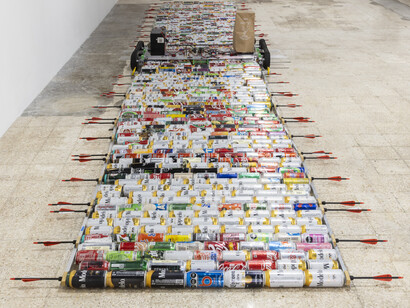
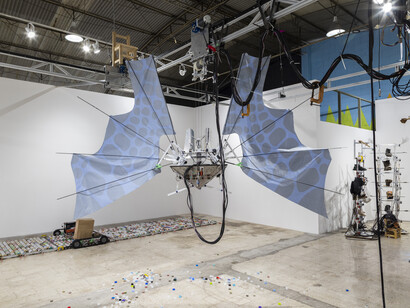
This is the case of the central work in this exhibition, Maxque tlein nochi omitzpanolo / Despite what you’ve been through. Tlaloc, oc nican tica timoyollchicahtoc, a large-scale sculpture that could be seen as a massive, mechanized plastic bat hanging from the gallery’s ceiling structure. This creature moves according to a specific program activated by sensors. Occasionally, it releases a torrent of soda bottle caps, as if they were guano.
This bat can be linked to the traditional understanding of the animal as a being belonging to the underworld, associated with night, darkness, the earth, and death. However, with its shower of objects, it could also be related to its meaning as a symbol of fertility (due to the pollination the animal facilitates) and to its connection with corn. In line with this, Palma has established a connection between the action depicted in this piece—an image of rain—and the representation of Tlaloc suggested in his sculpture, ever since he first presented it in 2025 at the National Asian Culture Center (ACC) in Gwangju, South Korea.
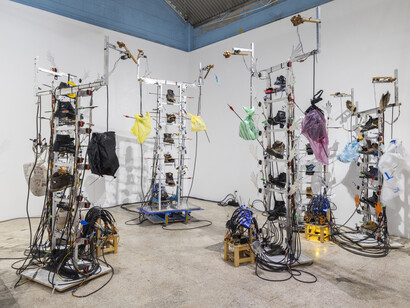
At that Gwangju exhibition, Fernando Palma presented Muro de botas / cemihqui nimitzitaqui quen ce papalotl; a work that is also on display for this show. This sculpture consists of various modules made from ladders and used work boots that have been altered so that each one takes on a personality of its own, as if it were a collection of animated faces. Reminiscent of a tzompantli, each boot gestures and opens its mouth. Palma has incorporated a sound track so that they emit sounds that, in this case, correspond to extinct birds. The central sculpture in this ensemble is activated when a sensor encounters water, reminding us that the energy that drives them originates from natural forces.
(Text by Daniel Garza Usabiaga)