English
 Español
 Français
 Deutsch
 Italiano
 Português
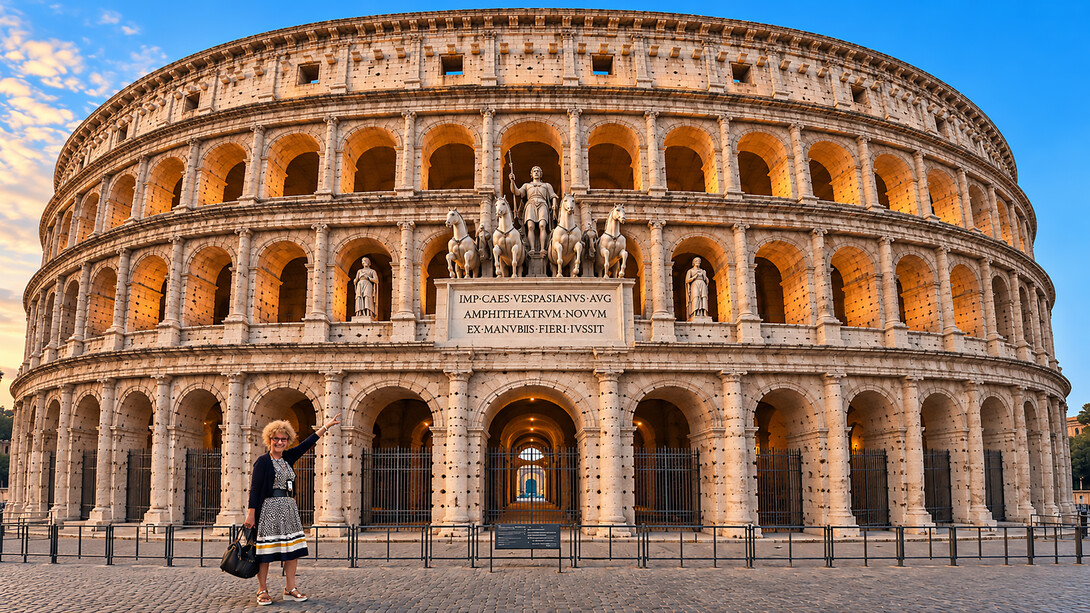
The Colosseum, the vast amphitheater built under the Flavian emperors between approximately 72 and 80 CE, remains one of ancient Rome’s most extraordinary monuments. Its towering arcades and massive travertine walls framed spectacles that could captivate tens of thousands of spectators, from gladiatorial combat to hunts involving wild animals.
The Romans knew how to put on a show. Gladiators underwent rigorous training in specialized schools known as ludi. They were divided into distinct categories according to their weapons, armor, and fighting techniques. Different types of gladiators were carefully matched against one another to create exciting contests that emphasized contrasting fighting styles, skill, and strategy.
Referees, including the summa rudis, could intervene with a staff. Far from being uncontrolled brawls, contests could be carefully regulated encounters. Some accounts suggest that gladiatorial bouts lasted approximately 10 to 15 minutes, although their typical duration remains a subject of scholarly debate.
Below the arena, corridors, cages, lifts, and trapdoors supported an elaborate backstage operation. Above it, seating reinforced the hierarchies of Roman society. Spectacle was entertainment but also a public display of imperial power.
And behind this enormous theater of spectacle lies a question that visitors rarely ask: Who paid for it?
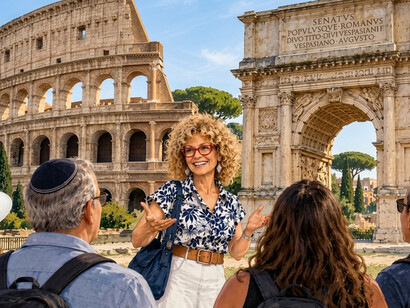
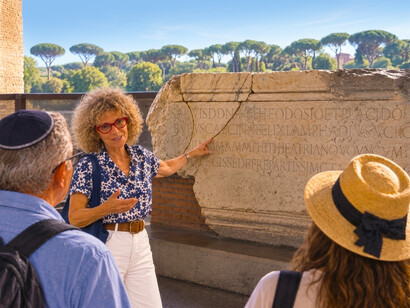
There is something almost theatrical about arriving at the Colosseum and looking up in awe. The film Gladiator (2000) captures the drama. But as Andrea Stoler, PhD, an American Jewish tour guide living in Rome, explains, “If you’re Jewish, like me, you arrive with Professor Louis H. Feldman’s essay on your iPhone, searching for the particular marble slab that reveals another story.”
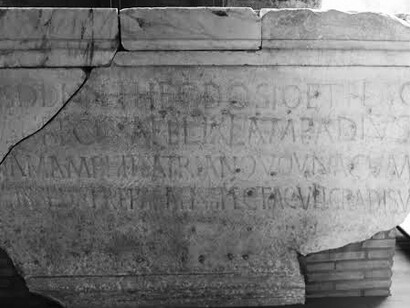
The reused marble slab bearing the later inscription commemorating repairs by Lampadius.
The detective story begins with a reused marble slab. Excavations in 1812 brought to light fragments bearing an inscription commemorating repairs by the fifth-century Roman prefect Lampadius. Yet the marble preserved something older: small holes that had once held the metal fastenings of letters from an earlier dedication.
In 1995, epigraphist Géza Alföldy reconstructed the earlier text from these traces. Its crucial words were ex manubiis—"from the spoils of war.” The reconstructed dedication associates the building of the new amphitheater with Emperor Vespasian and the proceeds of military victory. The holes, almost invisible to an unprepared visitor, had helped recover a lost message.
But which war? The inscription itself does not say. Historian Louis H. Feldman, writing in Biblical Archaeology Review in 2001, connected the spoils to Rome’s conquest of Jerusalem. The chronology is striking: Jerusalem and its Second Temple were destroyed in 70 CE, and construction of the Colosseum began soon afterward. Historians Keith Hopkins and Mary Beard, in The Colosseum (2005, pp. 32–33), likewise suggest that at least part of the amphitheater’s construction was almost certainly financed by spoils from the Jewish War.
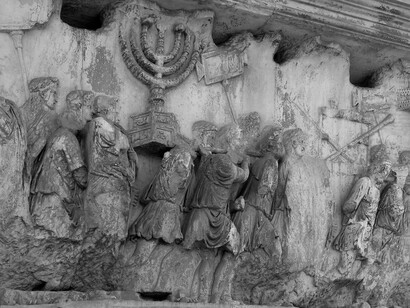
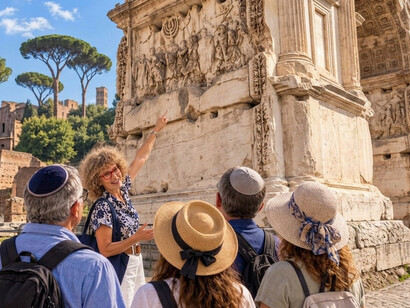
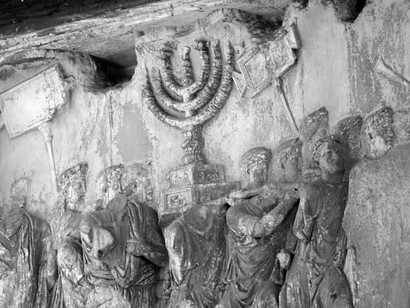
The Arch of Titus preserves the image of Rome's triumph over Jerusalem, while the Colosseum's reconstructed inscription offers another connection to that victory. But what might the original dedication have looked like when it adorned the amphitheater? In this imaginative reconstruction, Andrea Stoler points toward a possible appearance of the lost inscription, bringing an ancient archaeological discovery to life.
For Dr. Stoler, the significance extends far beyond the archaeological puzzle: “For Rome, the Colosseum celebrated imperial victory and grandeur. From a Jewish perspective, it also stands as a reminder of the destruction of Jerusalem, the loss of the Second Temple, and the human cost of Roman conquest.”
The Colosseum tells two intertwined stories: Rome’s triumph and Jerusalem’s tragedy, explains Andrea Stoler, PhD.
Its enduring presence invites visitors to consider whose achievements monuments celebrate and whose suffering their imposing facades can leave unspoken.
Authors note
Dr. Andrea Stoler is a Jewish American scholar tour guide in Rome. She is a storyteller and cultural ambassador for Rome’s Jewish history and identity; she brings intellectual and scientific rigor and moral clarity into spaces where these conversations are often oversimplified, avoided, or misunderstood. She has created academic bridges in Jewish-Christian dialogue and strategy—turning Jewish history into a practical tool for leadership, communication, and decision-making for Jewish families visiting Rome.
References
Epigraphic Database Heidelberg. (n.d.). Photograph record F010277.
Parco archeologico del Colosseo. (n.d.). Inscription for the Roman prefect C. V. Lampadius.
Alföldy, Géza. “Eine Bauinschrift aus dem Colosseum.” Zeitschrift für Papyrologie und Epigraphik 109 (1995): 195–226.
Feldman, Louis H. “Financing the Colosseum.” Biblical Archaeology Review 27, no. 4 (July/August 2001).
Hopkins, Keith, and Mary Beard. The Colosseum. London: Profile Books, 2005, pp. 32–33.
Parco archeologico del Colosseo. “Inscription for the Roman Prefect C. V. Lampadius.”
Carter, M. J. “Gladiatorial Combat: The Rules of Engagement.” The Classical Journal 102, no. 2 (2006–2007): 97–114.
Curry, Andrew. “Two Gladiators Enter—Only One Leaves Alive, Right? Think Again.” National Geographic, August 2021.
Parco archeologico del Colosseo. “Gladiators in the Arena: Between Colosseum and Ludus Magnus.”
Arya, Darius, and Erica Firpo. Hidden Rome: Uncover the City’s Ancient Past. National Geographic Special Edition, 2026, pp. 44, 53.