English
 Español
 Français
 Deutsch
 Italiano
 Português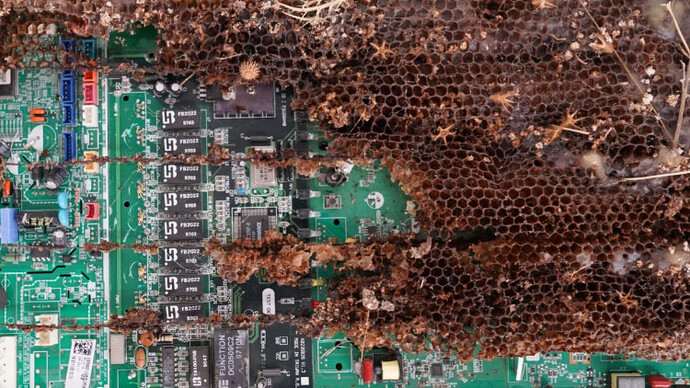
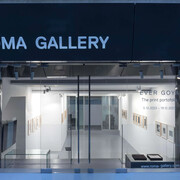
Roma Gallery is pleased to present Nidus, the first solo exhibition of Eirini Tampasouli. The exhibition opened on Thursday, 15 January 2026, and will run until Tuesday, 10 February 2026. It is curated by art historian Alia Tsagkari.
Born in Kavala in 1995, Eirini Tampasouli belongs to the younger generation of Greek artists under the age of 35. Her practice spans sculpture, video, and interactive environments, with a particular emphasis on processes of observation, documentation, and material aggregation. Her sculptural work, primarily based on assemblage, is constructed through the combination of organic matter with electronic circuitry, industrial materials, and obsolete technological devices. Characterised by a reduced formal vocabulary, interdisciplinary rigour, and the use of everyday technological residues, her work operates within contemporary posthumanist discourses, foregrounding a persistent biological drive toward survival and adaptability among non-human organisms, irrespective of environmental conditions.
She is a graduate of the School of Medicine at the National and Kapodistrian University of Athens and holds a postgraduate degree from the Athens School of Fine Arts, during which she also studied at the Film and TV School (FAMU) of the Academy of Performing Arts in Prague.
Her work has been presented in group exhibitions in Greece and internationally, and in festivals focused on contemporary art, digital media, and experimental cinema. She lives and works in Athens.
The exhibition features an assemblage-based environment composed of thirty distinct sculptural units and two video art works. Through the aggregation and physical assembly of disparate elements drawn from electronic devices, found objects, and organic structures into three-dimensional constructions, Tampasouli establishes a field of relations in which meaning emerges through the interdependence of biological, technological, and non-human forms.
Nidus is structured around the homonymous term, derived from medical and biological terminology, which denotes both a nest—a site of protection, incubation, and continuity—and a focus of infection, where bacteria, parasites, or other pathogenic agents lodge, multiply, and persist. Drawing on her interdisciplinary background, Tampasouli employs methods of field research informed by the biomedical sciences, observing insect nests developing within eroded animal skulls, abandoned buildings, and obsolete electronic devices. Despite material decay or technological obsolescence of their hosts, life continues to organise itself through processes of replication and mutation. Transposing this biological drive toward survival onto the human species, Nidus examines the intensifying interdependence between human evolution and technology as a condition that both shapes and threatens existence itself.
Within this framework, bees, an organism of critical importance to planetary survival, function as a structural model for a possible evolutionary continuity in which the human subject no longer occupies a privileged position. The work thus articulates a speculative ecosystem situated within a post-anthropocentric technological environment, where biological and technological processes jointly configure the conditions of survival.
This position is materially transcribed into Tampasouli’s practice through the installation of beehives containing living bee societies in a natural environment, outside the confines of the studio, in collaboration with an experienced beekeeper. Electronic circuit boards, components, and wiring are embedded within the interior of the hives, integrated into their structure and functioning as surfaces upon which the bees construct their honeycombs. These Circuit hives constitute the first works of the series and operate as active systems of observation and documentation, employing specially designed mechanisms of video recording and measurement that render processes of formation, temporality, and material transformation visible.
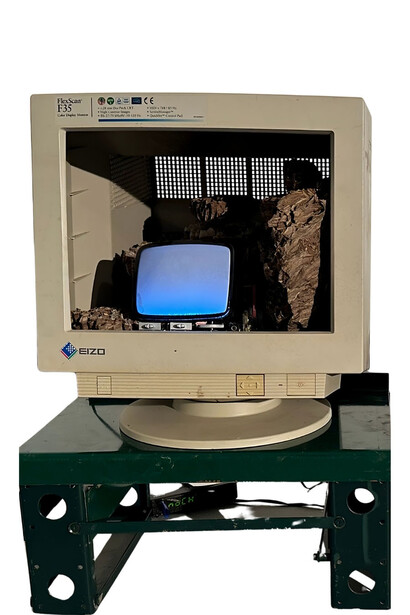
Nidus also includes two video works that combine archival and newly produced material, positioning historical and contemporary images within a shared field of reference. The video material draws on representations and inscriptions related to ancient beekeeping, pseudo-scientific theories of physiognomy concerning human evolution, as well as recordings of the care and observation of the bee colonies. In parallel, two interactive sound-based works constructed using Arduino technology articulate a convergence of sonic structures and narrative fragments.
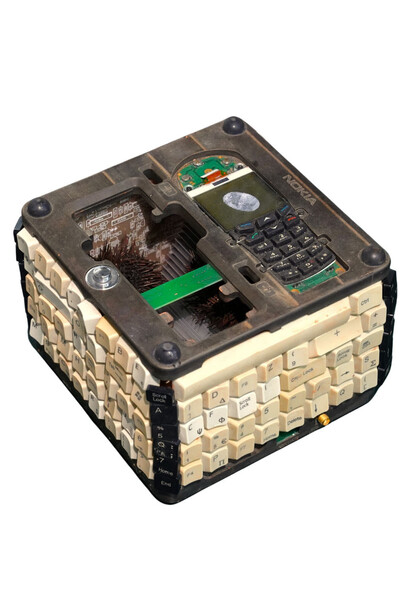
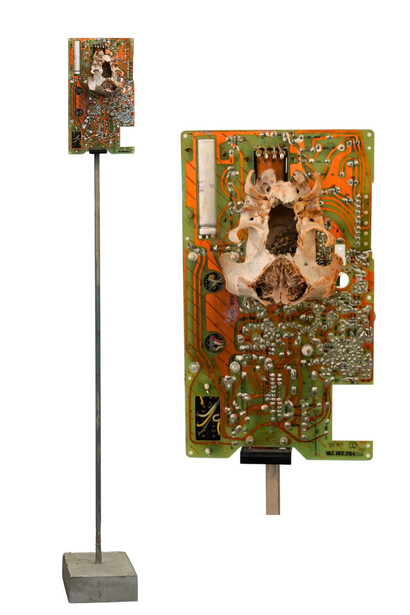
In Tampasouli’s practice, the assemblage sculptures integrate organic elements, such as nests, honeycombs, hives, and skeletal remains, into electronic circuit boards, cables, screens, and functional components. The technological elements remain largely exposed, with circuit structures and linear connections clearly legible, while organic matter adheres to, penetrates, or partially obscures these surfaces. The works are constituted as material records of processes in which biological and technological matter coexist without hierarchy. In this sense, they resemble artefacts from a hybrid archaeology of the future: objects bearing traces of use, observation, and experimentation, without fully disclosing their function.
The works are displayed on industrial shelving systems and pedestals designed by the artist as functional classificatory structures. These arrangements underscore the systemic organisation of the work and the shift from discrete objects to a relational field.
Situated within the gallery space, Nidus is configured as a constellation of material, technological, and biological systems in motion. The presentation maintains an open relation between the organic and the constructed, the natural and the artificial, allowing the works to operate as structures of observation, documentation, and material co-existence.